This text and video are based on an excerpt from The Twenty-Ninth Word in the Risale-i Nur Collection and explore the immortality (eternity) of the human spirit and its relationship with the World of Divine Command (Ālam al-Amr).
The main ideas and key points of the text are as follows:
The Nature and Origin of the Spirit: As expressed in Verse 85 of Surah Al-Isra (“Say: The spirit is of the command of my Lord”), the spirit originates from the World of Divine Command and the Divine Will. It is a living and conscious law to which Eternal Power has bestowed an external, tangible existence.
A Comparison with the Laws of Nature: The laws governing nature, which seemingly possess no independent external existence, also originate from the World of Divine Command. For example, when a fig tree dies, the law governing its formation remains preserved in its seed. These unconscious laws endure without corruption or alteration, even when the physical structures they govern disintegrate.
The Spirit’s Attainment of Eternity: If even the weakest and unconscious laws of Divine Command can preserve their existence and continuity, then it is all the more certain and necessary that the human spirit—which is stronger, more exalted, living, and conscious—should attain eternity.
THE TWENTY-NINTH WORD
SECOND AIM
FIRST FUNDAMENTAL POINT
FOURTH SOURCE
Look closely at the laws that govern life.
They are everywhere.
Silent. Constant. And remarkably enduring.
They shape the living world. They guide the development of countless forms. And they preserve the essential patterns of creation.
In a certain sense, these laws resemble the human spirit.
They originate from the World of Divine Command and Will.
Their nature is suited to the spirit. Yet they lack one thing.
A visible, external existence.
Imagine, for a moment, that these laws were given such an existence.
What would happen?
Each law would become, in effect, the spirit of a species.
And here we discover something remarkable.
These laws endure.
They remain constant. They preserve their unity. They are not destroyed by change or transformation.
Consider a fig tree.
One day, the tree may wither. Its branches may fall. Its physical form may disappear.
Yet something remains.
The law of its formation continues within its tiny seeds.
The tree itself may be gone.
But the principle that shapes it lives on.
It has not perished.
Now consider what this means.
Even simple and seemingly insignificant laws can possess such continuity.
Even laws without consciousness can endure beyond the forms they govern.
Then what of the human spirit?
Could it be destined for something less?
Something that merely continues?
Or does its nature point toward a far greater reality?
The Qur’an offers a profound insight.
It declares:
“Say: The Spirit is of the command of my Sustainer.”
Qur’an, 17:85.
The spirit, then, is not merely a product of physical matter.
It belongs to a different order of existence.
It is a living and conscious law.
It comes from the World of Divine Command.
And through the power of the Eternal Creator, it has been given an external existence.
Here, the argument takes a deeper turn.
If unconscious laws, proceeding from Divine Will, can endure through change…
Then surely the human spirit has an even stronger claim to permanence.
For it shares their origin.
It emerges from the same World of Command.
And it is connected to the same Divine Will.
But the spirit possesses qualities that these laws do not.
It has a real, external existence.
It is conscious.
And it is alive.
Think about that for a moment.
A law may preserve a pattern.
But the human spirit possesses awareness.
A law may continue without knowing that it exists.
But the spirit experiences life.
It knows. It perceives. It reflects.
And this gives the human spirit a special place among the realities of creation.
If even unconscious laws can endure…
Then the conscious human spirit has an even greater reason to be connected with permanence.
Not merely survival.
Not merely continuation.
But a destiny that reaches beyond the limits of this world.
And perhaps this is the essential point.
The human spirit is not simply something that exists for a moment and then disappears.
Its origin points beyond the temporary.
Its nature suggests continuity.
And its consciousness opens the door to a deeper understanding of eternity.
For if the Creator has given the spirit existence…
And if the Creator wills its permanence…
Then what power could compel it to perish?
The question is no longer simply whether the human spirit can endure.
The deeper question is this:
Why should a spirit, created with such a nature, be destined for extinction?
Perhaps the signs of eternity are already written into the very nature of our existence.
We need only learn how to see them.
ChatGPT
THE TWENTY-NINTH WORD …
SECOND AIM …
FIRST FUNDAMENTAL POINT …
FOURTH SOURCE:
Consider the laws that govern in species, for they resemble the spirit to a degree: since they issue from the World of the Divine Command and Will, by virtue of their source, they are to some extent appropriate for the spirit and only lack a perceptible existence. Study them and it will be seen that if those commanding laws were clothed in external existence, each of them would become the spirit of a species. Moreover, the laws are always permanent; they are perpetual and constant. No change or transformation affects their unity, or spoils them. For example, should a fig tree die and be dispersed, the law of its formation, which is like its spirit, will persist in its tiny seeds; it will not die. Therefore, since even commonplace and weak commanding laws are thus connected to permanence and continuance, the human spirit must be connected not only with permanence and immortality, but with all eternity. For according to the Qur’an’s glorious decree of: Say: The Spirit (comes) by command of my Sustainer, (17:85) spirit too is a conscious and living law which proceeds from the World of the Divine Command and which pre-eternal power has clothed with external existence. That is to say, just as the unconscious laws which proceed from the divine attribute of will and the World of the Divine Command are always, or mostly, enduring, so it is even more definite that the spirit, which is a sort of brother to them, and like them is a manifestation of the attribute of will and comes from the World of the Command, manifests immortality. It is also more worthy of it, because it is existent, it has an external reality. And it is more potent, more elevated, because it possesses consciousness. It is also more enduring than them, and more valuable, because it is living.
SOURCES Risale-i Nur Okuma Programı 2.1.0, Words[2021] – 551, email: syesilova72@gmail.com
Bediuzzaman Said Nursi, The Words – The Twenty-Ninth Word – About the Immortality of Man’s Spirit, the Angels, and the Resurrection of the Dead, The English translations of the Risale-i Nur Collection, translated by Şükran Vahide and published by Sözler Neşriyat, are an exact printed version of the original text. (erisale.com)
This video and text are based on a fundamental passage from Bediuzzaman Said Nursi’s The Twenty-Ninth Word, specifically the section Second Aim / First Fundamental Point / Third Source, which presents a foundational argument for the nature and immortality of the human spirit (baqā’ al-rūḥ).
The main ideas and conceptual framework can be summarized as follows:
The Definition of the Spirit (Kānūn-u Amrī): The spirit is described as a living, conscious, luminous “law of command” (kānūn-u amrī) that has been clothed with external existence (wujūd-u khārijī), and which possesses a comprehensive nature with the capacity to attain universality. While physical laws of nature, such as gravity, are based on abstract principles, the spirit is presented as a living and conscious embodiment of these divine laws.
A Constant Reality Amid Change: Although matter and living species undergo continuous change and transformation, there remains a constant reality at the essence of each species. Individuals are born and die, yet the law governing that species continues to exist.
The Human Being as a Species in Itself: Through the breadth of his nature, universal consciousness, and capacity for comprehensive conception, the individual human being, despite being only one person, has in a sense attained the rank of an entire species (nev’ in itself). Therefore, the law of continuity and permanence that applies to an entire species also applies directly to the human spirit.
Baqā’ al-Rūḥ — The Immortality of the Spirit: Even if the human spirit were to undergo hundreds of thousands of changes in state and form, or even if the body were to die, the spirit continues to exist through God’s command, permission, and preservation (ibqā’). It continues onward toward eternity, just as it came into this world.
Source: Gemini Notebook
THE TWENTY-NINTH WORD
SECOND AIM
FIRST FUNDAMENTAL POINT
THIRD SOURCE
There is another way to understand the immortality of the human spirit.
Look closely at life.
Everything changes.
Forms appear.
They develop.
They transform.
And eventually, they disappear.
Yet something remains.
Something constant.
Something that does not perish with the changing form.
This is true throughout the living world.
Behind the changing forms of life, there are laws that remain.
They continue to operate.
They remain stable.
They do not disappear with every transformation.
Even the weakest law of nature shows a certain permanence.
And this gives us a significant clue.
The human being is not merely an individual.
In a remarkable sense, he is like a whole species within himself.
Why?
Because human nature is comprehensive.
Human consciousness is universal.
And the human imagination can embrace countless things.
A person can think about the past.
He can imagine the future.
He can understand distant worlds.
He can reflect upon existence itself.
His inner world is vast.
For this reason, the laws that operate within a species can also be seen within the individual human being.
Now consider the human spirit.
The spirit is the conscious element of the human being.
It is the living essence within him.
The body changes.
It grows.
It weakens.
It renews itself.
And throughout a lifetime, its physical form can change again and again.
Yet we still say:
“I am the same person.”
Something remains.
Something preserves our identity.
Something continues through all these changes.
That something is the spirit.
The Creator has given the human being a comprehensive nature.
He has made humanity a mirror capable of reflecting the signs of the universe.
He has given the human being a capacity for universal worship.
And He has given the spirit a nature suited to permanence.
So even if the outer form of a person changes hundreds of thousands of times, the spirit does not necessarily perish with it.
With the permission of its Sustainer, it continues.
It remains.
And when its time in this world is complete, it departs.
Just as it came.
Therefore, the human spirit is not like the temporary form of the body.
The body changes.
The spirit remains.
The body belongs to the world of transformation.
The spirit belongs to a deeper reality.
And if the Creator wills its permanence, nothing can make it perish.
The human spirit is conscious.
It is alive.
It is the essential living element of the human being.
And by God’s command, and through His permission, it is immortal.
This is the third source.
A reflection drawn from the permanence found behind the changing forms of life.
And it points to a profound truth:
The body changes.
The spirit continues.
And the human being does not end with the disappearance of his outward form.
ChatGPT
Original text
THE TWENTY-NINTH WORD
The Immortality of Man’s Spirit The Angels, and the Resurrection of the Dead … SECOND AIM … FIRST FUNDAMENTAL POINT …
THIRD SOURCE:
The human spirit, which has been clothed in a living, conscious, luminous external existence, is a comprehensive and veracious commanding law disposed to acquiring universality. Even the weakest commanding laws manifest stability and permanence. For if considered carefully, it will be seen that present in all species which are subject to change, is a constant truth that, revolving within the changes, transformations, and stages of life, causes the outer forms of things to change, and yet living and not dying, is permanent. Thus, while the human being is an individual, he resembles a species owing to the comprehensiveness of his nature, his universal consciousness, and all-embracing imagination. A law that governs and is in force in the species is also in force in the human individual. Since the All-Glorious Creator has created man as a comprehensive mirror, for universal worship, and with an exalted nature, even if the spirit-truth which is present in each individual causes the individual’s outer form to change hundreds of thousands of times, with the Sustainer’s permission it will not die but will continue, departing as it came. In which case, at God’s command and with His permission and through His making it permanent, the human individual’s spirit, which is the conscious element and living part of him, is immortal.
Bediuzzaman Said Nursi, The Words – The Twenty-Ninth Word – About the Immortality of Man’s Spirit, the Angels, and the Resurrection of the Dead, The English translations of the Risale-i Nur Collection, translated by Şükran Vahide and published by Sözler Neşriyat, are an exact printed version of the original text. (erisale.com)
The Eternity of the Human Spirit and Why God Will Not Destroy It
The presented text and video explain the immortality of the human spirit and its existence after death through rational and philosophical arguments.
The author argues that, because the spirit is simple and indivisible in its nature, it cannot be fragmented or destroyed. Therefore, unlike the physical body, the spirit possesses an inherent nature suited to eternity.
Using a logical deductive approach, the text emphasizes that the continued existence of a single spirit points to a universal principle applicable to all humanity, and that the connection between us and the spiritual realms is not severed.
It is also stated that the Creator’s infinite mercy would not abandon the human spirit—the being most in need of the blessing of existence—to non-existence.
As part of the Risale-i Nur Collection, this work presents death not as an end, but as a doorway through which the spirit passes on its way back to its original homeland.
Gemini Notebook
THE TWENTY-NINTH WORD
The Immortality of Man’s Spirit
The Angels, and the Resurrection of the Dead
SECOND AIM
FIRST FUNDAMENTAL POINT
SECOND SOURCE
There is another way to understand this.
It is objective.
It is based on observation.
On experience.
And on events repeated throughout human history.
Consider this.
If even one spirit continues to exist after death…
then the existence of spirits as a whole cannot simply be dismissed.
Why?
Because when a quality belongs to something by its very nature…
that quality is not limited to one individual.
It belongs to the whole category.
If immortality belongs to one human spirit…
then the possibility of immortality belongs to human spirits themselves.
And there is something more.
The evidence is not based on a single observation.
It is not based on one story.
Or one unusual event.
There are countless indications.
Countless experiences.
Countless signs pointing toward the continued existence of the spirit.
So many…
that denying them entirely becomes difficult to justify.
Think of the New World.
America.
We may never have seen it with our own eyes.
Yet we do not doubt that it exists.
And we do not doubt that human beings live there.
Why?
Because the evidence is overwhelming.
In much the same way…
there is reason to believe that the spirits of those who have died…
continue to exist.
They belong to another dimension of existence.
A world beyond what our eyes can see.
A spiritual realm.
And perhaps…
there is still a relationship between that world and ours.
Our immaterial gifts may reach them.
And their luminous influences may reach us.
There is another sign.
One that does not come from the outside.
It comes from within.
Deep within the human conscience…
there is an intuitive certainty.
Something essential in a human being continues after death.
That essential reality…
is the spirit.
The body changes.
The body grows old.
The body eventually returns to the earth.
But the spirit is different.
It is not something that can simply be broken apart.
Or dissolved.
Or decomposed.
Why?
Because the spirit is simple.
It is not a compound structure.
It possesses unity.
And destruction through decomposition belongs to things made of parts.
Things that can be separated.
Things that can be broken down.
But the spirit is not like that.
Life itself gives us a glimpse of this mystery.
Within the countless changes of the body…
there remains a unity.
A continuity.
A sense of permanence.
The body changes.
Yet the person remains.
The years pass.
Yet something remains constant.
That something belongs to the spirit.
Unity belongs to the spirit.
And permanence flows from that unity.
So how could the spirit become mortal?
There would seem to be only two possibilities.
Either the spirit could be destroyed.
Or it could simply cease to exist.
But destruction and dissolution have no proper place in something that possesses such unity and simplicity.
The spirit cannot be decomposed like a physical substance.
And annihilation presents another problem.
For the Creator is described as the Absolutely Generous One.
His mercy is limitless.
His generosity is without end.
Would such boundless generosity…
give the human spirit the gift of existence…
only to take that gift away completely?
The human spirit longs for existence.
It desires permanence.
It reaches toward eternity.
And it possesses a nature suited to that desire.
So the question remains.
Why would the One who gave existence…
take it back through absolute annihilation?
Perhaps the deeper lesson is this.
The human spirit is not merely a temporary visitor in existence.
It carries within itself…
a longing for permanence.
A longing that points beyond the limits of the body.
And beyond the limits of this world.
The body has a beginning.
The body has an end.
But the spirit…
may belong to a different order of existence.
An order where death is not the final word.
And where existence…
does not simply disappear.
It continues.
ChatGPT
Original text
THE TWENTY-NINTH WORD
The Immortality of Man’s Spirit The Angels, and the Resurrection of the Dead … SECOND AIM … FIRST FUNDAMENTAL POINT …
SECOND SOURCE:
This is objective. That is to say, it is a sort of empirical judgement which has been formed through repeated observations and numerous occurrences of events. Indeed, when it is understood that a single spirit continues to exist after death, this necessitates the continued existence of all spirits as a category of being. For according to the science of logic it is certain that if an intrinsic quality is observed in a single individual, the existence of that quality may be assumed in all individuals. Because it is intrinsic. If it is intrinsic, it will be present in each individual. Whereas the indications based on not one observation but on observations beyond calculation and count and the signs pointing to the immortality of spirits, are so definite that we can in no way doubt their existence. Just as for us there is a place called the New World, that is, America, and we cannot doubt that human beings are found there. In the same way, it is unacceptable to doubt that the spirits of the dead are now present in great numbers in the World of the Inner Dimension of Things and in the Spirit World, and that they have relations with us. Our immaterial gifts go to them and their luminous emanations come to us. Moreover, one may perceive intuitively and certainly with one’s conscience that a fundamental aspect of man continues after his death. And that fundamental aspect is spirit. As for spirit, it is not subject to destruction and dissolution. This is because it is simple and uncompounded, it has unity. As for destruction, dissolution, and decomposition, they are the function of complex and compound substances. As we explained above, life ensures a form of unity within multiplicity; it causes a sort of permanence. That is to say, unity and permanence are fundamental to spirit, from which they spread to multiplicity. The mortality of man’s spirit would occur either through destruction and dissolution, whereas unity provides no opportunity for these, and its simple nature disallows decomposition; or it would be through annihilation. But the limitless compassion of the Absolutely Generous One would not permit annihilation, and His boundless munificence would not allow that He should take back from the human spirit the bounty of existence which He has bestowed on it, which it ardently desires and of which it is worthy.
Bediuzzaman Said Nursi, The Words – The Twenty-Ninth Word – About the Immortality of Man’s Spirit, the Angels, and the Resurrection of the Dead, The English translations of the Risale-i Nur Collection, translated by Şükran Vahide and published by Sözler Neşriyat, are an exact printed version of the original text. (erisale.com)
This text and video are based on a passage from the Risale-i Nur Collection by Bediüzzaman Said Nursi, focusing on the immortality of the spirit and the spiritual nature of the human being.
The author presents the body as a temporary garment or dwelling that changes over time and eventually passes away.
In contrast, the human spirit is described as an independent and self-sustaining essence that continues to exist without being dependent upon the physical body.
Death, therefore, is not the annihilation of the spirit. Rather, it is the spirit’s release from the heavy physical body, allowing it to continue its journey in a luminous form suited to its nature.
The source explains that, by looking inward and reflecting upon their own inner world, individuals can recognize their innate longing for eternity and perceive the permanence of the spirit through rational reasoning.
This brief examination emphasizes that the disintegration of physical matter cannot, in itself, cause any harm to the essential nature or continuity of the spirit.
Gemini Notebook
THE TWENTY-NINTH WORD
The Immortality of Man’s Spirit
The Angels, and the Resurrection of the Dead
SECOND AIM
FIRST FUNDAMENTAL POINT
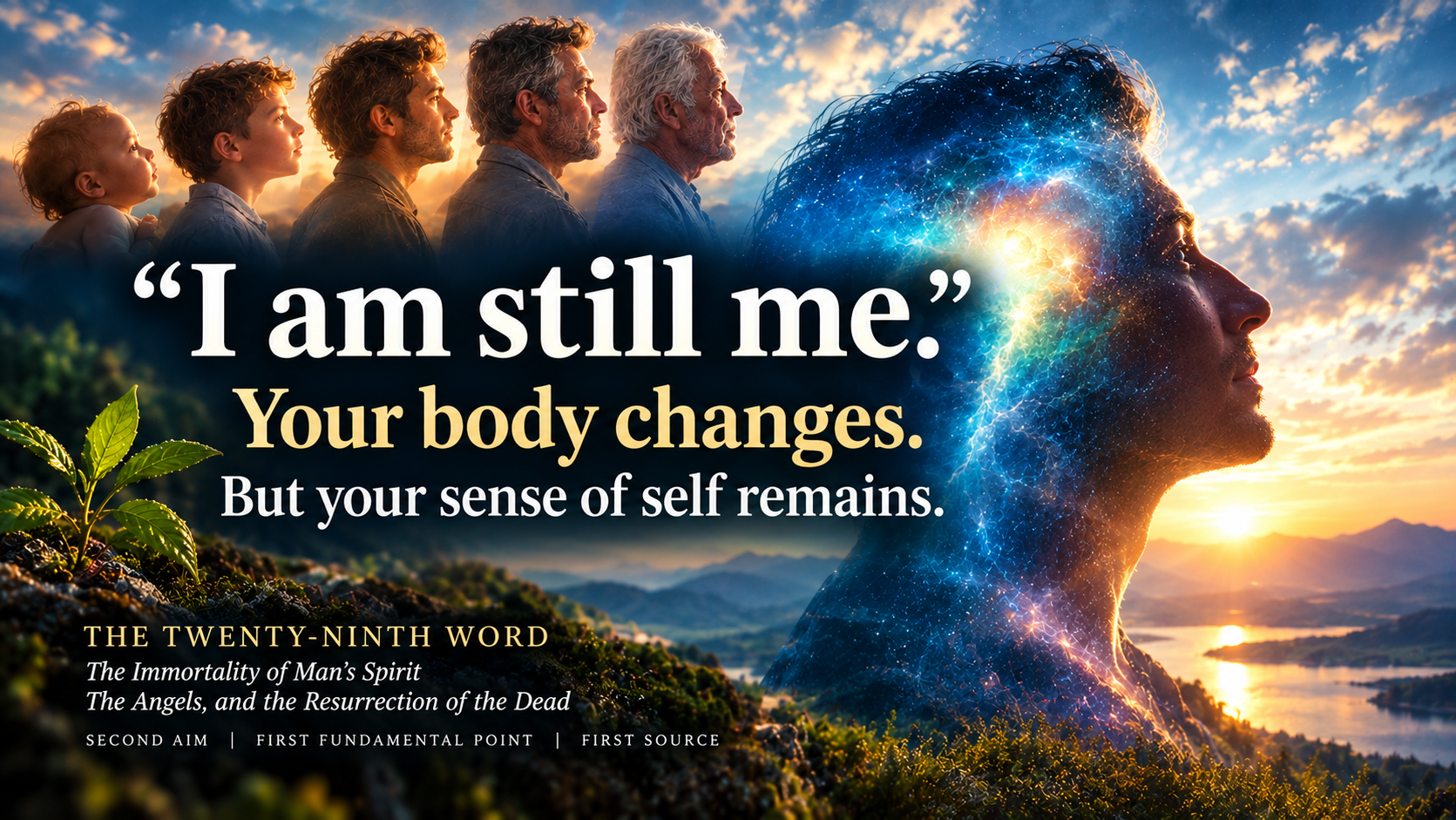
FIRST SOURCE
There is a way to understand this.
It begins with something very close to us.
Ourselves.
Look carefully at your own life.
And you may notice something remarkable.
Your body changes.
Year after year.
Cell by cell.
Appearance by appearance.
The body you have today is not the body you had years ago.
And yet…
something within you remains.
Something that says,
“I am still me.”
Your body changes.
But your sense of self remains.
Your memories remain.
Your consciousness remains.
Your inner identity remains.
This points to something deeper.
Something beyond the changing body.
Something permanent.
The human spirit.
For many years, the spirit inhabits the body.
And during those years, the body undergoes constant change.
It grows.
It ages.
It is renewed.
It is transformed.
Yet the spirit remains constant.
The body changes.
The spirit does not lose its identity.
The body is temporary.
But the spirit is not dependent upon the body for its existence.
Think of the body as a dwelling.
A house.
A home.
The spirit lives within it.
But the spirit is not the house.
And when the house changes, the one who lives inside it remains.
This is the central distinction.
The body does not give existence to the spirit.
Rather, the spirit gives direction to the body.
The body is its instrument.
Its dwelling place.
Its visible companion.
And so, the temporary nature of the body does not destroy the permanence of the spirit.
Death, then, is not necessarily the destruction of the spirit.
It is a separation.
The spirit leaves the body.
But it does not cease to exist.
There is another subtle point.
The body is not truly the spirit’s clothing.
The spirit possesses something more delicate.
A subtle sheath.
A fine and ethereal form.
Something that resembles a body.
Something that remains with the spirit to a certain degree.
So when death comes…
the spirit is not simply left without form.
It leaves its earthly home with its own subtle sheath.
The house is left behind.
The spirit continues.
And this leads us to a profound question.
If the body can change so completely while the spirit remains itself…
why should the spirit disappear when the body disappears?
Perhaps death is not the end of the journey.
Perhaps it is only the moment when the traveler leaves one home and continues onward.
The body changes.
The spirit remains.
The house is temporary.
But the inhabitant endures.
And in this distinction…
lies the first source for understanding the immortality of the human spirit.
ChatGPT
Original text
THE TWENTY-NINTH WORD
The Immortality of Man’s Spirit,
The Angels, and the Resurrection of the Dead
…
SECOND AIM
…
FIRST FUNDAMENTAL POINT
…
FIRST SOURCE: This is subjective. That is to say, if anyone studies his own life and self, he perceives an immortal spirit. Indeed, in the course of occupying its body for a number of years the spirit causes the body to change considerably, yet the spirit self-evidently remains constant. In which case, the body’s ephemerality does not affect the spirit’s permanence, nor spoil its nature, even though the spirit is completely naked at death. However, in the course of life, the spirit gradually changes its body-clothes, and at the time of death, it is suddenly undressed. It has been established by certain conjecture, indeed, by observation, that the body subsists though the spirit; in which case, the spirit does not subsist through the body. Rather, since the spirit subsists and is dominant of itself, the body may be dispersed and gathered together again as it wishes; it will not infringe the spirit’s independence. In fact, the body is the spirit’s house, it is its home; it is not its clothes. What clothes the spirit is a subtle, fine sheath, something which may be likened to a body, is to some extent constant, and is ethereal and appropriate for the spirit. At the time of death, then, the spirit is not completely naked, it leaves its home dressed in its wraithlike sheath.
Bediuzzaman Said Nursi, The Words – The Twenty-Ninth Word – About the Immortality of Man’s Spirit, the Angels, and the Resurrection of the Dead, The English translations of the Risale-i Nur Collection, translated by Şükran Vahide and published by Sözler Neşriyat, are an exact printed version of the original text. (erisale.com)
This text, drawn from the Risale-i Nur collection by Bediuzzaman Said Nursi, examines the immortality of the human spirit and the necessity of the permanence of existence within a rational framework.
The author argues that the infinite beauty, artistic perfection, and mercy manifested throughout the universe require human beings, who appreciate and contemplate these qualities, to possess an eternal existence.
The text points to the continuity found even in the simplest flowers and the seeds of trees, through memory and genetic codes, emphasizing that a conscious being such as the human being cannot ultimately be condemned to nonexistence.
The fact that divine wisdom preserves the entire program of a great tree within a tiny seed is presented as evidence that the human spirit and personal identity will likewise be preserved after death.
Ultimately, the work explains that the order of the universe and the attributes manifested by its Creator necessarily point to the permanence of the human spirit and the existence of the Hereafter.
Gemini Notebook
THE TWENTY-NINTH WORD
The Immortality of the Human Spirit, the Angels, and the Resurrection of the Dead
SECOND AIM
FIRST FUNDAMENTAL POINT
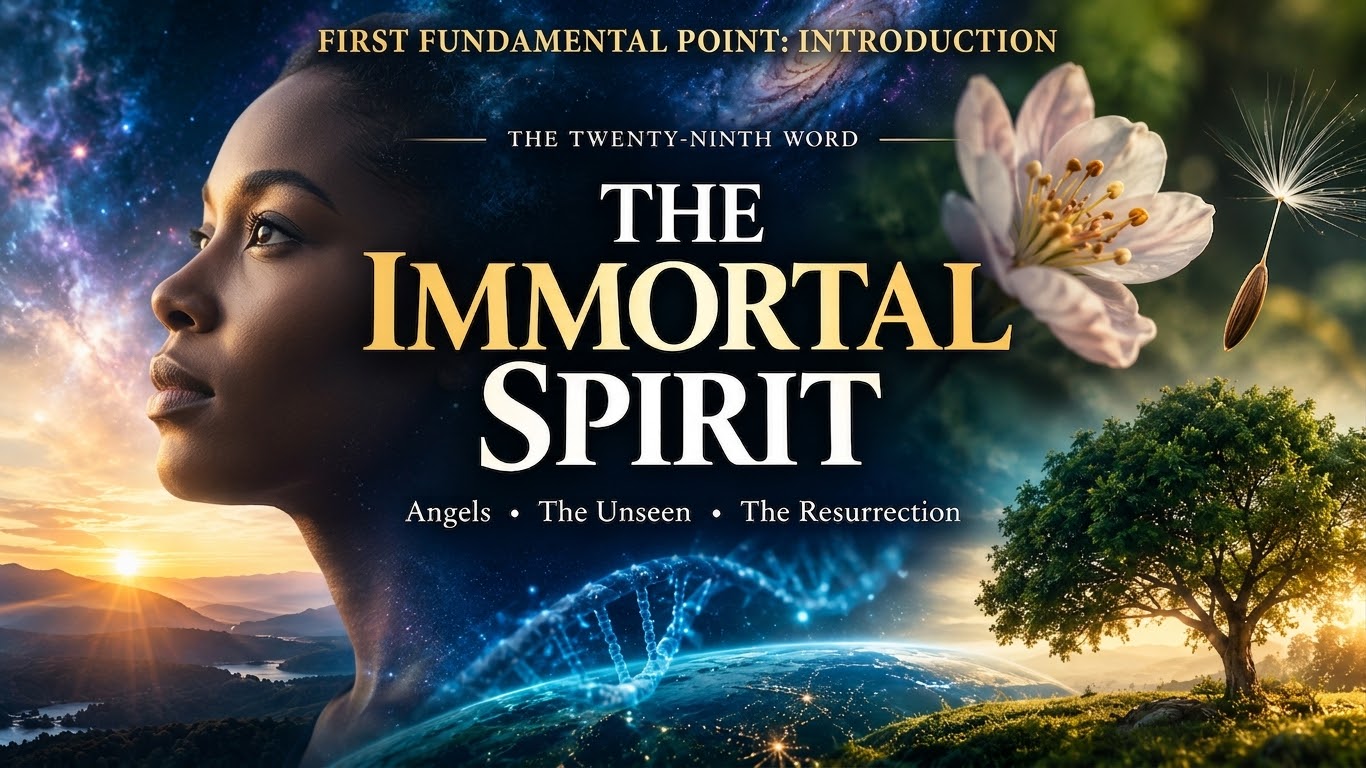
INTRODUCTION
Imagine a beauty that never fades.
A beauty without end.
A beauty unlike anything we have ever seen.
Such beauty calls for something more.
It calls for admirers who will never disappear.
It calls for hearts that will continue to witness it.
Forever.
A perfect work of art has the same need.
It seeks witnesses.
Thoughtful observers.
Heralds who can recognize its perfection.
And boundless mercy has another requirement.
It seeks those who receive its gifts.
Those who need.
Those who can feel gratitude.
Those who can say, “Thank you.”
And among all these beings…
There is one that stands above the rest.
The human spirit.
It is capable of recognizing beauty.
It can understand perfection.
It can receive mercy.
And it can respond with gratitude.
If the beauty is eternal…
If the perfection is eternal…
If the mercy is without end…
Then the spirit that reflects upon them cannot simply vanish.
It must continue.
It must accompany them.
Along the endless road of eternity.
The human spirit, therefore…
Is immortal.
But there is another sign.
A sign written into the smallest things around us.
Even the simplest forms of existence do not simply disappear.
Consider a flower.
It blooms.
For a brief moment, it lives before our eyes.
Then it fades.
Its visible form is gone.
But is everything really lost?
No.
Its image remains.
It lives in memories.
It appears in countless photographs.
It leaves an impression on the human mind.
And then…
There are its seeds.
Hundreds of them.
Sometimes thousands.
Within each tiny seed lies a pattern.
A programme.
A law of formation.
A hidden instruction for another flower.
The flower seems to disappear.
But its design continues.
Its form is carried forward.
Its pattern is preserved.
And all of this happens within something almost too small to see.
A tiny seed.
A silent vessel.
Yet within it…
The future is already written.
The form is preserved through change.
The law continues through generations.
And the process unfolds with remarkable order.
Now consider the human spirit.
It is far more comprehensive.
Far more elevated.
It is conscious.
It is living.
It is luminous.
It directs the human being from within.
It is not merely a physical form.
It is something far deeper.
If even a flower leaves traces of permanence…
If even a tiny seed preserves the pattern of a mighty tree…
Then what should we expect of the human spirit?
A spirit capable of thought.
A spirit capable of love.
A spirit capable of knowledge.
A spirit capable of recognizing the universe itself.
Can such a spirit simply cease to exist?
The argument points in another direction.
Toward permanence.
Toward eternity.
Toward immortality.
Think again about the seed.
Within a tiny point…
The programme of an enormous tree can be preserved.
Its structure.
Its potential.
Its future form.
All held within something incredibly small.
So ask yourself…
If the One who preserves the law of a great tree within a tiny seed…
Can preserve the spirit-like pattern of that tree…
Why would preserving the spirits of human beings be impossible?
Why should death mean absolute extinction?
Perhaps death is not disappearance.
Perhaps it is a transition.
A change of form.
A passage from one stage of existence to another.
The universe itself is filled with signs of preservation.
Signs of continuity.
Signs that nothing meaningful is simply thrown away.
And among all these signs…
The human spirit stands as one of the greatest.
Conscious.
Living.
Aware.
Searching for meaning.
Searching for eternity.
Perhaps that longing is not an accident.
Perhaps it points toward where we are going.
Toward a reality beyond what our eyes can see.
Toward a life…
That does not end.
Toward eternity.
ChatGPT
Original text
THE TWENTY-NINTH WORD
The Immortality of Man’s Spirit,
The Angels, and the Resurrection of the Dead
…
SECOND AIM
…
FIRST FUNDAMENTAL POINT
…
INTRODUCTION:
As is proved in the Fourth Truth of the Tenth Word, an eternal, everlasting, and peerless beauty requires the eternity and permanence of mirror-bearing enraptured admirers. A faultless, eternal, and perfect art seeks the perpetuation of thoughtful heralds. A boundless mercy and beneficence require the continued ease and happiness of needy ones to thank it. And the foremost of those mirror-bearing enraptured admirers, those heralding thoughtful ones, those needy thankful ones is the human spirit, in which case, it will accompany that beauty, that perfection, that mercy on the endless road to eternity; it will be immortal. As is also proved in the Tenth Word, in the Sixth Truth, not only the human spirit, but also the simplest levels of existence have not been created for extinction; they manifest a form of immortality. Even an insignificant flower, which has no spirit, manifests a sort of immortality in a thousand ways when it quits its external existence. For its form is made permanent in countless memories. And being perpetuated in its hundreds of seeds, the law of its formation continues. Since the flower’s law of formation, the model of its form, which resembles a tiny fragment of spirit, is made permanent by an All-Wise Preserver; and since it is preserved throughout turbulent transformations with perfect order in its tiny seeds and made permanent; you should understand the degree to which the human spirit, which has an extremely comprehensive and elevated nature, and has been clothed with external existence, and is a conscious, living, and luminous commanding law, most certainly manifests immortality and is tied and bound to eternity; if you do not understand this, how can you claim to be a conscious human being? Can it be asked of an All-Wise One of Glory, an Imperishable Preserver, Who includes and preserves in the tiny dot-like seed of a mighty tree the programme and law of its formation, which to some degree resembles a spirit, “How can He preserve the spirits of the dead?”
Bediuzzaman Said Nursi, The Words – The Twenty-Ninth Word – About the Immortality of Man’s Spirit, the Angels, and the Resurrection of the Dead, The English translations of the Risale-i Nur Collection, translated by Şükran Vahide and published by Sözler Neşriyat, are an exact printed version of the original text. (erisale.com)
The Immortality of the Spirit and the Reality of Resurrection
The presented text and videos are taken from The Words, a work from the Risale-i Nur Collection written by Bediüzzaman Said Nursi, particularly from the section known as The Twenty-Ninth Word.
This source primarily addresses metaphysical subjects such as the immortality of the spirit, the existence of angels, and the reality of the life of the Hereafter.
While arguing that the human spirit is everlasting, the author emphasizes that the connection between this world and the realm of spirits is extremely strong and close.
The text states that experiences such as spiritual discoveries and truthful dreams constitute tangible evidence for the continued existence of the spirit.
It also explains that various arguments will be presented to satisfy both the intellect and the heart, with the aim of removing the doubts created by materialistic philosophy.
Overall, this section serves as a systematic guide explaining the rational and spiritual foundations of life after death.
Gemini Notebook
THE TWENTY-NINTH WORD
The Immortality of Man’s Spirit,
The Angels, and the Resurrection of the Dead
SECOND AIM
Now, we turn to the Second Aim.
It takes us somewhere deeper.
To the resurrection of the dead.
To the end of this world.
And to the life of the Hereafter.
This Aim contains four fundamental points.
But before we reach them…
there is an introduction.
An introduction that begins with a comparison.
FIRST FUNDAMENTAL POINT
The human spirit is immortal.
This is not merely a possibility.
It is a reality.
A reality supported by many signs.
The same signs that point to the existence of angels…
and other spiritual beings…
also point toward the immortality of the human spirit.
In fact, the matter is so certain…
that further explanation may seem unnecessary.
Consider this.
Around us…
there are countless immortal spirits.
They have passed beyond this visible world.
They now wait…
for the journey into the Hereafter.
Some dwell in what we call the Intermediate World.
Others belong to the World of Spirits.
And the distance between us…
and these countless beings…
may be far smaller than we imagine.
For many people throughout history…
this has not been a distant idea.
It has been a lived experience.
Saints and people of spiritual insight…
have spoken of contact with these beings.
Those who have perceived the mysteries of the grave…
have witnessed signs of their existence.
Even ordinary people…
have sometimes experienced communication with them.
And perhaps most remarkably…
many people have encountered them in true dreams.
Across generations…
these experiences have been repeated.
Across cultures…
similar accounts have emerged.
Together…
they have formed a vast body of testimony.
A testimony that has become part of humanity’s accepted knowledge.
And yet…
in our age…
something has changed.
Materialistic thought has become powerful.
It has influenced the way we see reality.
It has made people doubt…
even what once seemed obvious.
It has placed a veil of uncertainty…
over the deepest questions of existence.
Is the human spirit truly immortal?
Does consciousness continue beyond death?
Is the grave really an ending?
Or is it…
a doorway?
These questions cannot simply be dismissed.
They call for deeper reflection.
And so…
we shall go further.
To remove the doubts…
we will consider an introduction.
Then…
four sources.
Four different paths of insight.
They arise from two remarkable faculties within us.
The intuition of the heart…
and the insight of the intellect.
Together…
they invite us to look beyond what the eyes can see.
Beyond the limits of matter.
Beyond the boundary we call death.
And toward a reality…
that may be far greater…
than this temporary world.
This is where our journey begins.
ChatGPT
Orijinal text
The Twente-Ninth Word
About the Immortality of Man’s Spirit, the Angels, and the Resurrection of the Dead
…
Second Aim
The Second Aim is about the resurrection of the dead, the end of the world, and the life of the hereafter. It consists of four fundamental points, and an introduction which is in the form of a comparison.
…
FIRST FUNDAMENTAL POINT
The human spirit is definitely immortal. Almost all the indications in the First Aim which point to the existence of the angels and spirit beings also point to the immortality of the human spirit, which is our topic here. In my opinion, the matter is so certain that further explanation would be profitless. Indeed, the distance between us and the caravans of innumerable immortal spirits who are waiting to go to the hereafter in the Intermediate and Spirit Worlds is so fine and slight that there is no need to demonstrate it with proofs. Numberless saints and people of illumination getting in touch with them, and those who discern the secrets of the grave seeing them, and even a number of ordinary people communicating with them, and the mass of people forming relations with them in true dreams, have formed a mass of unanimous reports and have quite simply become part of the commonly accepted knowledge of mankind. However, because materialist thought has stupified everyone this age, it has been able to implant doubts in their minds concerning even the most evident matters. In order to remove these doubts, therefore, we shall set forth an introduction and four sources from the numerous sources springing from the heart’s intuition and the intellect’s insight.
Bediuzzaman Said Nursi, The Words – The Twenty-Ninth Word – About the Immortality of Man’s Spirit, the Angels, and the Resurrection of the Dead, The English translations of the Risale-i Nur Collection, translated by Şükran Vahide and published by Sözler Neşriyat, are an exact printed version of the original text. (erisale.com)
The Architecture of Resurrection and Cosmic Renewal
The texts and videos presented here offer an excerpt from The Twenty-Ninth Word, written by Bediüzzaman Said Nursi, which establishes belief in the Hereafter upon a rational foundation.
The work explains, through the metaphor of a magnificent palace, how the universe will one day come to an end and how an eternal life will subsequently begin.
The text examines the process of the destruction and reconstruction of the universe through six fundamental questions concerning necessity, possibility, and the power of the Agent responsible for creation.
The author emphasizes that the destruction of the world and the resurrection at the appointed time of the Resurrection can be demonstrated through rational proofs.
Accordingly, these sources constitute a systematic theological defense aimed at dispelling doubts concerning the end of the world and the immortality of the human spirit.
In conclusion, the text offers a convincing and comprehensive perspective on the questions surrounding the future of existence.
Gemini Notebook
THE TWENTY-NINTH WORD
The Immortality of Man’s Spirit, the Angels, and the Resurrection of the Dead
SECOND AIM
The Second Aim turns our attention to something profound.
The resurrection of the dead.
The end of the world.
And the life of the Hereafter.
It contains four fundamental points.
But before we reach them, there is an introduction.
An introduction built around a simple comparison.
INTRODUCTION
Imagine a magnificent palace.
Or an extraordinary city.
Someone tells you:
“This palace will one day be destroyed.
And then…
it will be rebuilt.
It will rise again,
complete and intact.”
What would you ask?
Naturally…
six questions would come to mind.
THE FIRST QUESTION
Why should it be destroyed?
Is there a reason?
Is there something that makes its destruction necessary?
If the answer is yes…
then that reason must be proven.
There must be a cause.
A purpose.
A necessity.
THE SECOND QUESTION
Now consider something else.
Who is going to destroy it?
And who will rebuild it?
Does its builder possess the power to do so?
Does he have the ability to create it again?
If the answer is yes…
then that power must also be demonstrated.
THE THIRD QUESTION
Then comes another question.
Is its destruction actually possible?
And more importantly…
will it really happen?
If the answer is yes,
then both must be established.
The possibility of its destruction.
And the certainty of its occurrence.
TWO MORE QUESTIONS
But the inquiry does not end there.
Another question appears.
Could this remarkable palace…
or this magnificent city…
be rebuilt from the beginning?
Could every part of it be brought together again?
Could it return to its former perfection?
If the answer is yes…
then another question follows.
Will it actually be rebuilt?
Will it rise again?
And if all these questions are answered…
if every point is demonstrated…
then something remarkable happens.
There is no opening left for doubt.
No hidden gap.
No place for suspicion to enter.
The argument becomes complete.
THE COMPARISON
Now consider the universe.
Look at the Earth.
Look at the heavens above it.
Think of the countless forms of life.
The immense order.
The delicate balance.
The extraordinary harmony.
The Earth is like a palace.
And the universe…
like a vast and magnificent city.
According to this comparison,
this great palace will one day be destroyed.
And then…
it will be rebuilt.
But this is not presented as a mere possibility.
There are reasons that necessitate it.
There are signs that point toward it.
And there is a Creator…
whose power is sufficient for it.
The destruction is possible.
And it will occur.
The reconstruction is possible.
And it will occur.
These truths will be examined carefully.
And they will be demonstrated…
beginning with the First Fundamental Point.
For now,
we are standing at the threshold.
A threshold between this world…
and the world to come.
And beyond it lies one of the greatest questions ever asked:
What happens…
when this world comes to an end?
And what happens…
when humanity rises again?
The answer begins here.
ChatGPT
Original text and videos
The Twente-Ninth Word
About the Immortality of Man’s Spirit, the Angels, and the Resurrection of the Dead
…
Second Aim
The Second Aim is about the resurrection of the dead, the end of the world, and the life of the hereafter. It consists of four fundamental points, and an introduction which is in the form of a comparison.
INTRODUCTION
If someone was to claim about a palace or a city: “This palace or city will be destroyed, and will then be repaired and reconstructed so that it is intact,” six questions would surely arise in the face of his claim.
The First:
Why should it be destroyed? Is there a reason or something to necessitate it? If the answer is “Yes,” he would have to prove it.
The Second:
A question such as the following would arise: “Does the builder who would destroy and then reconstruct it possess the power to do so? Would he be capable of it?” If the answer is “Yes,” he would have to prove it.
The Third:
The following such question would arise: “Is its destruction possible? And, is it going to be destroyed in the future?”
If the answer is “Yes,” and if he proves both the possibility of the destruction and its occurrence, the following two further questions would arise:
“Is it possible for this strange palace or city to be reconstructed from scratch, I wonder? If it is possible, will it be reconstructed?”
If the answer is “Yes” and he proves these as well, then in no aspect or corner of this matter can a gap or chink remain through which any doubt, misgiving or suspicion might enter.
Thus, like in the comparison, there are facts necessitating the destruction and reconstruction of the palace of the earth and city of the universe. Its author and builder is powerful enough; its destruction is possible, and will occur. Its reconstruction is possible, and will occur. These matters will be proved after the First Fundamental Point.
Bediuzzaman Said Nursi, The Words – The Twenty-Ninth Word – About the Immortality of Man’s Spirit, the Angels, and the Resurrection of the Dead, The English translations of the Risale-i Nur Collection, translated by Şükran Vahide and published by Sözler Neşriyat, are an exact printed version of the original text. (erisale.com)
The texts and videos presented explore the existence of angels, their roles in the universe, and the spiritual dimension of creation from the perspective of Bediuzzaman Said Nursi.
While emphasizing that every being in the universe is engaged in its own form of glorification and worship, the text highlights the necessity of appointed angels who consciously represent and carry out these duties on behalf of beings that lack consciousness.
Unlike human beings, angels are described as messengers who seek no personal benefit, obey only Divine commands, and derive a spiritual pleasure from serving in this way.
The text explains that the descriptions in the Hadiths of angels with multiple heads or speaking multiple languages are, in fact, indications of their universal and immense innate duties.
In the final section, drawing upon verses of the Qur’an, the text presents the reality of angels and jinn as servants and officials of the Divine sovereignty.
This work aims to explain, through rational and transmitted evidence, the spiritual order that exists behind the material realm.
Gemini Notebook
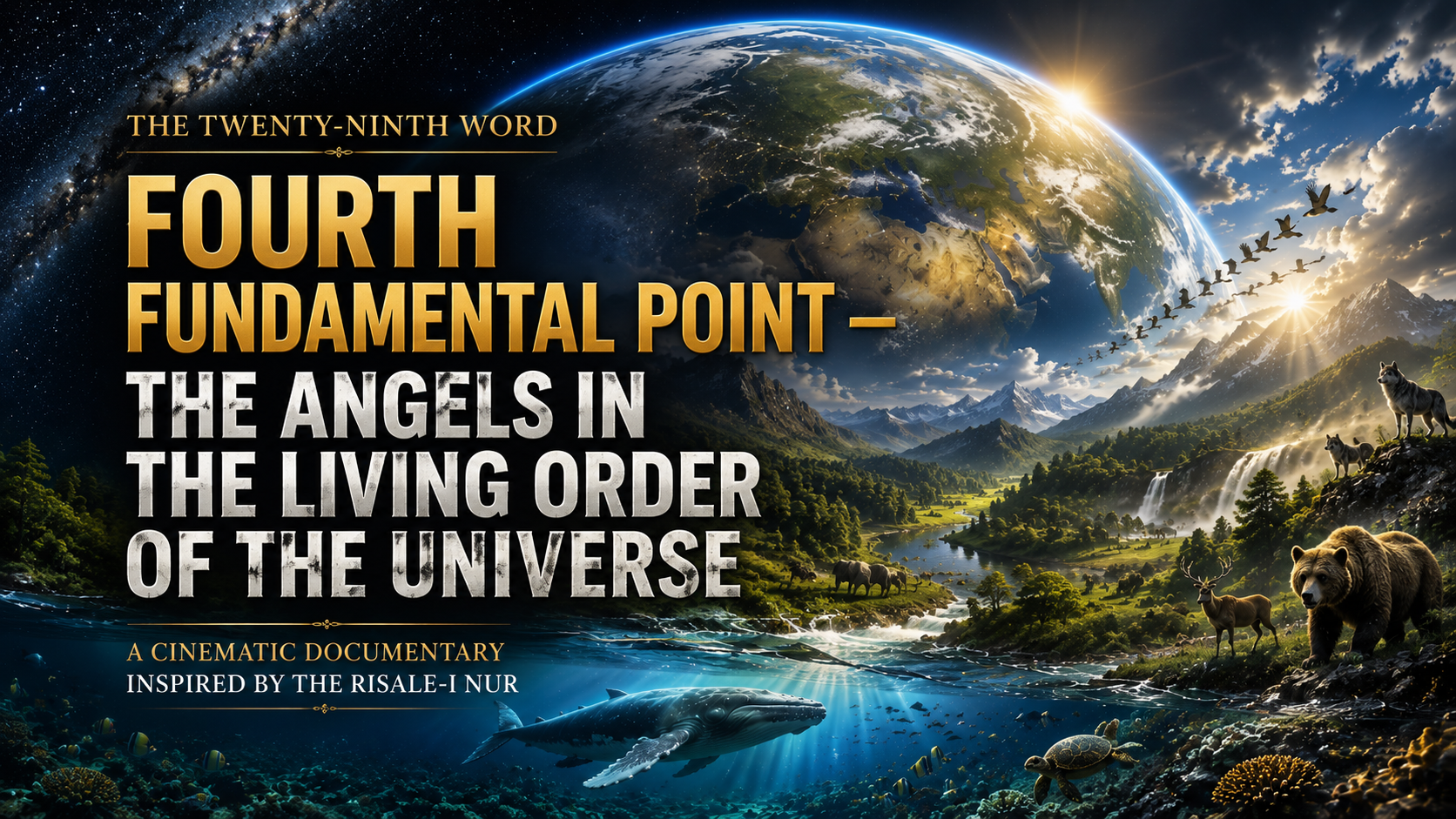
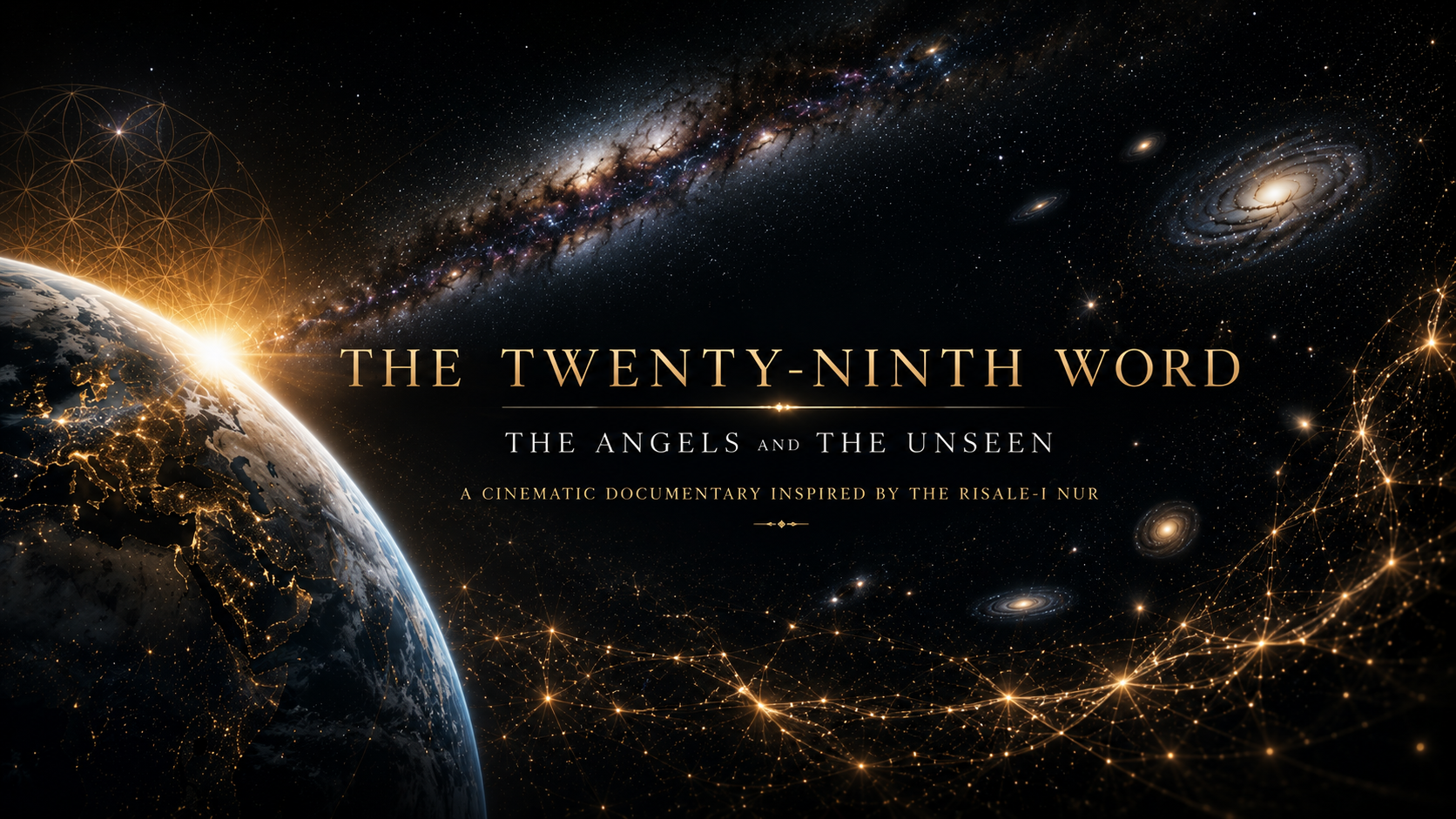
THE TWENTY-NINTH WORD
THE ANGELS AND THE UNSEEN
Fourth Fundamental Point — The Angels in the Living Order of the Universe
What if the universe is far more alive than we imagine?
Look closely.
A flower is not merely a flower.
It carries a remarkable pattern of beauty.
Its very existence seems to speak.
It points beyond itself.
And it praises its Creator through the language of its being.
Now look at a garden.
A single flower has its own purpose.
But the garden has a greater purpose.
It becomes like one vast flower.
Its colors.
Its harmony.
Its countless forms of life.
Together, they perform a universal act of praise.
The same is true of a tree.
A fruit appears.
A flower opens.
A leaf unfolds.
Each has its own function.
Yet the entire tree performs a greater service.
It becomes like a single living declaration.
And the pattern continues.
The heavens themselves can be viewed in the same way.
The sun.
The moon.
The stars.
Countless worlds moving through immense spaces.
Each appears like a word.
And together, they form a vast cosmic expression.
A declaration of order.
A declaration of beauty.
A declaration of power.
From this perspective, even what appears lifeless is not without purpose.
Matter may seem silent.
Unconscious.
Still.
Yet it participates in an extraordinary order.
Everything performs a function.
Everything contributes to a greater harmony.
And according to this vision, the angels are connected to this hidden dimension of creation.
They represent the worship and glorification expressed by the universe.
They are, in a sense, the counterparts of these visible creatures in the unseen world.
The universe becomes like a vast palace.
And within that palace, there are many kinds of servants.
Plants and inanimate things perform their duties without knowing them.
Animals serve wider purposes without fully understanding them.
Human beings, however, can recognize the purpose behind creation.
They can understand.
They can choose.
And they can consciously respond.
But there is another order of beings.
Beings beyond physical desire.
Beyond material reward.
For them, the greatest reward is closeness to their Creator.
His command.
His attention.
His favour.
His presence.
Their worship is their joy.
Their service is their perfection.
And their connection to God is their fulfilment.
Their duties are not all the same.
Just as a great government has many offices and many officials, the universe contains different realms of service.
Each has its own function.
Each has its own form of glorification.
Tradition describes the Archangel Michael as having a special connection with the creatures of the earth.
He is associated with the vast processes of life that unfold across the planet.
The animals, too, are described as having their own appointed spiritual guardians.
Different realms.
Different duties.
Different forms of service.
But one greater order.
This helps us understand why angels are described in such extraordinary ways in the teachings of the Prophet Muhammad.
One narration speaks of angels with enormous numbers of heads.
Each head.
Many mouths.
And every mouth.
Many tongues.
All glorifying God in different ways.
Taken literally, the image is immense.
But beneath the image lies a deeper idea.
The worship of the angels is vast.
Ordered.
Comprehensive.
And beyond our ordinary perception.
Consider the Earth.
From space, it appears as one world.
One living system.
Yet within it are countless forms of life.
Forests.
Oceans.
Mountains.
Animals.
Plants.
Millions upon millions of individual acts.
Each contributing to the greater whole.
In this sense, the Earth itself can be imagined as having countless tongues of praise.
And the angel associated with it represents this vast universal meaning in the unseen realm.
There is an example from nature that makes this idea even more striking.
Consider an almond tree.
A single tree can have dozens of great branches.
Each branch divides into smaller branches.
Those branches carry flowers.
And each flower contains its own intricate structure.
Layer after layer.
Pattern after pattern.
Order within order.
Beauty within beauty.
And each detail points toward a greater meaning.
The question then arises:
Could such a tree perform so many intricate functions…
and yet have no appointed spiritual representative?
Could all this order exist…
without a deeper dimension?
For the believer, the answer is no.
The visible world is not the whole story.
It is only the surface.
Behind the visible form lies another dimension.
A dimension of meaning.
A dimension of worship.
A dimension inhabited by beings we cannot normally see.
And now…
we are invited to look beyond the visible.
To open the doors of the Qur’an.
To enter a world where angels are not distant ideas…
but part of a living cosmic order.
The Qur’an speaks of them.
It describes their movements.
Their obedience.
Their duties.
Their worship.
It presents them as servants who act only by divine command.
They do not act independently.
They do not rebel.
They carry out what they are commanded.
The Qur’an says:
“Glory be to Him!
They are but servants raised to honour.
They speak not before He speaks.
And they act by His command.”
These words offer a powerful image.
A universe filled with obedience.
A universe filled with service.
A universe in which countless beings perform their duties…
even when human eyes cannot see them.
And then there is another unseen creation.
The jinn.
The Qur’an tells of a group of them listening to the revelation.
They hear the recitation.
They recognize its guidance.
And they respond.
They say that they have heard a wondrous recitation.
A recitation that guides to what is right.
And they believe in it.
They refuse to associate anything with their Lord.
So the Qur’an opens another door.
Beyond the world of matter.
Beyond what our senses normally reveal.
A world of angels.
A world of jinn.
A world of unseen realities.
Perhaps the universe is not silent after all.
Perhaps the silence is only our limitation.
Perhaps every star…
every ocean…
every tree…
every living creature…
is part of a greater order.
An order we can observe…
but cannot completely see.
And perhaps, beyond the visible universe…
there is a world that is constantly praising its Creator.
A world of beings whose existence is hidden from our eyes…
but whose purpose is deeply connected to the meaning of creation.
The visible world may be only the beginning.
The unseen…
may be far closer than we think.
ChatGPT
Original text
The Twente-Ninth Word
About the Immortality of Man’s Spirit, the Angels, and the Resurrection of the Dead …
First Aim
To believe in the angels and affirm that belief is a pillar of faith. There are four fundamental points in this aim. …
FOURTH FUNDAMENTAL POINT
If the creatures of the universe are observed with care, it may be seen that like particulars, universals have collective identities, each of which appears as a universal function; it is apparent that each performs a universal duty. For example, just as a flower as itself displays an embroidery full of art and with the tongue of its being recites the Creator’s names, so the garden of the globe resembles a flower and performs an extremely orderly, universal duty of glorification. And just as a fruit issues a proclamation expressing its glorification of God within an order and regularity, so does a mighty tree in its entirety have a most orderly natural duty and worship. And just as a tree glorifies God through the words of its fruits, flowers and leaves, so do the vast oceans of the heavens glorify the All-Glorious Creator and praise the Sublime Maker through their suns, moons, and stars, which are like words; and so on. Although external beings are outwardly inanimate and unconscious, they all perform extremely vital, living, and conscious duties and glorification. Of a certainty, therefore, just as angels are their representatives expressing their glorification in the World of the Inner Dimensions of Things, so are they the counterparts, dwellings, and mosques of those angels in the external and manifest world. As is explained in the Fourth Branch of the Twenty-Fourth Word, the first of the four categories of workers employed by the All-Glorious Maker of the palace of this world is that of the angels and spirit beings. Since, without knowing it, plants and inanimate beings perform extremely important though wageless duties at the command of One Who does know; also without knowing it, animals serve extensive universal aims in return for an insignificant wage; and since, observedly, in return for two wages, one immediate and the other postponed, human beings, knowing the All-Glorious Maker’s aims, are employed by their conforming to them, their taking a share of everything for themselves, and their supervising the other servants; it will certainly be the first category, as well as the fourth, which will constitute the servants and workers. They both resemble human beings in that knowing the universal aims of the All-Glorious Maker, they conform to them through worship, and they are contrary to them. For being beyond sensual pleasure and some partial wage, they consider sufficient the pleasure, perfection, delight and bliss they experience from the All-Glorious Maker’s attention, command, favour, consideration, and name, through their perception of Him, connection with Him, and proximity to Him. They labour with the purest sincerity, their duties of worship varying according to their different kinds, and according to the varieties of the creatures in the universe. Like in a government there are various officials in the various offices, so too the duties of worship and glorification vary in the spheres of the realm of dominicality. For example, through the power, strength, reckoning and command of God Almighty, the Archangel Michael is like the general overseer of God’s creatures sown in the field of the face of the earth. If one may say so, he is the head of the angels that resemble farmers. And, through the permission, command, power, and wisdom of the All-Glorious Creator, the incorporeal shepherds of the animals have a head, a supreme angel appointed to the task. Thus, since it is necessary for there to be an angel appointed to each of these external creatures in order to represent in the World of the Inner Dimensions of Things the duties of worship and service of glorification which it performs, and to present them knowingly at the divine court, the way the angels are described in the narrations of the Bringer of Sure News (UWBP) is certainly most appropriate and rational. For example, he declared: “There are some angels which have either forty, or forty thousand, heads. In each of the heads are forty thousand mouths, and with the forty thousand tongues in each of those mouths they glorify God in forty thousand ways.” This Hadith expresses a truth, and both contains a meaning, and has a form or manner of expression. Its meaning is as follows: The angels’ worship is both orderly and perfect, and universal and comprehensive. As for the form of the truth, it is this: There are certain mighty corporeal beings that perform their duties of worship with forty thousand heads in forty thousand ways. For example, the heavens glorify God with the suns and the stars. While the earth, which is a single being, performs its duty of worship, its dominical glorification, with a hundred thousand heads and with the hundreds of thousands of tongues in each mouth. Thus, the angel appointed to the globe of the earth has to be envisaged in this way in order to display this meaning in the World of the Inner Dimensions of Things. I myself, even, saw a medium-sized almond tree which had close on forty large branches resembling heads. When I looked at one branch, I saw it had nearly forty smaller branches like tongues. Then I looked at one tongue of one of those small branches; forty flowers had opened on it. I studied the flowers considering the wisdom in them, and saw in each close on forty exquisite, well-ordered stamens, colours, and arts, each of which proclaimed one of the All-Glorious Maker’s names and their constantly varying manifestations. Is it at all possible that the All-Wise and Beauteous One, Who is the All-Glorious Maker of the almond tree, would impose this many duties on an inanimate tree, and not mount on it an appointed angel appropriate to it, to be like its spirit, to understand and express its meaning, proclaim it to the universe, and present it at the divine court? O friend! So far, our explanation has been an introduction to bring the heart to acceptance, the reason to submission, and to compel the soul to surrender. If you have understood it to some degree and wish to meet with the angels, prepare yourself. Moreover, purify yourself of wrongful prejudice. Now look, the doors of the Qur’an’s world are open! Look, the paradise of the Qur’an is with “wide-open gates” (38:50)! Enter and Look! See the angels in beautiful form in the paradise of the Qur’an! Each of its revealed verses is a place to alight, so look from them: By the [winds] sent forth one after another [to man’s profit], * Which then blow violently in tempestuous gusts * And scatter [things] far and wide; * Then separate, one from another * Then spread abroad a message. (77:1-5) By the [angels] who tear out [the souls of the wicked] with violence, * By those who gently draw out [the souls of the blessed] ,* And by those who gently glide along [on errands of mercy],* Then press forward as if in a race, * Then arrange to do [the commands of their Lord]. (79:1-5) Therein come down the angels and the Spirit by God’s permission in every errand. (97:4) … over which are [appointed] angels stern [and] severe, who flinch not [from executing] the commands they receive from God, but do [precisely] what they are commanded. (66:6) Also listen to: Glory be to Him! They are but servants raised to honour. They speak not before He speaks and they act [in all things] by His command, (21:26-27) listen to its praises. And if you wish to meet with the jinn, enter this resounding sura: Say, it has been revealed to me that a company of jinn listened [to the Qur’an]. (72:1) See them and listen to what they say. Take a lesson from them. Look, they are saying: “We have really heard a wonderful recital * It gives guidance to the right, and we have believed therein: We shall not join [in worship] any [gods] with our Lord.” (72:1-2)
Bediuzzaman Said Nursi, The Words – The Twenty-Ninth Word – About the Immortality of Man’s Spirit, the Angels, and the Resurrection of the Dead, The English translations of the Risale-i Nur Collection, translated by Şükran Vahide and published by Sözler Neşriyat, are an exact printed version of the original text. (erisale.com)
The Eternal Reality of Angels and Spiritual Beings
This text and the accompanying videos are based on a classical work of Islamic thought that establishes the existence of angels and spiritual beings through both rational and transmitted evidence.
The author emphasizes that belief in the existence of these beings is a fundamental pillar of faith, presenting the enduring consensus of humanity throughout history and the common testimony of religious scholars as primary evidence.
The text develops a logical inference based on the idea that the witnessing of even a single spiritual being would be sufficient to establish the existence of the entire category to which it belongs.
It further states that the testimony of prophets and saints concerning this matter is far more authoritative and conclusive than the views of those who deny their existence.
Ultimately, it is expressed that the nature and mode of existence of angels can be understood most accurately only within the framework of the truths conveyed by the Qur’an and the Prophet Muhammad.
Gemini Notebook
THE TWENTY-NINTH WORD — THE ANGELS AND THE UNSEEN
There are questions that reach beyond what the human eye can see.
Questions about the unseen.
About angels.
About spiritual beings.
And about the life of the human spirit.
For thousands of years, humanity has asked the same questions.
Are we truly alone?
Is there a world beyond the visible?
And if we cannot see it…
does that mean it does not exist?
The Twenty-Ninth Word approaches these questions from a different perspective.
It begins with a simple principle.
Sometimes, the existence of the whole can be understood through a single example.
If one member of a species is known to exist…
then the existence of that species can no longer be dismissed.
And this principle leads us to something remarkable.
Across the ages, people of revelation have spoken of angels.
They have spoken of spiritual beings.
And they have described encounters with them.
Not in one place.
Not in one generation.
But across civilizations.
Across centuries.
Across the long history of humanity.
From the time of Adam…
until the present day.
The great scholars of the revealed religions have affirmed their existence.
And many have claimed to have witnessed them.
Some have described speaking with them.
Others have recorded signs of their presence.
Different peoples.
Different languages.
Different cultures.
And yet…
a remarkably consistent belief.
But could such a belief have appeared from nothing?
Could it have survived thousands of years…
through wars…
through revolutions…
through the rise and fall of civilizations…
if it had no foundation?
Could an idea without evidence become one of the most persistent beliefs in human history?
The argument presented here is simple.
Perhaps this universal belief is not based on imagination.
Perhaps it comes from countless observations.
Countless testimonies.
Countless signs.
One testimony may be questioned.
A second may be doubted.
But what happens when the number becomes enormous?
When generations upon generations report similar experiences?
When those reports come from people regarded as trustworthy and spiritually qualified?
Then the question changes.
We are no longer asking…
“Why do people believe?”
We are asking…
“What lies behind this belief?”
And there is another important point.
Throughout human history, prophets and saints have spoken about the unseen world.
They have described angels.
They have spoken of spiritual beings.
And they have claimed to have encountered them.
These individuals were not merely observers.
They were people who devoted their lives to truth.
People who accepted immense responsibility.
People who spoke to humanity about realities beyond ordinary experience.
If a person is qualified to speak about a particular subject…
his testimony carries weight.
And in this question, the argument becomes even stronger.
Because the prophets and saints were not alone.
Their testimony was supported by generations of followers.
By traditions.
By observations.
By signs.
And by revelation.
The Qur’an stands at the center of this argument.
For believers, it is not simply an ancient book.
It is a source of revelation.
A light in the world of truth.
Its message points repeatedly toward realities beyond the visible world.
And at the center of that message stands the Prophet Muhammad.
The Messenger of God.
The one whose life became a testimony to the unseen.
His prophetic journey reaches beyond ordinary human experience.
Beyond the limits of the physical world.
And toward realities that cannot be measured by the senses alone.
Here, the argument reaches its deepest point.
Suppose…
just once…
the existence of a single spiritual being were established with certainty.
Then something extraordinary would follow.
The existence of one individual would demonstrate the possibility…
and reality…
of the entire species.
Just as seeing one living creature can prove that such a species exists…
one verified spiritual being would establish that spiritual beings are not merely products of imagination.
The question would no longer be whether they exist.
The question would become…
what are they?
And what is their place in the universe?
According to the Qur’anic vision…
they belong to a reality far greater than the world we normally perceive.
A reality filled with beings of light.
A reality in which the visible universe is only one layer of existence.
Perhaps this is the deeper lesson.
Human beings have always lived between two worlds.
One that we can see.
And one that we cannot.
We see stars.
But we do not see everything that exists between them.
We see matter.
But we do not see every force acting upon it.
We see the surface of life.
But beneath that surface lies a universe of hidden processes.
So perhaps the unseen should not be dismissed simply because it is unseen.
After all…
the universe has always been larger than our senses.
There was a time when humanity could not see bacteria.
They were there.
We simply lacked the means to perceive them.
There was a time when we could not see distant galaxies.
They were there too.
Our vision had limits.
Reality did not.
And perhaps…
that is the question at the heart of the Twenty-Ninth Word.
How much of existence lies beyond the boundary of human perception?
Maybe the unseen world is not a contradiction to reason.
Maybe it is a reminder of reason’s limits.
And if even one glimpse beyond that boundary can be established…
then the universe becomes larger than we imagined.
The visible world is no longer the whole story.
It becomes only the beginning.
A doorway…
into a reality far greater.
A reality in which angels exist.
Spiritual beings exist.
And the human spirit itself may possess a destiny beyond death.
Because perhaps…
what we call the end…
is only the end of what we can see.
Not the end of existence.
Not the end of the journey.
And certainly…
not the end of the human spirit.
ChatGPT
Original text
The Twenty-Ninth Word
About the Immortality of Man’s Spirit, the Angels, and the Resurrection of the Dead …
First Aim
To believe in the angels and affirm that belief is a pillar of faith. There are four fundamental points in this aim. …
THIRD FUNDAMENTAL POINT
The angels and spirit beings are one of those questions in which the reality of a universal may be inferred from the existence of a single particular. If a single individual is seen, the existence of the species may be concluded. Whoever denies it, denies it as a member of the species to which it belongs. While whoever accepts the single individual is compelled to accept its whole species. Since it is thus, consider the following: Have you not seen and heard that all the scholars of the revealed religions throughout the ages from the time of Adam until now have agreed on the existence of the angels and the reality of spirit beings? The different groups of humankind have concurred in having seen and conversed with angels and in their narrations concerning them, as though they were discussing and narrating events about one another. Do you think that if a single angel had not been seen, and the existence of one or numerous individuals not been established through observation, and their existence not been perceived clearly, self-evidently, that it would have been at all possible for such accord and such a consensus to continue, and to continue persistently and unanimously in such an affirmative and positive manner, based on observation? Also, is it at all possible that the source of this general belief should not be some necessary principles and self-evident matters? And is it all possible that a baseless delusion should persist and become permanent in all the beliefs of mankind throughout all the revolutions it has undergone? And is it all possible that the basis of the assertion of these scholars of the religions, of this mighty consensus, should not be a certain intuition and empirical certainty? And is it at all possible that that certain intuition and empirical certainty which result from innumerable signs, and those signs which have been observed on numerous occasions, and those numerous observations should not all, without doubt or hesitation, be founded on necessary principles? In which case, the cause and the basis of the assertion of the universal belief held by these scholars are the necessary and categorical principles resulting from the great number of times the angels and spirit beings have been observed and seen, which demonstrates the strength of the consensus. Furthermore, is it all possible, rational or feasible that the unanimous testimony of the prophets and saints, who are like the suns, moons, and stars in human society, concerning the existence of the angels and spirit beings and their actually seeing them, should be prey to doubts or be the object of suspicion? Especially since they are qualified to speak in this matter. It is obvious that two people who are qualified to speak on a matter are preferable to thousands who are not. Moreover, in this question they are affirming a matter, and people who affirm a matter are preferable to thousands who deny or reject it. Is it at all possible for there to be any doubt concerning the statements of the Qur’an of Miraculous Exposition, the Sun of Suns in the world of truths, which never at any time sets, shining continuously in the skies of the universe? And can there be doubt concerning the testimony and witnessings of the Muhammadan Being (UWBP), the Sun of Prophethood? Since, if on a single occasion the existence of a single spirit being is verified, this demonstrates the actual existence of the whole species; and since it proves the existence of the whole species to be true, for sure, the best and most rational and acceptable form of their real existence will be similar to that expounded by the Shari’a, described by the Qur’an, and seen by the One who ascended to the “distance of two bow-lengths.”
Bediuzzaman Said Nursi, The Words – The Twenty-Ninth Word – About the Immortality of Man’s Spirit, the Angels, and the Resurrection of the Dead, The English translations of the Risale-i Nur Collection, translated by Şükran Vahide and published by Sözler Neşriyat, are an exact printed version of the original text. (erisale.com)
The Living Messengers of the Universe – A Documentary Narration Inspired by The Twenty-Ninth Word – Bediuzzaman Said Nursi
The Existence and Nature of the Angels
This text and video is a passage from The Twenty-Ninth Word by Bediüzzaman Said Nursi, in which the existence and nature of angels are explained through both rational and transmitted evidence.
The author points out that not only religious scholars, but also various philosophical schools—and even materialists—have been compelled to acknowledge the reality of spiritual beings, although they may refer to them by different names.
Angels are described as luminous beings devoted to worship, representing the laws of creation that originate from the Divine Will and holding the reins of these laws.
The text emphasizes that the universe is not limited to the visible, material realm. Rather, the unseen realm is also filled with beings suited to life and existence.
According to the text, angels constitute a vast community that completely obeys the commands of God and serves as the representatives of the Shariah of Creation (Shariah al-Takwiniyyah)—the divinely established laws governing the universe.
In conclusion, the text presents, within a logical framework, the idea that behind the delicate and intricate order of the universe lie these subtle, luminous beings.
Gemini Notebook
The Living Messengers of the Universe
A Documentary Narration Inspired by
The Twenty-Ninth Word
Look up at the night sky.
It seems silent.
Empty.
Still.
But is it?
For thousands of years…
philosophers…
scientists…
and believers…
have all asked the same question.
Is this universe truly uninhabited?
Or is there a hidden order…
beyond what our eyes can see?
Across civilizations…
across cultures…
and across centuries…
remarkably similar answers emerged.
Different words.
Different languages.
One shared reality.
Every realm of creation…
has its own unseen guardians.
Some philosophers called them…
the Intellects.
Others…
the Lords of Creation.
The revealed religions…
called them angels.
Different names.
The same profound idea.
Even those who rejected revelation…
could not completely reject this reality.
Unable to explain the perfect harmony of nature…
they invented new names.
Invisible forces.
Natural laws.
Hidden energies.
But changing a name…
does not change a reality.
Because laws…
cannot act by themselves.
A law cannot see.
A law cannot choose.
A law cannot obey.
It has no awareness.
No intention.
No life.
A traffic law…
does not direct the cars.
Someone must enforce it.
Someone must carry it into action.
The same is true…
on a cosmic scale.
The universe operates with astonishing precision.
Every star follows its course.
Every cloud moves in perfect measure.
Every raindrop reaches its destination.
Every seed knows when to awaken.
Could unconscious laws…
truly govern a living universe?
Or are there conscious servants…
carrying out the Divine command?
The Qur’an offers a clear answer.
The angels…
are honored servants.
They never rebel.
They never hesitate.
They fulfill every command entrusted to them.
They are beings of light.
Invisible to us.
Yet deeply involved…
in the order of creation.
Think about our own world.
Earth…
is overflowing with life.
Every forest.
Every ocean.
Every mountain.
Every handful of soil.
Life fills every available place.
If this small planet…
is so full of living creatures…
why would the immeasurable heavens…
remain empty?
Would the greatest realms…
contain the least life?
Or is life…
far greater than we imagine?
The visible universe…
may only be the surface.
A beautifully woven curtain.
Behind it…
exist other dimensions.
Realms beyond sight.
Worlds beyond matter.
Places where spirit…
is as natural…
as water is for fish.
If oceans are made for fish…
then unseen realms…
are made for beings of spirit.
This is not an empty universe.
It is a living universe.
Humanity itself…
follows Divine guidance.
Through revelation.
Through moral law.
Likewise…
the angels serve another sacred mission.
They carry…
the Divine laws of creation.
Not as independent powers.
But as devoted servants.
Every star…
becomes a place of worship.
Every galaxy…
a sign of obedience.
Every movement…
an act of submission.
Nothing moves alone.
Nothing exists without purpose.
Seen or unseen…
everything belongs…
to one magnificent order.
Perhaps…
the universe has never been silent.
Perhaps…
we simply hear…
only a small part…
of its eternal symphony.
ChatGPT
Original text
The Twenty-Ninth Word
About the Immortality of Man’s Spirit, the Angels, and the Resurrection of the Dead …
First Aim
To believe in the angels and affirm that belief is a pillar of faith. There are four fundamental points in this aim. …
SECOND FUNDAMENTAL POINT
It may be said that all the scholars of the speculative and the scriptural sciences have, knowingly or unknowingly, united to effect a consensus in affirming, despite difference of expression, the existence and reality of the angels and spirit beings. One group of Peripatetic philosophers of the Illuminist School even, who made much progress in the study of matter, stated without denying the meaning of the angels that each realm in creation has a spiritual, incorporeal essence. They described the angels thus. Also, a group of the early philosophers who were Illuminists, being compelled to accept the meaning of the angels, were only wrong in naming them the Ten Intellects and Masters of the Realms of Creation. Through the inspiration and guidance of Revelation, scholars of all the revealed religions have accepted that each realm of creation has an angel appointed to it and have named them the Mountain Angel, the Sea Angel, and the Rain Angel, for example. Even the materialists and naturalists, whose reasoning is restricted to what is immediately apparent to them and who have in effect fallen from the level of humanity to that of inanimate matter, rather than being able to deny the meaning of the angels, {(*): They have been unable to find a way to deny the reality and meaning of the angels and spirit beings. In fact, they have been compelled to affirm them in one respect by claiming them to be one of the natural laws, although they described them wrongly, naming them kuva-yı sâriya or suffusing forces. (Hey you who consider yourselves to be so clever!)} have been compelled to accept them in one respect, though naming them the suffusing forces.
O you wretched man who is reluctant to accept the angels and spirit beings, on what do you base this view? What facts do you rely on that you oppose the conscious or otherwise unanimity of all rational people concerning the existence and reality of the meaning of the angels and the real existence of spirit beings? And since, as was proved in the First Fundamental Point, life is the revealer of beings, indeed, is their consequence, their quintessence; and since all the scholars are in effect unanimous in their acceptance of the meaning of the angels; and this world of ours has been filled to such a degree with animate creatures and beings with spirits; is it all possible that the vastness of space and the rarefied heavens would remain empty of dwellers and have no inhabitants? You should never suppose that the laws in force in this creation are sufficient for the universe to be alive, because those governing laws are insubstantial commands; they are imaginary principles; they may be considered non-existent. If there were no absolutely obedient creatures called angels to represent them, make them apparent, and take their reins into their hands, those laws could not be defined as existent, nor be represented as having a particular identity, nor be an external reality. Whereas, life is an external reality, and an imaginary command cannot sustain an external reality.
In Short: Since the scholars of religion and philosophy, and of the speculative and scriptural sciences, have in effect agreed that beings are not restricted to this Manifest World; and since, despite being inanimate and inappropriate for the formation of spirits, the visible Manifest World has been adorned to such an extent with beings with spirits; existence is surely not limited to it. There are numerous other levels of existence in relation to which the Manifest World is an embroidered veil.
Furthermore, since, just as the sea is appropriate for fish and the World of the Unseen and the World of Meaning appropriate for spirits, and this necessitates their being filled with them; and since all commands testify to the existence of the angels’ meaning; certainly and without any shadow of a doubt, the most beautiful form of the angels’ existence and spirit beings’ reality, and the most rational view of their nature which sound intellects will accept and acclaim, is that which the Qur’an has expounded and elucidated. The Qur’an of Miraculous Exposition states that: “The angels are honoured slaves. Never contesting a command, they do whatever they are ordered. The angels are subtle, luminous beings, and are divided into different kinds.”
Just as humankind is a nation and human beings are the bearers, representatives, and embodiments of the Shari’a or code of divine laws which proceeds from the attribute of divine speech, so are the angels a mighty nation, and those of them who are workers are the bearers, representatives, and embodiments of the code of laws pertaining to creation, which proceeds from the attribute of divine will. They are a class of God’s slaves who are dependent on the commands of the creative power and pre-eternal will, which are the true effective agent, and for whom all the heavenly bodies are places of worship, like mosques.
Bediuzzaman Said Nursi, The Words – The Twenty-Ninth Word – About the Immortality of Man’s Spirit, the Angels, and the Resurrection of the Dead, The English translations of the Risale-i Nur Collection, translated by Şükran Vahide and published by Sözler Neşriyat, are an exact printed version of the original text. (erisale.com)