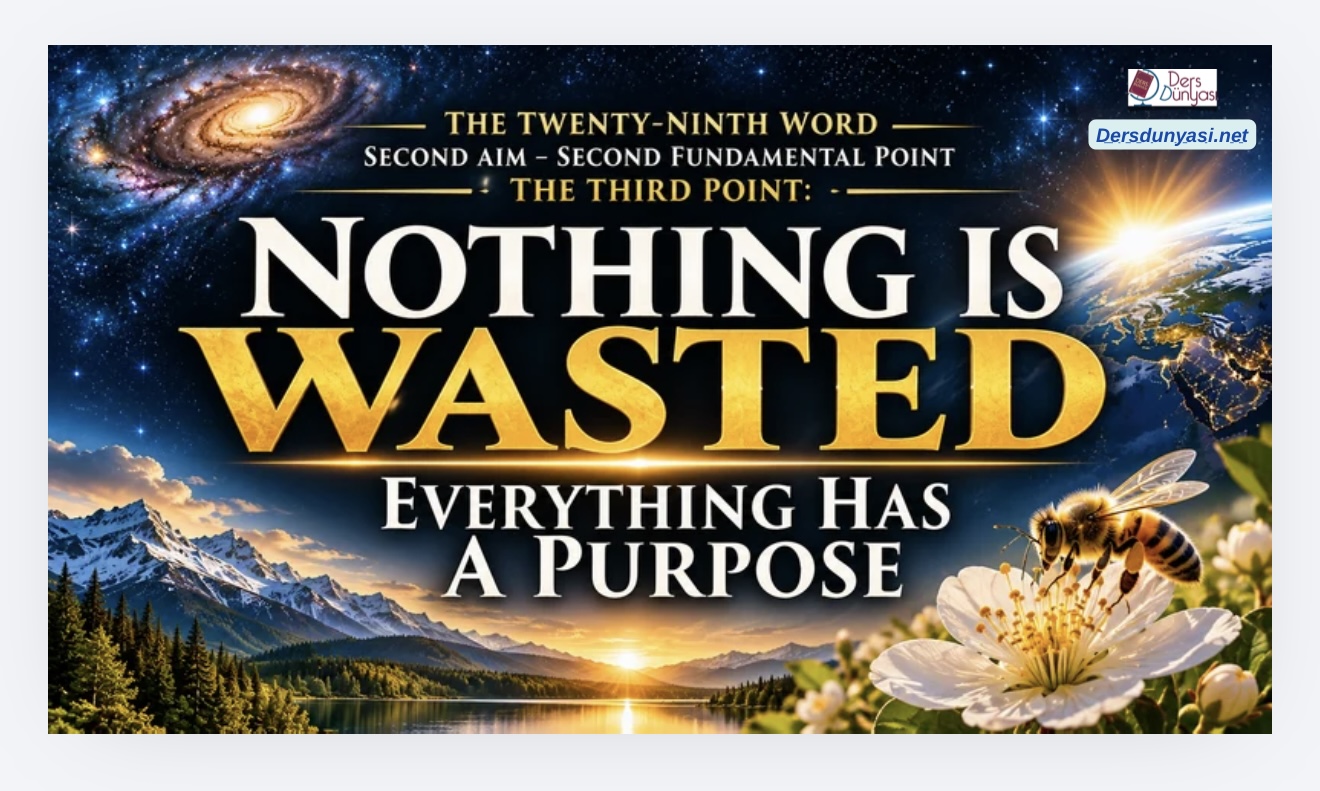
NOTHING IS WASTED: DOES EVERYTHING HAVE A PURPOSE?
The Twenty-Ninth Word – Third Point
What if nothing in the universe is truly wasted?
From the smallest living creature to the vastness of distant galaxies, creation reveals an extraordinary order. Everything has a purpose. Everything serves a function.
But what about humanity?
Why do we possess limitless hopes, endless desires, and a deep longing for perfection? Could these remarkable qualities have been created for nothing?
In this episode, we explore the Third Point of the Second Fundamental Point in the Second Aim of Bediuzzaman Said Nursi’s The Twenty-Ninth Word.
Through the testimony of reason, wisdom, science, and observation, we examine a profound argument:
If nothing in creation is without purpose, how could the eternal hopes of the human heart be left without fulfilment?
The order of the universe points beyond this temporary life. It directs our thoughts towards resurrection, eternal life, and everlasting happiness.
Nothing is created in vain. And the deepest hopes of humanity are not without purpose.
IN THIS VIDEO
- The wisdom and purpose behind creation
- Why nothing in the universe is wasted
- The extraordinary potential of the human being
- Humanity’s longing for perfection and happiness
- The relationship between creation and resurrection
- The promise of eternal happiness
ABOUT THE AUTHOR
Bediuzzaman Said Nursi (1877–1960) was a prominent Islamic scholar and the author of the Risale-i Nur Collection. His works explore faith, reason, the universe, human existence, and the hereafter.
SOURCE
Bediuzzaman Said Nursi – The Words
The Twenty-Ninth Word – Second Aim, Second Fundamental Point, Third Point.
English translation by Şükran Vahide, published by Sözler Neşriyat.
Original text:
https://www.erisale.com/en/words/the-twenty-ninth-word-second-aim#4240
Risale-i Nur Reading Programme 2.1.0
Words [2021] – 553
EXPLORE MORE
Discover more episodes on the Risale-i Nur Collection, faith, the meaning of existence, and the mysteries of the universe.
Subscribe to DERSDÜNYASIEnglish for more reflections on faith, reason, and eternal life.
If nothing in creation is wasted, could the deepest hopes of humanity be without an eternal purpose?
Share your thoughts in the comments.
#BediuzzamanSaidNursi #RisaleiNur #EternalHappiness
THE TWENTY-NINTH WORD
SECOND AIM – SECOND FUNDAMENTAL POINT
THE THIRD POINT: NOTHING IN CREATION IS WASTED
Look closely at the universe.
Observe the smallest details of creation.
Nothing is without purpose.
Nothing is created in vain.
Reason tells us this.
Wisdom confirms it.
Science reveals it.
And experience shows it to be true.
Throughout the universe, we see an extraordinary principle.
Nothing is wasted.
Nothing is left without a purpose.
The Creator chooses the shortest paths.
The closest ways.
The lightest forms.
And the most perfect designs.
Consider this remarkable truth.
A single thing may perform a hundred different duties.
And a seemingly insignificant creature may carry within it a thousand benefits.
A tiny being can serve countless purposes.
A simple creation can produce extraordinary results.
This is not coincidence.
It is the manifestation of divine wisdom.
It is evidence of perfect design.
And here, we encounter a profound question.
If everything in creation has a purpose…
If nothing is created in vain…
Then how could humanity be an exception?
How could the deepest hopes of the human heart simply disappear?
How could all our aspirations end in nothing?
If there were no resurrection…
If there were no return to life…
Then everything would ultimately become meaningless.
All those countless purposes would be left unfinished.
All those extraordinary possibilities would be wasted.
And this would contradict the wisdom we observe throughout creation.
Science has already shown us something remarkable.
Even the smallest details of the human body serve specific purposes.
Nothing is accidental.
Nothing is without function.
So what about the human spirit?
What about the limitless potential within us?
What about our endless hopes?
Our thoughts.
Our dreams.
Our desires.
Could all these extraordinary faculties have been created for nothing?
Could the human heart, with its infinite longing, have no final destination?
Certainly not.
For the human being carries within himself a profound desire for perfection.
He seeks what is greater.
He longs for what is eternal.
And above all…
He desires true happiness.
But think about it.
Why would such a deep-rooted desire exist…
If there were no ultimate happiness to fulfil it?
Why would humanity be given an endless longing…
If there were no eternal destination?
The desire for perfection points towards perfection itself.
And the longing for happiness points towards a happiness beyond the limits of this world.
A happiness that does not fade.
A happiness that does not end.
Eternal happiness.
Otherwise, something extraordinary would happen.
Unlike every other creature in the universe…
Humanity’s highest faculties would be left without purpose.
Our deepest hopes would be wasted.
Our spiritual abilities would wither away.
And our greatest desires would remain forever unfulfilled.
Could this be consistent with the perfect wisdom displayed throughout creation?
No.
The wisdom that governs the universe cannot be separated from the destiny of humanity.
The One who creates with such purpose…
Does not create our deepest aspirations in vain.
And so, the very order of the universe points beyond this temporary world.
It points towards resurrection.
It points towards eternal life.
And ultimately…
It points towards eternal happiness.
This truth has already been established in the Eleventh Truth of the Tenth Word.
Therefore, we shall not prolong the discussion here.
But one conclusion remains clear:
In a universe where nothing is created in vain, the eternal hopes of humanity cannot be without an eternal fulfilment.
For creation has a purpose.
And so does human existence.
The story does not end here.
ChatGPT
THE TWENTY-NINTH WORD
…
SECOND AIM
…
SECOND FUNDAMENTAL POINT
…
Third Point: Through the testimony of reason, wisdom, induction, and experience, the absence of futility and absence of waste in the creation of beings, which is constant, indicate eternal happiness. The sign of there being no waste and nothing vain in creation is the All-Glorious Maker’s choosing and preferring the shortest way, the closest point, the lightest form, and the best manner in the creation of everything, and His sometimes imposing a hundred duties on one thing, and His attaching a thousand fruits and aims to a slight being. Since there is no waste and nothing in vain, there will surely be eternal happiness. For non-existence and no return would make everything futile; everything would be a waste. The absence of waste in all creation, and in man for instance, which is established by science, demonstrates that man’s limitless disposition, and infinite hopes, ideas, and desires will not be wasted either. In which case, man’s deep-rooted desire to be perfected points to the existence of a perfection, and his desire for happiness proclaims that he is definitely destined for eternal happiness. If it were not so, contrary to other beings, which are all made wisely and purposefully, those authentic immaterial faculties, those elevated hopes, would go to waste and be futile; they would wither up and go for nothing. Since this truth is proved in the Eleventh Truth of the Tenth Word, we cut the discussion short here.
SOURCES
Risale-i Nur Okuma Programı 2.1.0, Words[2021] – 553, email: syesilova72@gmail.com
Bediuzzaman Said Nursi, The Words – The Twenty-Ninth Word – About the Immortality of Man’s Spirit, the Angels, and the Resurrection of the Dead, The English translations of the Risale-i Nur Collection, translated by Şükran Vahide and published by Sözler Neşriyat, are an exact printed version of the original text. (erisale.com)
https://www.erisale.com/en/words/the-twenty-ninth-word-second-aim#4240