This video and text are based on a fundamental passage from Bediuzzaman Said Nursi’s The Twenty-Ninth Word, specifically the section Second Aim / First Fundamental Point / Third Source, which presents a foundational argument for the nature and immortality of the human spirit (baqā’ al-rūḥ).
The main ideas and conceptual framework can be summarized as follows:
The Definition of the Spirit (Kānūn-u Amrī):
The spirit is described as a living, conscious, luminous “law of command” (kānūn-u amrī) that has been clothed with external existence (wujūd-u khārijī), and which possesses a comprehensive nature with the capacity to attain universality. While physical laws of nature, such as gravity, are based on abstract principles, the spirit is presented as a living and conscious embodiment of these divine laws.
A Constant Reality Amid Change:
Although matter and living species undergo continuous change and transformation, there remains a constant reality at the essence of each species. Individuals are born and die, yet the law governing that species continues to exist.
The Human Being as a Species in Itself:
Through the breadth of his nature, universal consciousness, and capacity for comprehensive conception, the individual human being, despite being only one person, has in a sense attained the rank of an entire species (nev’ in itself). Therefore, the law of continuity and permanence that applies to an entire species also applies directly to the human spirit.
Baqā’ al-Rūḥ — The Immortality of the Spirit:
Even if the human spirit were to undergo hundreds of thousands of changes in state and form, or even if the body were to die, the spirit continues to exist through God’s command, permission, and preservation (ibqā’). It continues onward toward eternity, just as it came into this world.
Source: Gemini Notebook
THE TWENTY-NINTH WORD
SECOND AIM
FIRST FUNDAMENTAL POINT
THIRD SOURCE
There is another way to understand the immortality of the human spirit.
Look closely at life.
Everything changes.
Forms appear.
They develop.
They transform.
And eventually, they disappear.
Yet something remains.
Something constant.
Something that does not perish with the changing form.
This is true throughout the living world.
Behind the changing forms of life,
there are laws that remain.
They continue to operate.
They remain stable.
They do not disappear with every transformation.
Even the weakest law of nature shows a certain permanence.
And this gives us a significant clue.
The human being is not merely an individual.
In a remarkable sense,
he is like a whole species within himself.
Why?
Because human nature is comprehensive.
Human consciousness is universal.
And the human imagination can embrace countless things.
A person can think about the past.
He can imagine the future.
He can understand distant worlds.
He can reflect upon existence itself.
His inner world is vast.
For this reason,
the laws that operate within a species
can also be seen within the individual human being.
Now consider the human spirit.
The spirit is the conscious element of the human being.
It is the living essence within him.
The body changes.
It grows.
It weakens.
It renews itself.
And throughout a lifetime,
its physical form can change again and again.
Yet we still say:
“I am the same person.”
Something remains.
Something preserves our identity.
Something continues through all these changes.
That something is the spirit.
The Creator has given the human being
a comprehensive nature.
He has made humanity a mirror
capable of reflecting the signs of the universe.
He has given the human being
a capacity for universal worship.
And He has given the spirit
a nature suited to permanence.
So even if the outer form of a person changes
hundreds of thousands of times,
the spirit does not necessarily perish with it.
With the permission of its Sustainer,
it continues.
It remains.
And when its time in this world is complete,
it departs.
Just as it came.
Therefore, the human spirit
is not like the temporary form of the body.
The body changes.
The spirit remains.
The body belongs to the world of transformation.
The spirit belongs to a deeper reality.
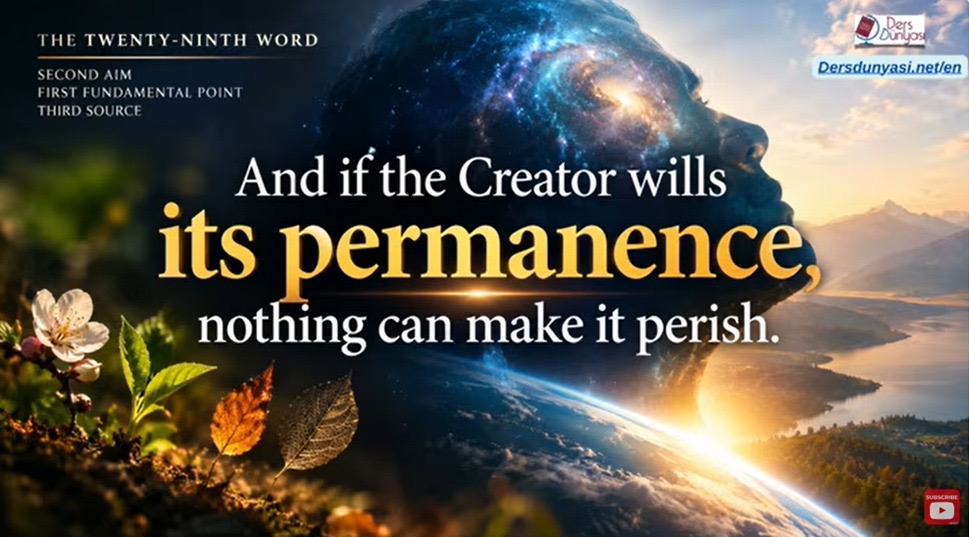
And if the Creator wills its permanence,
nothing can make it perish.
The human spirit is conscious.
It is alive.
It is the essential living element of the human being.
And by God’s command,
and through His permission,
it is immortal.
This is the third source.
A reflection drawn from the permanence
found behind the changing forms of life.
And it points to a profound truth:
The body changes.
The spirit continues.
And the human being does not end
with the disappearance of his outward form.
ChatGPT
Original text
THE TWENTY-NINTH WORD
The Immortality of Man’s Spirit
The Angels, and the Resurrection of the Dead
…
SECOND AIM
…
FIRST FUNDAMENTAL POINT
…
THIRD SOURCE:
The human spirit, which has been clothed in a living, conscious, luminous external existence, is a comprehensive and veracious commanding law disposed to acquiring universality. Even the weakest commanding laws manifest stability and permanence. For if considered carefully, it will be seen that present in all species which are subject to change, is a constant truth that, revolving within the changes, transformations, and stages of life, causes the outer forms of things to change, and yet living and not dying, is permanent.
Thus, while the human being is an individual, he resembles a species owing to the comprehensiveness of his nature, his universal consciousness, and all-embracing imagination. A law that governs and is in force in the species is also in force in the human individual. Since the All-Glorious Creator has created man as a comprehensive mirror, for universal worship, and with an exalted nature, even if the spirit-truth which is present in each individual causes the individual’s outer form to change hundreds of thousands of times, with the Sustainer’s permission it will not die but will continue, departing as it came. In which case, at God’s command and with His permission and through His making it permanent, the human individual’s spirit, which is the conscious element and living part of him, is immortal.
SOURCES
Risale-i Nur Okuma Programı 2.1.0, Words[2021] – 551, email: syesilova72@gmail.com
Bediuzzaman Said Nursi, The Words – The Twenty-Ninth Word – About the Immortality of Man’s Spirit, the Angels, and the Resurrection of the Dead, The English translations of the Risale-i Nur Collection, translated by Şükran Vahide and published by Sözler Neşriyat, are an exact printed version of the original text. (erisale.com)
https://www.erisale.com/en/words/the-twenty-ninth-word-second-aim#4224