The Wisdom of the Universe: Is Eternal Happiness Possible? | The 29th Word

Does the wisdom we see throughout the universe point toward eternal happiness?

In this episode of The Twenty-Ninth Word, Bediuzzaman Said Nursi explores the relationship between divine wisdom, the blessings of creation, and the possibility of eternal happiness.

Look closely at the universe. From the harmony of the stars and planets to the intricate order of nature, signs of wisdom appear everywhere.

But what does this wisdom tell us?

If eternal happiness did not exist, how would we understand the constant wisdom and countless blessings displayed throughout creation?

This reflection invites us to consider a profound question: Does the order of the universe point beyond our temporary life toward an eternal purpose?

Drawing on the Second Aim and Second Fundamental Point of the Twenty-Ninth Word, this video presents a contemplative journey through the meaning of divine wisdom and eternal happiness.

IN THIS VIDEO

  • The wisdom and order of the universe
  • Divine blessings and the purpose of creation
  • The relationship between wisdom and eternal happiness
  • The Tenth Truth of the Tenth Word
  • Bediuzzaman Said Nursi’s perspective on eternal life

SOURCE TEXT

Bediuzzaman Said Nursi, The Words – The Twenty-Ninth Word: About the Immortality of Man’s Spirit, the Angels, and the Resurrection of the Dead.

English translation by Şükran Vahide, published by Sözler Neşriyat.

Original text:
https://www.erisale.com/en/words/the-twenty-ninth-word-second-aim#4238

ABOUT THIS CHANNEL

DERSDUNYASIEnglish explores the ideas of the Risale-i Nur Collection through English-language readings, reflections, and documentary-style videos.

If you enjoy thoughtful discussions about faith, creation, divine wisdom, and eternal life, subscribe to the channel and join us on this journey.

What do you think? Does the order of the universe point toward a greater purpose?

Share your thoughts in the comments.

#EternalHappiness #RisaleiNur #SaidNursi


https://youtu.be/rm75mEEsc_c?is=uzk6vZwuzk9XnWw_

THE TWENTY-NINTH WORD

SECOND AIM

SECOND FUNDAMENTAL POINT

The Wisdom of the Universe

Look closely at the universe.

Observe the stars.
The planets.
The countless forms of life.

Everywhere, there is order.
Everywhere, there is purpose.
And everywhere, wisdom reveals itself.

But what does this wisdom tell us?

It points toward a truth far greater than the world we see.

Eternal happiness.

Divine wisdom is a reflection of eternal grace.
And this wisdom speaks through everything in creation.

Through the blessings we receive.
Through the purposes woven into existence.
And through the perfect harmony of the universe as a whole.

Everything points toward a greater meaning.

Now, consider this.

If eternal happiness did not exist, what would become of all this wisdom?

What would be the purpose of so many blessings?
Why would the universe display such constant order?
Why would creation reveal purpose at every turn?

To deny eternal happiness would mean denying the very wisdom that is so clearly visible throughout the universe.

It would mean turning away from the evidence before our eyes.

But divine wisdom is not without purpose.

And divine blessings are not without meaning.

The universe itself bears witness to a greater promise.

A promise that reaches beyond this temporary life.

A promise of eternal happiness.

This truth is explained with remarkable clarity in the Tenth Truth of the Tenth Word.

There, the argument shines with a clarity as bright as the sun.

And so, we shall leave the matter here.

For sometimes, a truth needs no further words.

It only asks us to look…

And to understand.

SOURCES

Risale-i Nur Okuma Programı 2.1.0
Words [2021] – 553

Bediuzzaman Said Nursi
The Words – The Twenty-Ninth Word
About the Immortality of Man’s Spirit, the Angels, and the Resurrection of the Dead

English translation by Şükran Vahide, published by Sözler Neşriyat.

Original text: erisale.com


THE TWENTY-NINTH WORD
…

SECOND AIM
…

SECOND FUNDAMENTAL POINT
…

Second Point:

Total wisdom is apparent in the universe. Indeed, divine wisdom, which is the representation of pre-eternal favour, proclaims eternal happiness through the tongue of the observance of benefits and following of purposes demonstrated by the universe in its entirety. For if there were no eternal happiness, it would be necessary, out of pride, to deny the wisdom and benefits which are self-evidently constant in the universe. Since the Tenth Truth of the Tenth Word demonstrates this truth as clearly as the sun, we shall content ourselves with that and cut short the discussion here.

SOURCES


Risale-i Nur Okuma Programı 2.1.0, Words[2021] – 553, email: syesilova72@gmail.com

Bediuzzaman Said Nursi, The Words – The Twenty-Ninth Word – About the Immortality of Man’s Spirit, the Angels, and the Resurrection of the Dead, The English translations of the Risale-i Nur Collection, translated by Şükran Vahide and published by Sözler Neşriyat, are an exact printed version of the original text. (erisale.com)

https://www.erisale.com/en/words/the-twenty-ninth-word-second-aim#4238

Does the Order of the Universe Point to Eternal Happiness?

Does the order of the universe point to eternal happiness?

Look around you. The universe is filled with order, harmony, and remarkable patterns.

From the vastness of galaxies to the smallest details of nature, everything invites us to reflect on a deeper question:

What is the ultimate purpose of this magnificent order?

In this documentary, we explore the Second Aim, Second Fundamental Point of The Twenty-Ninth Word by Bediuzzaman Said Nursi, from the Risale-i Nur Collection.

This section presents a thought-provoking argument: if human existence ended with this temporary worldly life, what would become of the deeper meaning and ultimate fulfillment of the order we observe throughout creation?

Through reflections on nature, the cosmos, wisdom, and the meaning of existence, we explore why the order of the universe points, in this argument, toward eternal happiness.

This is an invitation to think beyond the visible world and consider the deeper questions of life, faith, and eternity.

IN THIS VIDEO

  • The remarkable order of the universe
  • Signs of purpose and wisdom in nature
  • The meaning of existence beyond this temporary life
  • The relationship between cosmic order and eternal happiness
  • Reflections on faith, reason, and the hereafter

SOURCE

Bediuzzaman Said Nursi, The Words — The Twenty-Ninth Word: About the Immortality of Man’s Spirit, the Angels, and the Resurrection of the Dead.

English translation by Şükran Vahide, published by Sözler Neşriyat.

Original text:
https://www.erisale.com/tr/sozler/yirmidokuzuncu-soz-ikinci-maksad#4230

JOIN THE JOURNEY

If you enjoy thoughtful documentaries exploring faith, philosophy, the universe, and the meaning of life, consider subscribing to DERS DÜNYASI English.

Like the video, share your thoughts in the comments, and share it with someone who enjoys exploring life’s deeper questions.

Thank you for watching.

THE TWENTY-NINTH WORD

SECOND AIM

SECOND FUNDAMENTAL POINT

The First Argument: The Order of the Universe

Look closely at the universe.

Observe the world around you.

Everywhere, there is order.

A perfect order.

A deliberate harmony.

Nothing appears without purpose.

In every direction, signs of choice can be seen.

Traces of intention are everywhere.

In every object, there is a light of purpose.

In every event, a reflection of will.

In every movement, a glimpse of choice.

And in every combination of things, a spark of wisdom.

Look at their results.

Look at the countless fruits they produce.

They all point toward the same truth.

This universe is not merely a collection of random events.

Its order speaks of meaning.

Its harmony reveals purpose.

Its relationships connect everything into a greater whole.

But consider this.

What if there were no eternal happiness?

What if human existence ended in complete disappearance?

Then what would become of this profound order?

Would it not be reduced to something fragile?

Something temporary.

Something without a lasting foundation.

An order that appears meaningful, yet leads nowhere.

The deeper connections between things would lose their ultimate significance.

Their spiritual meanings would fade away.

Their relationships would become like dust scattered into the wind.

And the wisdom reflected throughout creation would remain without its final fulfillment.

But true order cannot be separated from meaning.

And meaning points beyond the limits of this brief worldly life.

This is the heart of the argument.

Eternal happiness is what gives the order of the universe its ultimate meaning.

Without it, the greater purpose of this magnificent order would remain unfulfilled.

Therefore, the order of the universe is not silent.

It speaks.

It points beyond itself.

It directs our attention toward eternal happiness.

And invites us to look beyond this temporary world.

To a reality where wisdom reaches its fulfillment.

Where justice finds its completion.

And where the deepest purposes of existence are finally revealed.

The universe, in all its magnificent order, points toward eternal happiness.

SOURCES

Bediuzzaman Said Nursi, The Words — The Twenty-Ninth Word: About the Immortality of Man’s Spirit, the Angels, and the Resurrection of the Dead.

English translation by Şükran Vahide, published by Sözler Neşriyat.

Original text: Risale-i Nur Okuma Programı 2.1.0, Words [2021], p. 552.

Reference: https://www.erisale.com/tr/sozler/yirmidokuzuncu-soz-ikinci-maksad#4230

ChatGPT


THE TWENTY-NINTH WORD
…

SECOND AIM
…

SECOND FUNDAMENTAL POINT
…

First Point:

If observed carefully, it will be seen that a perfect and intentional order embraces the whole universe. Traces of choice and flashes of purpose are to be seen in every aspect of it. What strikes the eyes through the testimony of their fruits is that in every thing is a light of intention; in every function, a flash of will; in every motion, a gleam of choice; in every composite whole, a blaze of wisdom. Thus, if there were no eternal happiness, this authentic order would merely consist of a weak and futile form. It would be a false order, not a true order. Connections and relations and immaterial things, which are the spirit of order, would be lost and come to nothing. That is to say, what gives order to order is eternal happiness. In which case, the order of the universe points to eternal happiness.

SOURCES
Risale-i Nur Okuma Programı 2.1.0, Words[2021] – 552, email: syesilova72@gmail.com

Bediuzzaman Said Nursi, The Words – The Twenty-Ninth Word – About the Immortality of Man’s Spirit, the Angels, and the Resurrection of the Dead, The English translations of the Risale-i Nur Collection, translated by Şükran Vahide and published by Sözler Neşriyat, are an exact printed version of the original text. (erisale.com)

https://www.erisale.com/en/words/the-twenty-ninth-word-second-aim#4236


Is Eternal Happiness Possible? | The 29th Word – Said Nursi

This text and video examine the Second Fundamental Point of the Second Aim of The Twenty-Ninth Word, a work from the Risale-i Nur Collection by Bediuzzaman Said Nursi.

This section explains several fundamental subjects through rational arguments. These include the necessity of eternal happiness, Allah’s power to bestow this happiness, and the eventual destruction and reconstruction of the world.

In addition to the powerful arguments presented in The Tenth Word, which aim to satisfy the heart, the author adopts a concise style in this treatise. His particular aim is to convince the intellect and silence its objections through clear and rational reasoning.

The work also explores the logical foundations of such subjects as the immortality of the spirit, the existence of angels, and the resurrection of the dead in the Hereafter.

According to the bibliographic information, the text has been compiled from the 2012 edition of The Words and digital reading programs.

Source: Gemini Notebook


THE TWENTY-NINTH WORD

SECOND AIM

SECOND FUNDAMENTAL POINT

The Necessity of Eternal Happiness

There are questions that reach beyond this life.

Questions about eternity.

About the destiny of the human soul.

And about what lies beyond the end of this world.

Is eternal happiness possible?

Can the universe come to an end?

And if this world comes to an end, can it be brought back to life?

According to Bediuzzaman Said Nursi, these are not merely questions of faith.

They are questions that reason itself can examine.

In the Twenty-Ninth Word, Nursi addresses these profound realities.

He explains that eternal happiness is not beyond the power of the Creator.

The One who brought existence into being is capable of granting it everlasting life.

The destruction of the universe is also possible.

And, according to this teaching, it will one day take place.

But the story does not end with destruction.

The resurrection of the world is possible, too.

And so is the Last Judgement.

These are matters of immense importance.

Yet Nursi approaches them with a clear purpose.

To explain them briefly.

To examine them rationally.

And to present arguments that speak directly to the human intellect.

In the Tenth Word, he presents arguments that seek to strengthen the heart and elevate faith toward certainty.

Here, however, the approach is different.

He draws upon the method of the Old Said.

This was the name he used for his earlier intellectual period.

In his treatise known as Nokta, or The Point, he employed a concise and rational style.

His aim was to confront the intellect with arguments that could not easily be dismissed.

Now, in this section, he follows a similar path.

He begins with a fundamental question.

What makes eternal happiness necessary?

What in existence points toward a destiny beyond death?

And what evidence suggests that human life is not destined to end in nothingness?

Nursi proposes that the answer can be approached through a series of interconnected considerations.

He describes them as ten sources.

Ten starting points for reflection.

Each one invites us to examine existence from a different perspective.

Together, they form the foundation of his argument.

The journey begins here.

With reason.

With reflection.

And with one of humanity’s oldest questions.

Does our existence end with this world?

Or is this world only the beginning of a greater reality?

To explore Nursi’s answer, we must now turn to the ten sources that form the basis of his argument.

And examine, step by step, the case for eternal happiness.

ChatGPT


THE TWENTY-NINTH WORD
…

SECOND AIM
…

SECOND FUNDAMENTAL POINT
   There are matters necessitating eternal happiness, and the All-Glorious Agent is capable of bestowing such happiness. Also, the destruction of the universe and death of the world are possible, and they will occur. And the resurrection of the world and the Last Judgement are possible, and they will occur. We shall explain all these six matters briefly and in such a way as to satisfy the reason. In fact, in the Tenth Word, arguments are presented which raise the heart to the level of perfect belief, while here, we shall discuss them in the manner of the Old Said’s explanations in his treatise called Nokta (The Point), which convince and silence the reason only.
   There are matters which necessitate eternal happiness. A decisive argument pointing to those matters consists of a supposition filtered through ten sources and central points.

SOURCES
Risale-i Nur Okuma Programı 2.1.0, Words[2021] – 552, email: syesilova72@gmail.com

Bediuzzaman Said Nursi, The Words – The Twenty-Ninth Word – About the Immortality of Man’s Spirit, the Angels, and the Resurrection of the Dead, The English translations of the Risale-i Nur Collection, translated by Şükran Vahide and published by Sözler Neşriyat, are an exact printed version of the original text. (erisale.com)

https://www.erisale.com/en/words/the-twenty-ninth-word-second-aim#4233


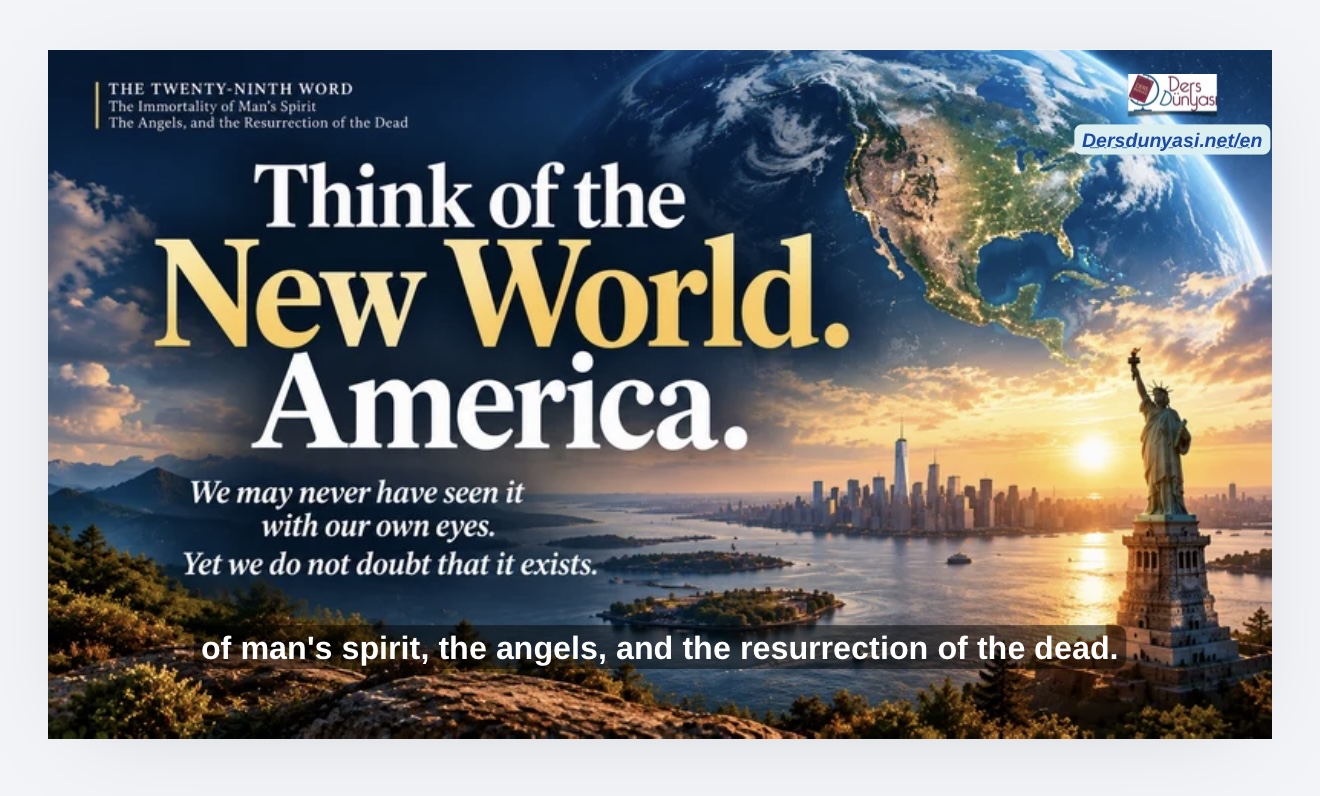
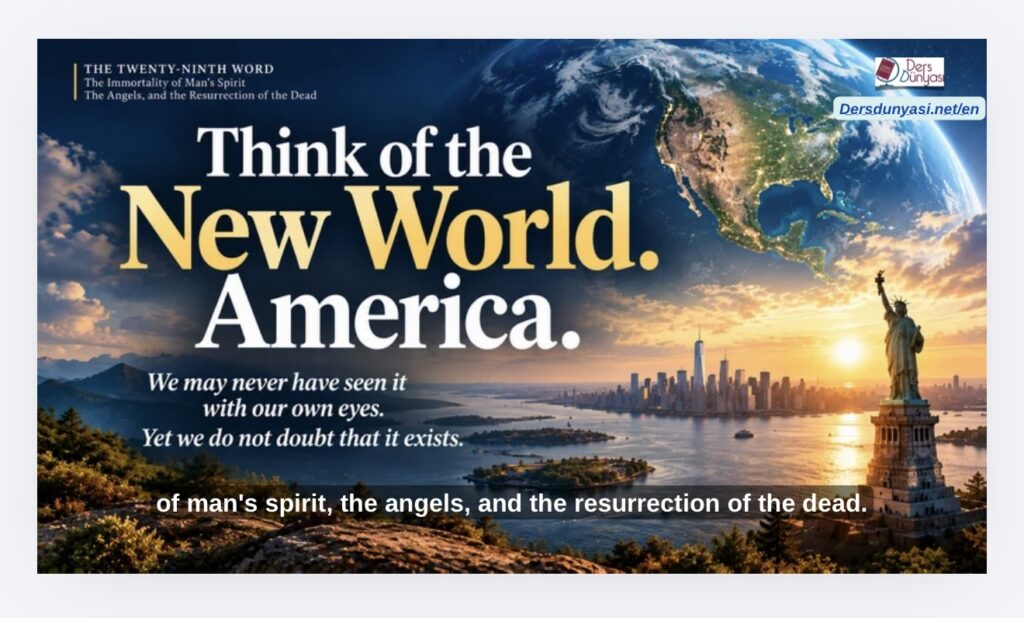
Think of the New World. America. We may never have seen it with our own eyes. Yet we do not doubt that it exists. – 29th WORD – Bediüzzaman Said Nursi

The Eternity of the Human Spirit and Why God Will Not Destroy It

The presented text and video explain the immortality of the human spirit and its existence after death through rational and philosophical arguments.

The author argues that, because the spirit is simple and indivisible in its nature, it cannot be fragmented or destroyed. Therefore, unlike the physical body, the spirit possesses an inherent nature suited to eternity.

Using a logical deductive approach, the text emphasizes that the continued existence of a single spirit points to a universal principle applicable to all humanity, and that the connection between us and the spiritual realms is not severed.

It is also stated that the Creator’s infinite mercy would not abandon the human spirit—the being most in need of the blessing of existence—to non-existence.

As part of the Risale-i Nur Collection, this work presents death not as an end, but as a doorway through which the spirit passes on its way back to its original homeland.

Gemini Notebook


THE TWENTY-NINTH WORD

The Immortality of Man’s Spirit

The Angels, and the Resurrection of the Dead

SECOND AIM

FIRST FUNDAMENTAL POINT

SECOND SOURCE

There is another way to understand this.

It is objective.

It is based on observation.

On experience.

And on events repeated throughout human history.

Consider this.

If even one spirit continues to exist after death…

then the existence of spirits as a whole cannot simply be dismissed.

Why?

Because when a quality belongs to something by its very nature…

that quality is not limited to one individual.

It belongs to the whole category.

If immortality belongs to one human spirit…

then the possibility of immortality belongs to human spirits themselves.

And there is something more.

The evidence is not based on a single observation.

It is not based on one story.

Or one unusual event.

There are countless indications.

Countless experiences.

Countless signs pointing toward the continued existence of the spirit.

So many…

that denying them entirely becomes difficult to justify.

Think of the New World.

America.

We may never have seen it with our own eyes.

Yet we do not doubt that it exists.

And we do not doubt that human beings live there.

Why?

Because the evidence is overwhelming.

In much the same way…

there is reason to believe that the spirits of those who have died…

continue to exist.

They belong to another dimension of existence.

A world beyond what our eyes can see.

A spiritual realm.

And perhaps…

there is still a relationship between that world and ours.

Our immaterial gifts may reach them.

And their luminous influences may reach us.

There is another sign.

One that does not come from the outside.

It comes from within.

Deep within the human conscience…

there is an intuitive certainty.

Something essential in a human being continues after death.

That essential reality…

is the spirit.

The body changes.

The body grows old.

The body eventually returns to the earth.

But the spirit is different.

It is not something that can simply be broken apart.

Or dissolved.

Or decomposed.

Why?

Because the spirit is simple.

It is not a compound structure.

It possesses unity.

And destruction through decomposition belongs to things made of parts.

Things that can be separated.

Things that can be broken down.

But the spirit is not like that.

Life itself gives us a glimpse of this mystery.

Within the countless changes of the body…

there remains a unity.

A continuity.

A sense of permanence.

The body changes.

Yet the person remains.

The years pass.

Yet something remains constant.

That something belongs to the spirit.

Unity belongs to the spirit.

And permanence flows from that unity.

So how could the spirit become mortal?

There would seem to be only two possibilities.

Either the spirit could be destroyed.

Or it could simply cease to exist.

But destruction and dissolution have no proper place in something that possesses such unity and simplicity.

The spirit cannot be decomposed like a physical substance.

And annihilation presents another problem.

For the Creator is described as the Absolutely Generous One.

His mercy is limitless.

His generosity is without end.

Would such boundless generosity…

give the human spirit the gift of existence…

only to take that gift away completely?

The human spirit longs for existence.

It desires permanence.

It reaches toward eternity.

And it possesses a nature suited to that desire.

So the question remains.

Why would the One who gave existence…

take it back through absolute annihilation?

Perhaps the deeper lesson is this.

The human spirit is not merely a temporary visitor in existence.

It carries within itself…

a longing for permanence.

A longing that points beyond the limits of the body.

And beyond the limits of this world.

The body has a beginning.

The body has an end.

But the spirit…

may belong to a different order of existence.

An order where death is not the final word.

And where existence…

does not simply disappear.

It continues.

ChatGPT


Original text 

THE TWENTY-NINTH WORD


The Immortality of Man’s Spirit
The Angels, and the Resurrection of the Dead
…
SECOND AIM
…
FIRST FUNDAMENTAL POINT
…


SECOND SOURCE:

This is objective. That is to say, it is a sort of empirical judgement which has been formed through repeated observations and numerous occurrences of events. Indeed, when it is understood that a single spirit continues to exist after death, this necessitates the continued existence of all spirits as a category of being. For according to the science of logic it is certain that if an intrinsic quality is observed in a single individual, the existence of that quality may be assumed in all individuals. Because it is intrinsic. If it is intrinsic, it will be present in each individual. Whereas the indications based on not one observation but on observations beyond calculation and count and the signs pointing to the immortality of spirits, are so definite that we can in no way doubt their existence. Just as for us there is a place called the New World, that is, America, and we cannot doubt that human beings are found there. In the same way, it is unacceptable to doubt that the spirits of the dead are now present in great numbers in the World of the Inner Dimension of Things and in the Spirit World, and that they have relations with us. Our immaterial gifts go to them and their luminous emanations come to us.
Moreover, one may perceive intuitively and certainly with one’s conscience that a fundamental aspect of man continues after his death. And that fundamental aspect is spirit. As for spirit, it is not subject to destruction and dissolution. This is because it is simple and uncompounded, it has unity. As for destruction, dissolution, and decomposition, they are the function of complex and compound substances. As we explained above, life ensures a form of unity within multiplicity; it causes a sort of permanence. That is to say, unity and permanence are fundamental to spirit, from which they spread to multiplicity.
The mortality of man’s spirit would occur either through destruction and dissolution, whereas unity provides no opportunity for these, and its simple nature disallows decomposition; or it would be through annihilation. But the limitless compassion of the Absolutely Generous One would not permit annihilation, and His boundless munificence would not allow that He should take back from the human spirit the bounty of existence which He has bestowed on it, which it ardently desires and of which it is worthy.

SOURCES


Risale-i Nur Okuma Programı 2.1.0, Words[2021] – 550, email: syesilova72@gmail.com

Bediuzzaman Said Nursi, The Words – The Twenty-Ninth Word – About the Immortality of Man’s Spirit, the Angels, and the Resurrection of the Dead, The English translations of the Risale-i Nur Collection, translated by Şükran Vahide and published by Sözler Neşriyat, are an exact printed version of the original text. (erisale.com)

https://www.erisale.com/en/words/the-twenty-ninth-word-second-aim#4218