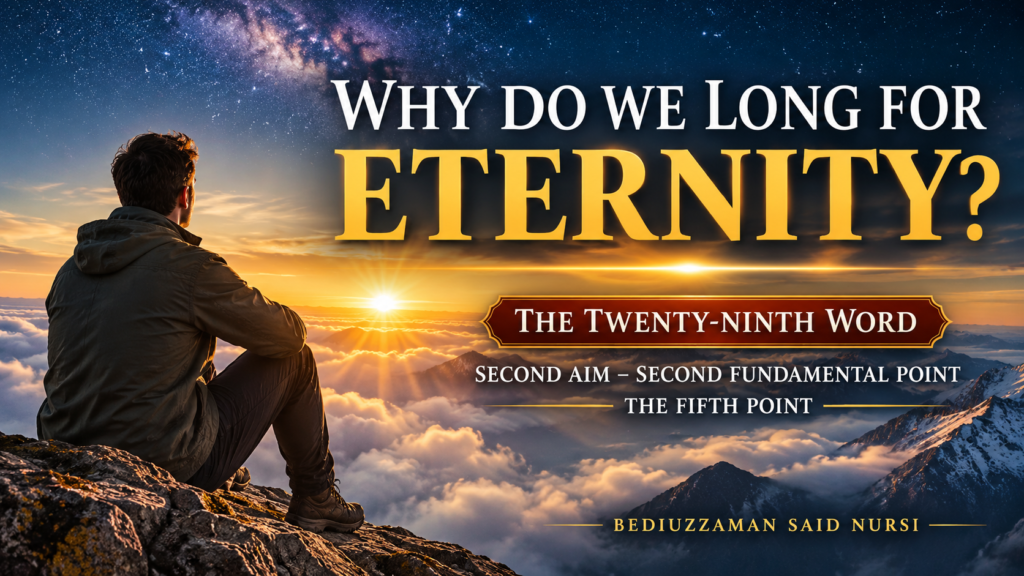
Why Does the Human Spirit Long for Eternity? | The Twenty-Ninth Word – Fifth Point

Why does the human spirit long for something beyond this temporary world?

Why do we desire happiness that never ends? Why do our hopes reach beyond the boundaries of life itself?

In this episode of the Twenty-Ninth Word, Bediuzzaman Said Nursi explores one of the deepest mysteries of human nature: our longing for eternal happiness.

The human spirit possesses unlimited potentialities. From these arise countless abilities, endless desires, infinite hopes, and limitless thoughts.

But could these extraordinary qualities be pointing towards an eternal destination?

Could our deep and unwavering desire for everlasting happiness be a sign that we were created for something beyond this temporary existence?

Nursi invites us to reflect on the nature of the human spirit and the meaning of its longing for eternity.

Perhaps our deepest desires are not without purpose.

Perhaps they are pointing towards our eternal home.

THE TWENTY-NINTH WORD
Second Aim – Second Fundamental Point – Fifth Point

Based on the Risale-i Nur Collection by Bediuzzaman Said Nursi.

SOURCE & FURTHER READING:

The Words – The Twenty-Ninth Word
Translated by Şükran Vahide
Published by Sözler Neşriyat

https://www.erisale.com/en/words/the-twenty-ninth-word-second-aim#4251

Risale-i Nur Reading Program 2.1.0 – Words [2021], p. 554

A QUESTION FOR YOU:

Do you believe that humanity’s deep desire for eternal happiness is a sign of an eternal destiny?

Share your thoughts in the comments.

If this reflection inspired you, please like, subscribe, and share this video.

#EternalHappiness #HumanSpirit #TwentyNinthWord

THE TWENTY-NINTH WORD

SECOND AIM

SECOND FUNDAMENTAL POINT

FIFTH POINT

Have you ever wondered why the human heart longs for something beyond this world?

Why do we dream of a happiness that never fades?

Why do we desire an eternity that life itself cannot offer?

Those who have deeply studied the mysteries of creation have discovered something remarkable.

Within the human spirit lies an extraordinary potential.

A potential without limits.

And within that potential are countless abilities.

From these abilities emerge endless desires.

From these desires arise infinite hopes.

And from these hopes are born limitless thoughts and ideas.

But what does all this mean?

Could these extraordinary qualities be pointing towards something beyond our visible world?

Consider this.

Every one of these desires seems to reach beyond the boundaries of this temporary life.

Every hope appears to look towards a greater reality.

As though the human spirit were stretching out its hands towards eternal happiness.

As though its eyes were constantly searching for a world beyond this one.

A world where happiness does not disappear.

Where beauty does not fade.

And where life is not overshadowed by death.

There is something even more remarkable.

Human nature itself cannot lie.

The longing for eternal happiness is not a passing wish.

It is deep.

It is powerful.

And it is unwavering.

This desire is woven into the very nature of the human spirit.

And such a profound longing cannot be dismissed as meaningless.

It speaks to the human conscience.

It inspires a powerful certainty.

The certainty that eternal happiness is not merely a dream.

It is a reality towards which human nature is directed.

And this is the great truth.

The human spirit does not seem to have been created merely for a temporary world.

Its endless desires point towards an eternal destination.

Its infinite hopes point towards an everlasting happiness.

A happiness that transcends the limits of this visible existence.

This profound reality is explained in the Eleventh Truth of the Tenth Word.

There, the evidence is presented with remarkable clarity.

As clearly as daylight.

And so, we conclude this point here.

But the question remains:

If the human spirit longs for eternity, could that longing itself be a sign of its eternal destiny?

ChatGPT


THE TWENTY-NINTH WORD
…

SECOND AIM
…

SECOND FUNDAMENTAL POINT
…

Fifth Point: Those who have looked closely into the realities of creation consider that the unlimited potentialities included in the essence of man’s spirit, and the unlimited abilities contained in those potentialities, and the endless desires arising from those abilities, and the infinite hopes resulting from those endless desires, and the limitless thoughts and ideas born of those infinite hopes to be hands stretched out towards eternal happiness, which is beyond this Manifest World, and eyes gazing at it; that they are turned towards it. Thus, man’s nature, which cannot lie, and the definite, intense, unwavering desire for eternal happiness in his nature inspire the conscience with certainty concerning the realization of eternal happiness. This fact is demonstrated as clearly as daylight in the Eleventh Truth of the Tenth Word, and so we cut this short here.

SOURCES

Risale-i Nur Okuma Programı 2.1.0, Words[2021] – 554, email: syesilova72@gmail.com

Bediuzzaman Said Nursi, The Words – The Twenty-Ninth Word – About the Immortality of Man’s Spirit, the Angels, and the Resurrection of the Dead, The English translations of the Risale-i Nur Collection, translated by Şükran Vahide and published by Sözler Neşriyat, are an exact printed version of the original text. (erisale.com)

https://www.erisale.com/en/words/the-twenty-ninth-word-second-aim#4251
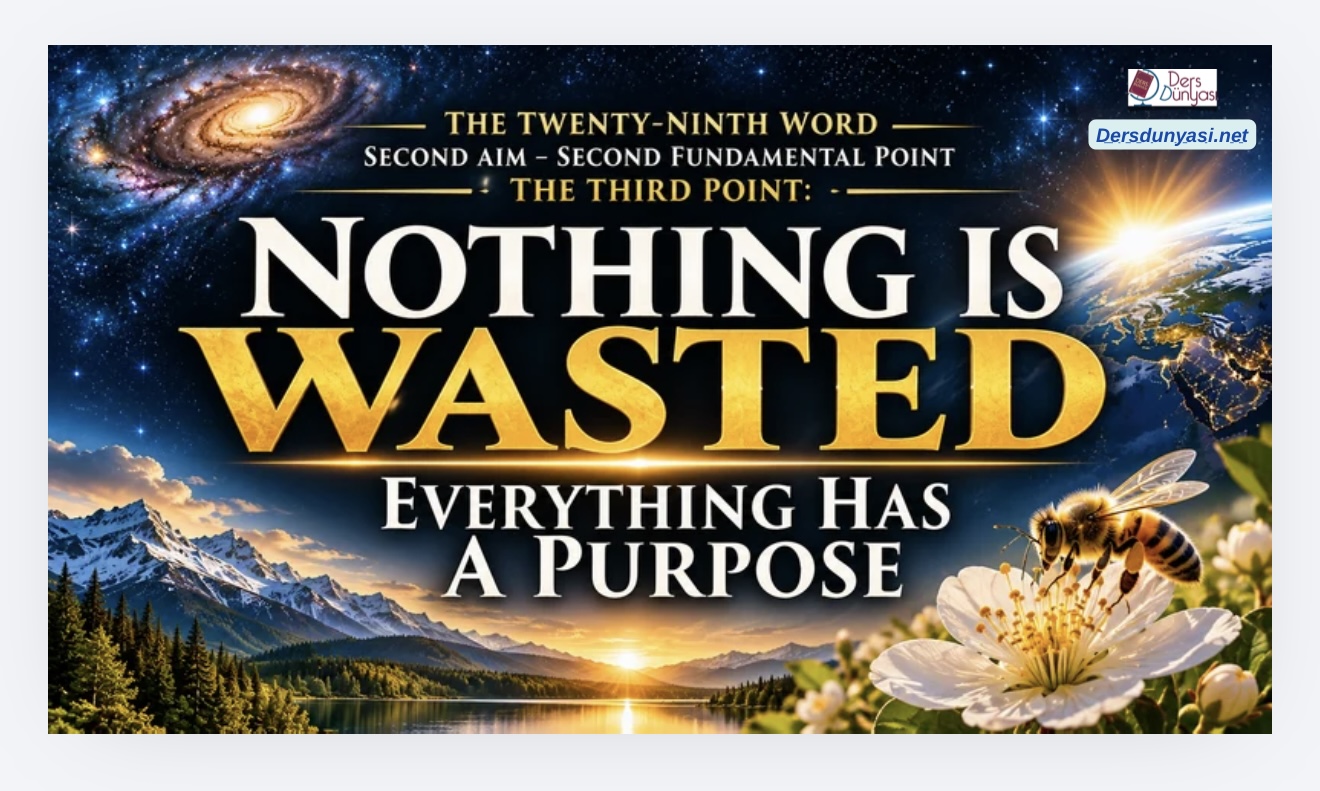

Nothing Is Wasted: Does Everything Have a Purpose? | The 29th Word

NOTHING IS WASTED: DOES EVERYTHING HAVE A PURPOSE?

The Twenty-Ninth Word – Third Point

What if nothing in the universe is truly wasted?

From the smallest living creature to the vastness of distant galaxies, creation reveals an extraordinary order. Everything has a purpose. Everything serves a function.

But what about humanity?

Why do we possess limitless hopes, endless desires, and a deep longing for perfection? Could these remarkable qualities have been created for nothing?

In this episode, we explore the Third Point of the Second Fundamental Point in the Second Aim of Bediuzzaman Said Nursi’s The Twenty-Ninth Word.

Through the testimony of reason, wisdom, science, and observation, we examine a profound argument:

If nothing in creation is without purpose, how could the eternal hopes of the human heart be left without fulfilment?

The order of the universe points beyond this temporary life. It directs our thoughts towards resurrection, eternal life, and everlasting happiness.

Nothing is created in vain. And the deepest hopes of humanity are not without purpose.

IN THIS VIDEO

  • The wisdom and purpose behind creation
  • Why nothing in the universe is wasted
  • The extraordinary potential of the human being
  • Humanity’s longing for perfection and happiness
  • The relationship between creation and resurrection
  • The promise of eternal happiness

ABOUT THE AUTHOR

Bediuzzaman Said Nursi (1877–1960) was a prominent Islamic scholar and the author of the Risale-i Nur Collection. His works explore faith, reason, the universe, human existence, and the hereafter.

SOURCE

Bediuzzaman Said Nursi – The Words
The Twenty-Ninth Word – Second Aim, Second Fundamental Point, Third Point.

English translation by Şükran Vahide, published by Sözler Neşriyat.

Original text:
https://www.erisale.com/en/words/the-twenty-ninth-word-second-aim#4240

Risale-i Nur Reading Programme 2.1.0
Words [2021] – 553

EXPLORE MORE

Discover more episodes on the Risale-i Nur Collection, faith, the meaning of existence, and the mysteries of the universe.

Subscribe to DERSDÜNYASIEnglish for more reflections on faith, reason, and eternal life.

If nothing in creation is wasted, could the deepest hopes of humanity be without an eternal purpose?

Share your thoughts in the comments.

#BediuzzamanSaidNursi #RisaleiNur #EternalHappiness

THE TWENTY-NINTH WORD

SECOND AIM – SECOND FUNDAMENTAL POINT

THE THIRD POINT: NOTHING IN CREATION IS WASTED

Look closely at the universe.

Observe the smallest details of creation.

Nothing is without purpose.

Nothing is created in vain.

Reason tells us this.

Wisdom confirms it.

Science reveals it.

And experience shows it to be true.

Throughout the universe, we see an extraordinary principle.

Nothing is wasted.

Nothing is left without a purpose.

The Creator chooses the shortest paths.

The closest ways.

The lightest forms.

And the most perfect designs.

Consider this remarkable truth.

A single thing may perform a hundred different duties.

And a seemingly insignificant creature may carry within it a thousand benefits.

A tiny being can serve countless purposes.

A simple creation can produce extraordinary results.

This is not coincidence.

It is the manifestation of divine wisdom.

It is evidence of perfect design.

And here, we encounter a profound question.

If everything in creation has a purpose…

If nothing is created in vain…

Then how could humanity be an exception?

How could the deepest hopes of the human heart simply disappear?

How could all our aspirations end in nothing?

If there were no resurrection…

If there were no return to life…

Then everything would ultimately become meaningless.

All those countless purposes would be left unfinished.

All those extraordinary possibilities would be wasted.

And this would contradict the wisdom we observe throughout creation.

Science has already shown us something remarkable.

Even the smallest details of the human body serve specific purposes.

Nothing is accidental.

Nothing is without function.

So what about the human spirit?

What about the limitless potential within us?

What about our endless hopes?

Our thoughts.

Our dreams.

Our desires.

Could all these extraordinary faculties have been created for nothing?

Could the human heart, with its infinite longing, have no final destination?

Certainly not.

For the human being carries within himself a profound desire for perfection.

He seeks what is greater.

He longs for what is eternal.

And above all…

He desires true happiness.

But think about it.

Why would such a deep-rooted desire exist…

If there were no ultimate happiness to fulfil it?

Why would humanity be given an endless longing…

If there were no eternal destination?

The desire for perfection points towards perfection itself.

And the longing for happiness points towards a happiness beyond the limits of this world.

A happiness that does not fade.

A happiness that does not end.

Eternal happiness.

Otherwise, something extraordinary would happen.

Unlike every other creature in the universe…

Humanity’s highest faculties would be left without purpose.

Our deepest hopes would be wasted.

Our spiritual abilities would wither away.

And our greatest desires would remain forever unfulfilled.

Could this be consistent with the perfect wisdom displayed throughout creation?

No.

The wisdom that governs the universe cannot be separated from the destiny of humanity.

The One who creates with such purpose…

Does not create our deepest aspirations in vain.

And so, the very order of the universe points beyond this temporary world.

It points towards resurrection.

It points towards eternal life.

And ultimately…

It points towards eternal happiness.

This truth has already been established in the Eleventh Truth of the Tenth Word.

Therefore, we shall not prolong the discussion here.

But one conclusion remains clear:

In a universe where nothing is created in vain, the eternal hopes of humanity cannot be without an eternal fulfilment.

For creation has a purpose.

And so does human existence.

The story does not end here.

ChatGPT


THE TWENTY-NINTH WORD
…

SECOND AIM
…

SECOND FUNDAMENTAL POINT
…

Third Point: Through the testimony of reason, wisdom, induction, and experience, the absence of futility and absence of waste in the creation of beings, which is constant, indicate eternal happiness. The sign of there being no waste and nothing vain in creation is the All-Glorious Maker’s choosing and preferring the shortest way, the closest point, the lightest form, and the best manner in the creation of everything, and His sometimes imposing a hundred duties on one thing, and His attaching a thousand fruits and aims to a slight being. Since there is no waste and nothing in vain, there will surely be eternal happiness. For non-existence and no return would make everything futile; everything would be a waste. The absence of waste in all creation, and in man for instance, which is established by science, demonstrates that man’s limitless disposition, and infinite hopes, ideas, and desires will not be wasted either. In which case, man’s deep-rooted desire to be perfected points to the existence of a perfection, and his desire for happiness proclaims that he is definitely destined for eternal happiness. If it were not so, contrary to other beings, which are all made wisely and purposefully, those authentic immaterial faculties, those elevated hopes, would go to waste and be futile; they would wither up and go for nothing. Since this truth is proved in the Eleventh Truth of the Tenth Word, we cut the discussion short here.

SOURCES

Risale-i Nur Okuma Programı 2.1.0, Words[2021] – 553, email: syesilova72@gmail.com

Bediuzzaman Said Nursi, The Words – The Twenty-Ninth Word – About the Immortality of Man’s Spirit, the Angels, and the Resurrection of the Dead, The English translations of the Risale-i Nur Collection, translated by Şükran Vahide and published by Sözler Neşriyat, are an exact printed version of the original text. (erisale.com)

https://www.erisale.com/en/words/the-twenty-ninth-word-second-aim#4240


Think of the New World. America. We may never have seen it with our own eyes. Yet we do not doubt that it exists. – 29th WORD – Bediüzzaman Said Nursi

The Eternity of the Human Spirit and Why God Will Not Destroy It

The presented text and video explain the immortality of the human spirit and its existence after death through rational and philosophical arguments.

The author argues that, because the spirit is simple and indivisible in its nature, it cannot be fragmented or destroyed. Therefore, unlike the physical body, the spirit possesses an inherent nature suited to eternity.

Using a logical deductive approach, the text emphasizes that the continued existence of a single spirit points to a universal principle applicable to all humanity, and that the connection between us and the spiritual realms is not severed.

It is also stated that the Creator’s infinite mercy would not abandon the human spirit—the being most in need of the blessing of existence—to non-existence.

As part of the Risale-i Nur Collection, this work presents death not as an end, but as a doorway through which the spirit passes on its way back to its original homeland.

Gemini Notebook


THE TWENTY-NINTH WORD

The Immortality of Man’s Spirit

The Angels, and the Resurrection of the Dead

SECOND AIM

FIRST FUNDAMENTAL POINT

SECOND SOURCE

There is another way to understand this.

It is objective.

It is based on observation.

On experience.

And on events repeated throughout human history.

Consider this.

If even one spirit continues to exist after death…

then the existence of spirits as a whole cannot simply be dismissed.

Why?

Because when a quality belongs to something by its very nature…

that quality is not limited to one individual.

It belongs to the whole category.

If immortality belongs to one human spirit…

then the possibility of immortality belongs to human spirits themselves.

And there is something more.

The evidence is not based on a single observation.

It is not based on one story.

Or one unusual event.

There are countless indications.

Countless experiences.

Countless signs pointing toward the continued existence of the spirit.

So many…

that denying them entirely becomes difficult to justify.

Think of the New World.

America.

We may never have seen it with our own eyes.

Yet we do not doubt that it exists.

And we do not doubt that human beings live there.

Why?

Because the evidence is overwhelming.

In much the same way…

there is reason to believe that the spirits of those who have died…

continue to exist.

They belong to another dimension of existence.

A world beyond what our eyes can see.

A spiritual realm.

And perhaps…

there is still a relationship between that world and ours.

Our immaterial gifts may reach them.

And their luminous influences may reach us.

There is another sign.

One that does not come from the outside.

It comes from within.

Deep within the human conscience…

there is an intuitive certainty.

Something essential in a human being continues after death.

That essential reality…

is the spirit.

The body changes.

The body grows old.

The body eventually returns to the earth.

But the spirit is different.

It is not something that can simply be broken apart.

Or dissolved.

Or decomposed.

Why?

Because the spirit is simple.

It is not a compound structure.

It possesses unity.

And destruction through decomposition belongs to things made of parts.

Things that can be separated.

Things that can be broken down.

But the spirit is not like that.

Life itself gives us a glimpse of this mystery.

Within the countless changes of the body…

there remains a unity.

A continuity.

A sense of permanence.

The body changes.

Yet the person remains.

The years pass.

Yet something remains constant.

That something belongs to the spirit.

Unity belongs to the spirit.

And permanence flows from that unity.

So how could the spirit become mortal?

There would seem to be only two possibilities.

Either the spirit could be destroyed.

Or it could simply cease to exist.

But destruction and dissolution have no proper place in something that possesses such unity and simplicity.

The spirit cannot be decomposed like a physical substance.

And annihilation presents another problem.

For the Creator is described as the Absolutely Generous One.

His mercy is limitless.

His generosity is without end.

Would such boundless generosity…

give the human spirit the gift of existence…

only to take that gift away completely?

The human spirit longs for existence.

It desires permanence.

It reaches toward eternity.

And it possesses a nature suited to that desire.

So the question remains.

Why would the One who gave existence…

take it back through absolute annihilation?

Perhaps the deeper lesson is this.

The human spirit is not merely a temporary visitor in existence.

It carries within itself…

a longing for permanence.

A longing that points beyond the limits of the body.

And beyond the limits of this world.

The body has a beginning.

The body has an end.

But the spirit…

may belong to a different order of existence.

An order where death is not the final word.

And where existence…

does not simply disappear.

It continues.

ChatGPT


Original text 

THE TWENTY-NINTH WORD


The Immortality of Man’s Spirit
The Angels, and the Resurrection of the Dead
…
SECOND AIM
…
FIRST FUNDAMENTAL POINT
…


SECOND SOURCE:

This is objective. That is to say, it is a sort of empirical judgement which has been formed through repeated observations and numerous occurrences of events. Indeed, when it is understood that a single spirit continues to exist after death, this necessitates the continued existence of all spirits as a category of being. For according to the science of logic it is certain that if an intrinsic quality is observed in a single individual, the existence of that quality may be assumed in all individuals. Because it is intrinsic. If it is intrinsic, it will be present in each individual. Whereas the indications based on not one observation but on observations beyond calculation and count and the signs pointing to the immortality of spirits, are so definite that we can in no way doubt their existence. Just as for us there is a place called the New World, that is, America, and we cannot doubt that human beings are found there. In the same way, it is unacceptable to doubt that the spirits of the dead are now present in great numbers in the World of the Inner Dimension of Things and in the Spirit World, and that they have relations with us. Our immaterial gifts go to them and their luminous emanations come to us.
Moreover, one may perceive intuitively and certainly with one’s conscience that a fundamental aspect of man continues after his death. And that fundamental aspect is spirit. As for spirit, it is not subject to destruction and dissolution. This is because it is simple and uncompounded, it has unity. As for destruction, dissolution, and decomposition, they are the function of complex and compound substances. As we explained above, life ensures a form of unity within multiplicity; it causes a sort of permanence. That is to say, unity and permanence are fundamental to spirit, from which they spread to multiplicity.
The mortality of man’s spirit would occur either through destruction and dissolution, whereas unity provides no opportunity for these, and its simple nature disallows decomposition; or it would be through annihilation. But the limitless compassion of the Absolutely Generous One would not permit annihilation, and His boundless munificence would not allow that He should take back from the human spirit the bounty of existence which He has bestowed on it, which it ardently desires and of which it is worthy.

SOURCES


Risale-i Nur Okuma Programı 2.1.0, Words[2021] – 550, email: syesilova72@gmail.com

Bediuzzaman Said Nursi, The Words – The Twenty-Ninth Word – About the Immortality of Man’s Spirit, the Angels, and the Resurrection of the Dead, The English translations of the Risale-i Nur Collection, translated by Şükran Vahide and published by Sözler Neşriyat, are an exact printed version of the original text. (erisale.com)

https://www.erisale.com/en/words/the-twenty-ninth-word-second-aim#4218