This text and video are based on an excerpt from The Twenty-Ninth Word in the Risale-i Nur Collection and explore the immortality (eternity) of the human spirit and its relationship with the World of Divine Command (Ālam al-Amr).
The main ideas and key points of the text are as follows:
The Nature and Origin of the Spirit: As expressed in Verse 85 of Surah Al-Isra (“Say: The spirit is of the command of my Lord”), the spirit originates from the World of Divine Command and the Divine Will. It is a living and conscious law to which Eternal Power has bestowed an external, tangible existence.
A Comparison with the Laws of Nature: The laws governing nature, which seemingly possess no independent external existence, also originate from the World of Divine Command. For example, when a fig tree dies, the law governing its formation remains preserved in its seed. These unconscious laws endure without corruption or alteration, even when the physical structures they govern disintegrate.
The Spirit’s Attainment of Eternity: If even the weakest and unconscious laws of Divine Command can preserve their existence and continuity, then it is all the more certain and necessary that the human spirit—which is stronger, more exalted, living, and conscious—should attain eternity.
THE TWENTY-NINTH WORD
SECOND AIM
FIRST FUNDAMENTAL POINT
FOURTH SOURCE
Look closely at the laws that govern life.
They are everywhere.
Silent. Constant. And remarkably enduring.
They shape the living world. They guide the development of countless forms. And they preserve the essential patterns of creation.
In a certain sense, these laws resemble the human spirit.
They originate from the World of Divine Command and Will.
Their nature is suited to the spirit. Yet they lack one thing.
A visible, external existence.
Imagine, for a moment, that these laws were given such an existence.
What would happen?
Each law would become, in effect, the spirit of a species.
And here we discover something remarkable.
These laws endure.
They remain constant. They preserve their unity. They are not destroyed by change or transformation.
Consider a fig tree.
One day, the tree may wither. Its branches may fall. Its physical form may disappear.
Yet something remains.
The law of its formation continues within its tiny seeds.
The tree itself may be gone.
But the principle that shapes it lives on.
It has not perished.
Now consider what this means.
Even simple and seemingly insignificant laws can possess such continuity.
Even laws without consciousness can endure beyond the forms they govern.
Then what of the human spirit?
Could it be destined for something less?
Something that merely continues?
Or does its nature point toward a far greater reality?
The Qur’an offers a profound insight.
It declares:
“Say: The Spirit is of the command of my Sustainer.”
Qur’an, 17:85.
The spirit, then, is not merely a product of physical matter.
It belongs to a different order of existence.
It is a living and conscious law.
It comes from the World of Divine Command.
And through the power of the Eternal Creator, it has been given an external existence.
Here, the argument takes a deeper turn.
If unconscious laws, proceeding from Divine Will, can endure through change…
Then surely the human spirit has an even stronger claim to permanence.
For it shares their origin.
It emerges from the same World of Command.
And it is connected to the same Divine Will.
But the spirit possesses qualities that these laws do not.
It has a real, external existence.
It is conscious.
And it is alive.
Think about that for a moment.
A law may preserve a pattern.
But the human spirit possesses awareness.
A law may continue without knowing that it exists.
But the spirit experiences life.
It knows. It perceives. It reflects.
And this gives the human spirit a special place among the realities of creation.
If even unconscious laws can endure…
Then the conscious human spirit has an even greater reason to be connected with permanence.
Not merely survival.
Not merely continuation.
But a destiny that reaches beyond the limits of this world.
And perhaps this is the essential point.
The human spirit is not simply something that exists for a moment and then disappears.
Its origin points beyond the temporary.
Its nature suggests continuity.
And its consciousness opens the door to a deeper understanding of eternity.
For if the Creator has given the spirit existence…
And if the Creator wills its permanence…
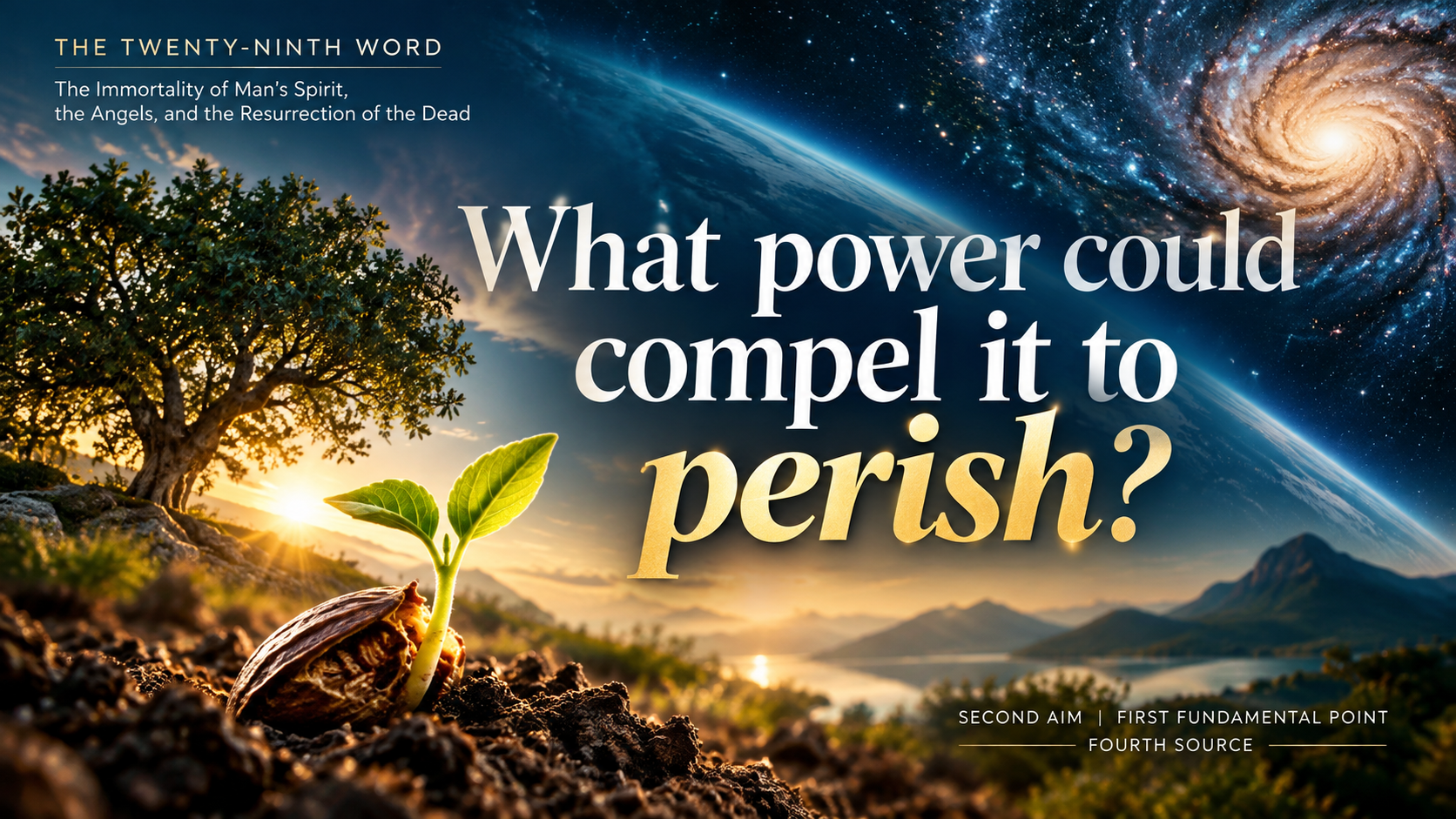
Then what power could compel it to perish?
The question is no longer simply whether the human spirit can endure.
The deeper question is this:
Why should a spirit, created with such a nature, be destined for extinction?
Perhaps the signs of eternity are already written into the very nature of our existence.
We need only learn how to see them.
ChatGPT
THE TWENTY-NINTH WORD …
SECOND AIM …
FIRST FUNDAMENTAL POINT …
FOURTH SOURCE:
Consider the laws that govern in species, for they resemble the spirit to a degree: since they issue from the World of the Divine Command and Will, by virtue of their source, they are to some extent appropriate for the spirit and only lack a perceptible existence. Study them and it will be seen that if those commanding laws were clothed in external existence, each of them would become the spirit of a species. Moreover, the laws are always permanent; they are perpetual and constant. No change or transformation affects their unity, or spoils them. For example, should a fig tree die and be dispersed, the law of its formation, which is like its spirit, will persist in its tiny seeds; it will not die. Therefore, since even commonplace and weak commanding laws are thus connected to permanence and continuance, the human spirit must be connected not only with permanence and immortality, but with all eternity. For according to the Qur’an’s glorious decree of: Say: The Spirit (comes) by command of my Sustainer, (17:85) spirit too is a conscious and living law which proceeds from the World of the Divine Command and which pre-eternal power has clothed with external existence. That is to say, just as the unconscious laws which proceed from the divine attribute of will and the World of the Divine Command are always, or mostly, enduring, so it is even more definite that the spirit, which is a sort of brother to them, and like them is a manifestation of the attribute of will and comes from the World of the Command, manifests immortality. It is also more worthy of it, because it is existent, it has an external reality. And it is more potent, more elevated, because it possesses consciousness. It is also more enduring than them, and more valuable, because it is living.
SOURCES Risale-i Nur Okuma Programı 2.1.0, Words[2021] – 551, email: syesilova72@gmail.com
Bediuzzaman Said Nursi, The Words – The Twenty-Ninth Word – About the Immortality of Man’s Spirit, the Angels, and the Resurrection of the Dead, The English translations of the Risale-i Nur Collection, translated by Şükran Vahide and published by Sözler Neşriyat, are an exact printed version of the original text. (erisale.com)
This video and text are based on a fundamental passage from Bediuzzaman Said Nursi’s The Twenty-Ninth Word, specifically the section Second Aim / First Fundamental Point / Third Source, which presents a foundational argument for the nature and immortality of the human spirit (baqā’ al-rūḥ).
The main ideas and conceptual framework can be summarized as follows:
The Definition of the Spirit (Kānūn-u Amrī): The spirit is described as a living, conscious, luminous “law of command” (kānūn-u amrī) that has been clothed with external existence (wujūd-u khārijī), and which possesses a comprehensive nature with the capacity to attain universality. While physical laws of nature, such as gravity, are based on abstract principles, the spirit is presented as a living and conscious embodiment of these divine laws.
A Constant Reality Amid Change: Although matter and living species undergo continuous change and transformation, there remains a constant reality at the essence of each species. Individuals are born and die, yet the law governing that species continues to exist.
The Human Being as a Species in Itself: Through the breadth of his nature, universal consciousness, and capacity for comprehensive conception, the individual human being, despite being only one person, has in a sense attained the rank of an entire species (nev’ in itself). Therefore, the law of continuity and permanence that applies to an entire species also applies directly to the human spirit.
Baqā’ al-Rūḥ — The Immortality of the Spirit: Even if the human spirit were to undergo hundreds of thousands of changes in state and form, or even if the body were to die, the spirit continues to exist through God’s command, permission, and preservation (ibqā’). It continues onward toward eternity, just as it came into this world.
Source: Gemini Notebook
THE TWENTY-NINTH WORD
SECOND AIM
FIRST FUNDAMENTAL POINT
THIRD SOURCE
There is another way to understand the immortality of the human spirit.
Look closely at life.
Everything changes.
Forms appear.
They develop.
They transform.
And eventually, they disappear.
Yet something remains.
Something constant.
Something that does not perish with the changing form.
This is true throughout the living world.
Behind the changing forms of life, there are laws that remain.
They continue to operate.
They remain stable.
They do not disappear with every transformation.
Even the weakest law of nature shows a certain permanence.
And this gives us a significant clue.
The human being is not merely an individual.
In a remarkable sense, he is like a whole species within himself.
Why?
Because human nature is comprehensive.
Human consciousness is universal.
And the human imagination can embrace countless things.
A person can think about the past.
He can imagine the future.
He can understand distant worlds.
He can reflect upon existence itself.
His inner world is vast.
For this reason, the laws that operate within a species can also be seen within the individual human being.
Now consider the human spirit.
The spirit is the conscious element of the human being.
It is the living essence within him.
The body changes.
It grows.
It weakens.
It renews itself.
And throughout a lifetime, its physical form can change again and again.
Yet we still say:
“I am the same person.”
Something remains.
Something preserves our identity.
Something continues through all these changes.
That something is the spirit.
The Creator has given the human being a comprehensive nature.
He has made humanity a mirror capable of reflecting the signs of the universe.
He has given the human being a capacity for universal worship.
And He has given the spirit a nature suited to permanence.
So even if the outer form of a person changes hundreds of thousands of times, the spirit does not necessarily perish with it.
With the permission of its Sustainer, it continues.
It remains.
And when its time in this world is complete, it departs.
Just as it came.
Therefore, the human spirit is not like the temporary form of the body.
The body changes.
The spirit remains.
The body belongs to the world of transformation.
The spirit belongs to a deeper reality.
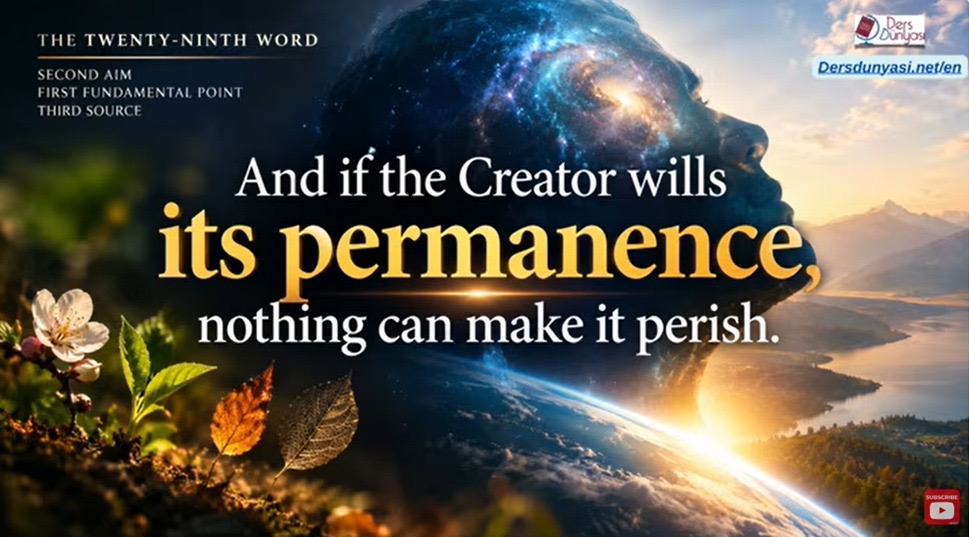
And if the Creator wills its permanence, nothing can make it perish.
The human spirit is conscious.
It is alive.
It is the essential living element of the human being.
And by God’s command, and through His permission, it is immortal.
This is the third source.
A reflection drawn from the permanence found behind the changing forms of life.
And it points to a profound truth:
The body changes.
The spirit continues.
And the human being does not end with the disappearance of his outward form.
ChatGPT
Original text
THE TWENTY-NINTH WORD
The Immortality of Man’s Spirit The Angels, and the Resurrection of the Dead … SECOND AIM … FIRST FUNDAMENTAL POINT …
THIRD SOURCE:
The human spirit, which has been clothed in a living, conscious, luminous external existence, is a comprehensive and veracious commanding law disposed to acquiring universality. Even the weakest commanding laws manifest stability and permanence. For if considered carefully, it will be seen that present in all species which are subject to change, is a constant truth that, revolving within the changes, transformations, and stages of life, causes the outer forms of things to change, and yet living and not dying, is permanent. Thus, while the human being is an individual, he resembles a species owing to the comprehensiveness of his nature, his universal consciousness, and all-embracing imagination. A law that governs and is in force in the species is also in force in the human individual. Since the All-Glorious Creator has created man as a comprehensive mirror, for universal worship, and with an exalted nature, even if the spirit-truth which is present in each individual causes the individual’s outer form to change hundreds of thousands of times, with the Sustainer’s permission it will not die but will continue, departing as it came. In which case, at God’s command and with His permission and through His making it permanent, the human individual’s spirit, which is the conscious element and living part of him, is immortal.
Bediuzzaman Said Nursi, The Words – The Twenty-Ninth Word – About the Immortality of Man’s Spirit, the Angels, and the Resurrection of the Dead, The English translations of the Risale-i Nur Collection, translated by Şükran Vahide and published by Sözler Neşriyat, are an exact printed version of the original text. (erisale.com)
The Eternity of the Human Spirit and Why God Will Not Destroy It
The presented text and video explain the immortality of the human spirit and its existence after death through rational and philosophical arguments.
The author argues that, because the spirit is simple and indivisible in its nature, it cannot be fragmented or destroyed. Therefore, unlike the physical body, the spirit possesses an inherent nature suited to eternity.
Using a logical deductive approach, the text emphasizes that the continued existence of a single spirit points to a universal principle applicable to all humanity, and that the connection between us and the spiritual realms is not severed.
It is also stated that the Creator’s infinite mercy would not abandon the human spirit—the being most in need of the blessing of existence—to non-existence.
As part of the Risale-i Nur Collection, this work presents death not as an end, but as a doorway through which the spirit passes on its way back to its original homeland.
Gemini Notebook
THE TWENTY-NINTH WORD
The Immortality of Man’s Spirit
The Angels, and the Resurrection of the Dead
SECOND AIM
FIRST FUNDAMENTAL POINT
SECOND SOURCE
There is another way to understand this.
It is objective.
It is based on observation.
On experience.
And on events repeated throughout human history.
Consider this.
If even one spirit continues to exist after death…
then the existence of spirits as a whole cannot simply be dismissed.
Why?
Because when a quality belongs to something by its very nature…
that quality is not limited to one individual.
It belongs to the whole category.
If immortality belongs to one human spirit…
then the possibility of immortality belongs to human spirits themselves.
And there is something more.
The evidence is not based on a single observation.
It is not based on one story.
Or one unusual event.
There are countless indications.
Countless experiences.
Countless signs pointing toward the continued existence of the spirit.
So many…
that denying them entirely becomes difficult to justify.
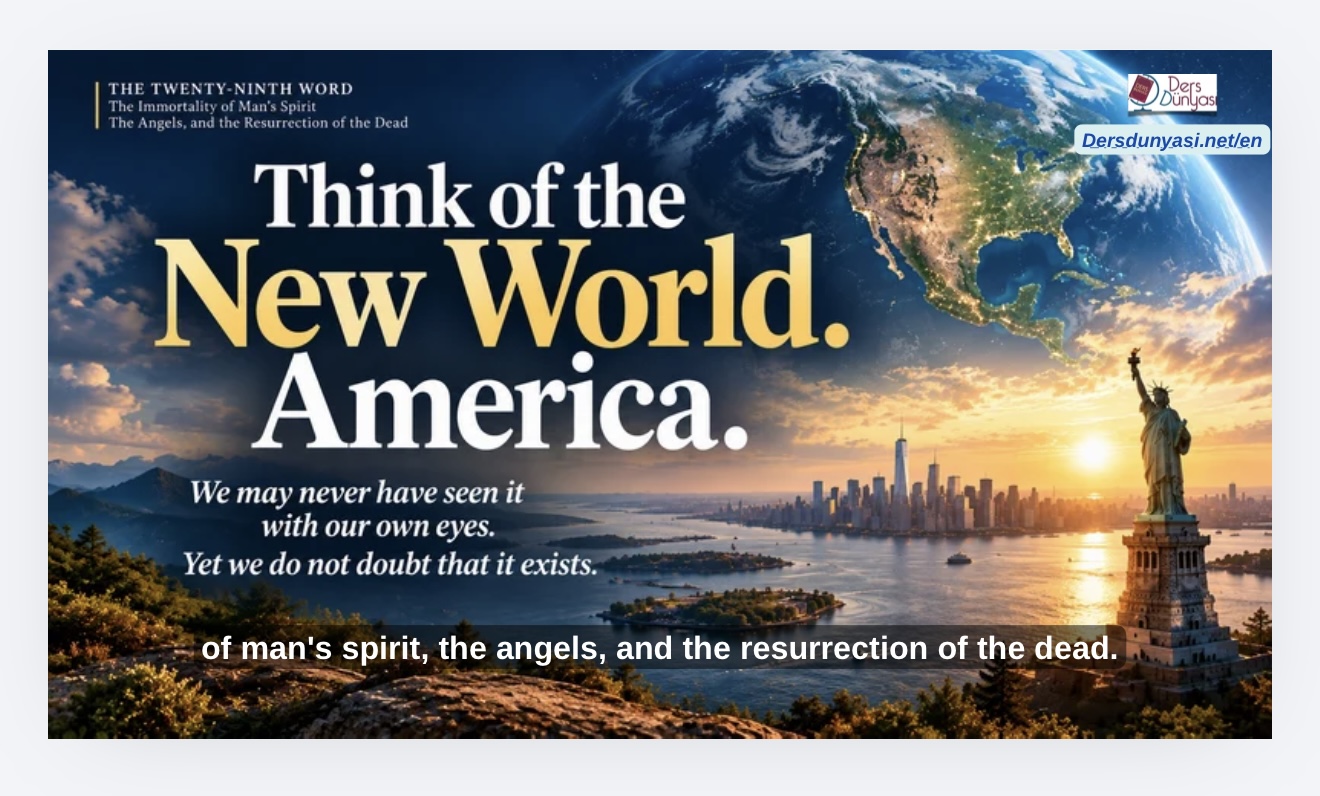
Think of the New World.
America.
We may never have seen it with our own eyes.
Yet we do not doubt that it exists.
And we do not doubt that human beings live there.
Why?
Because the evidence is overwhelming.
In much the same way…
there is reason to believe that the spirits of those who have died…
continue to exist.
They belong to another dimension of existence.
A world beyond what our eyes can see.
A spiritual realm.
And perhaps…
there is still a relationship between that world and ours.
Our immaterial gifts may reach them.
And their luminous influences may reach us.
There is another sign.
One that does not come from the outside.
It comes from within.
Deep within the human conscience…
there is an intuitive certainty.
Something essential in a human being continues after death.
That essential reality…
is the spirit.
The body changes.
The body grows old.
The body eventually returns to the earth.
But the spirit is different.
It is not something that can simply be broken apart.
Or dissolved.
Or decomposed.
Why?
Because the spirit is simple.
It is not a compound structure.
It possesses unity.
And destruction through decomposition belongs to things made of parts.
Things that can be separated.
Things that can be broken down.
But the spirit is not like that.
Life itself gives us a glimpse of this mystery.
Within the countless changes of the body…
there remains a unity.
A continuity.
A sense of permanence.
The body changes.
Yet the person remains.
The years pass.
Yet something remains constant.
That something belongs to the spirit.
Unity belongs to the spirit.
And permanence flows from that unity.
So how could the spirit become mortal?
There would seem to be only two possibilities.
Either the spirit could be destroyed.
Or it could simply cease to exist.
But destruction and dissolution have no proper place in something that possesses such unity and simplicity.
The spirit cannot be decomposed like a physical substance.
And annihilation presents another problem.
For the Creator is described as the Absolutely Generous One.
His mercy is limitless.
His generosity is without end.
Would such boundless generosity…
give the human spirit the gift of existence…
only to take that gift away completely?
The human spirit longs for existence.
It desires permanence.
It reaches toward eternity.
And it possesses a nature suited to that desire.
So the question remains.
Why would the One who gave existence…
take it back through absolute annihilation?
Perhaps the deeper lesson is this.
The human spirit is not merely a temporary visitor in existence.
It carries within itself…
a longing for permanence.
A longing that points beyond the limits of the body.
And beyond the limits of this world.
The body has a beginning.
The body has an end.
But the spirit…
may belong to a different order of existence.
An order where death is not the final word.
And where existence…
does not simply disappear.
It continues.
ChatGPT
Original text
THE TWENTY-NINTH WORD
The Immortality of Man’s Spirit The Angels, and the Resurrection of the Dead … SECOND AIM … FIRST FUNDAMENTAL POINT …
SECOND SOURCE:
This is objective. That is to say, it is a sort of empirical judgement which has been formed through repeated observations and numerous occurrences of events. Indeed, when it is understood that a single spirit continues to exist after death, this necessitates the continued existence of all spirits as a category of being. For according to the science of logic it is certain that if an intrinsic quality is observed in a single individual, the existence of that quality may be assumed in all individuals. Because it is intrinsic. If it is intrinsic, it will be present in each individual. Whereas the indications based on not one observation but on observations beyond calculation and count and the signs pointing to the immortality of spirits, are so definite that we can in no way doubt their existence. Just as for us there is a place called the New World, that is, America, and we cannot doubt that human beings are found there. In the same way, it is unacceptable to doubt that the spirits of the dead are now present in great numbers in the World of the Inner Dimension of Things and in the Spirit World, and that they have relations with us. Our immaterial gifts go to them and their luminous emanations come to us. Moreover, one may perceive intuitively and certainly with one’s conscience that a fundamental aspect of man continues after his death. And that fundamental aspect is spirit. As for spirit, it is not subject to destruction and dissolution. This is because it is simple and uncompounded, it has unity. As for destruction, dissolution, and decomposition, they are the function of complex and compound substances. As we explained above, life ensures a form of unity within multiplicity; it causes a sort of permanence. That is to say, unity and permanence are fundamental to spirit, from which they spread to multiplicity. The mortality of man’s spirit would occur either through destruction and dissolution, whereas unity provides no opportunity for these, and its simple nature disallows decomposition; or it would be through annihilation. But the limitless compassion of the Absolutely Generous One would not permit annihilation, and His boundless munificence would not allow that He should take back from the human spirit the bounty of existence which He has bestowed on it, which it ardently desires and of which it is worthy.
Bediuzzaman Said Nursi, The Words – The Twenty-Ninth Word – About the Immortality of Man’s Spirit, the Angels, and the Resurrection of the Dead, The English translations of the Risale-i Nur Collection, translated by Şükran Vahide and published by Sözler Neşriyat, are an exact printed version of the original text. (erisale.com)
Exploring the Harmony of Science, Philosophy and Faith Through the Risale-i Nur
What if life is not a product of matter, but the very reality that gives matter meaning? Inspired by The Twenty-Ninth Word of Bediuzzaman Said Nursi, this article explores the relationship between life, spirit, consciousness, and the existence of angels through reason, observation, and revelation.
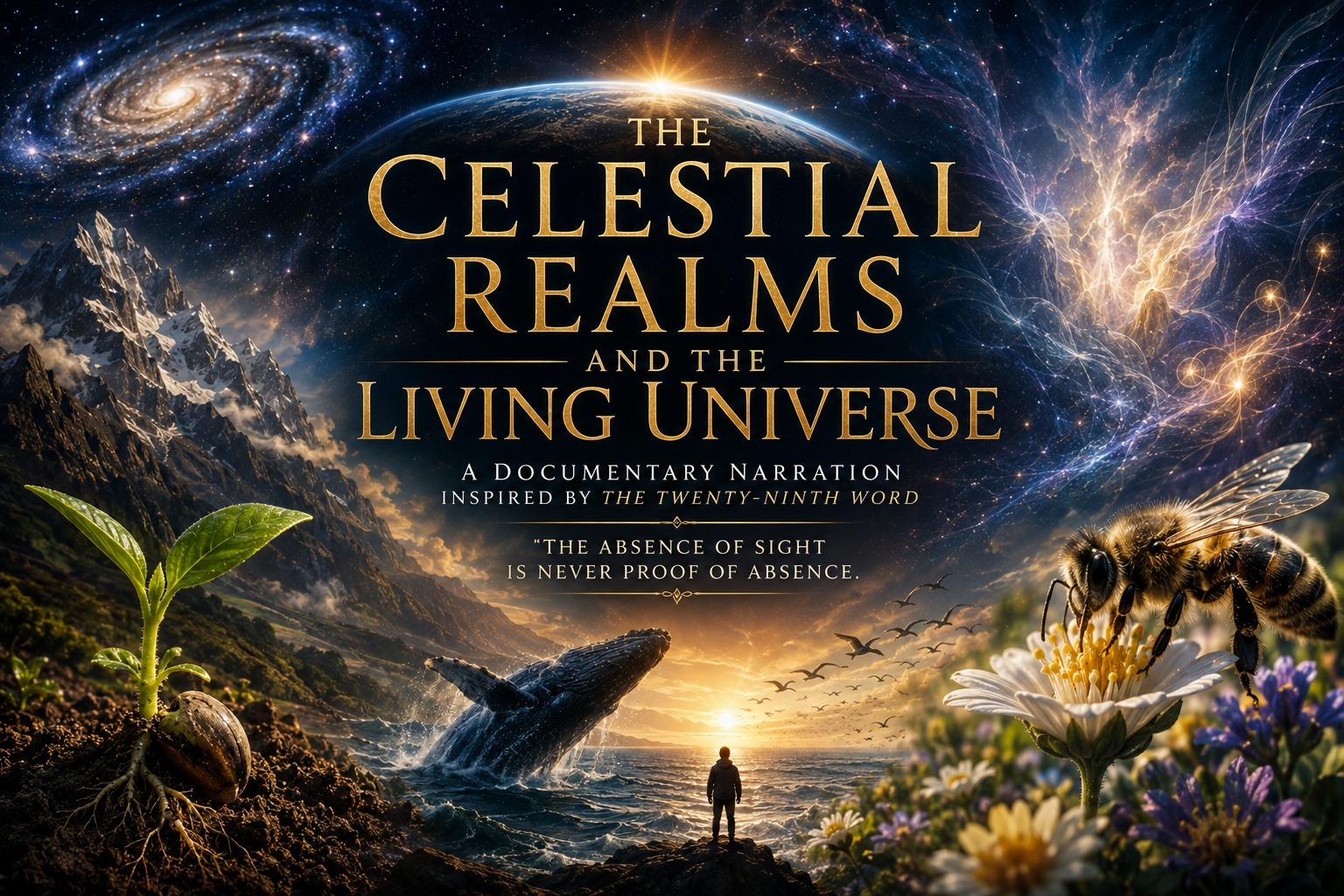
The Vitality of Spirit and the Existence of Angels – The Celestial Realms and the Living Universe – A Documentary Narration Inspired by The Twenty-Ninth Word
The Vitality of Spirit and the Existence of Angels
This text and video examines the essential nature of life—the fundamental pillar of existence—and, within a logical framework, explores the existence of angels as an inevitable consequence of this life-giving reality.
The author argues that life is not dependent upon matter; rather, matter is merely a temporary shell that derives its meaning through life and the spirit.
The extraordinary awareness and intricate web of relationships observed even in the smallest living beings point to the existence of a far more comprehensive spiritual life throughout the universe.
According to the author, the vast celestial bodies that appear lifeless, as well as the seemingly empty reaches of space, are inhabited by conscious beings suited to their own nature—namely angels and other spiritual entities.
The limitations of human vision cannot be considered evidence against the existence of these luminous beings, just as the remarkable order and harmony of the universe make the acceptance of such spiritual beings a rational necessity.
In summary, the work emphasizes the supremacy of life over matter and presents both rational and scriptural arguments in support of the existence of angels.
Notebook Gemini
The Celestial Realms and the Living Universe
A Documentary Narration Inspired byThe Twenty-Ninth Word
Look around you.
Everywhere you turn… there is life.
From the smallest seed hidden beneath the soil… to the largest creature crossing the oceans… life transforms everything it touches.
Without life, the universe would be little more than silent matter.
Life gives meaning. Life gives purpose. Life awakens existence itself.
A mountain may stand for millions of years, immense and majestic.
Yet without life, it remains alone… unaware… disconnected from the rest of creation.
Now consider something almost invisible.
A tiny bee.
The moment it comes alive, it enters into a remarkable relationship with the world.
Flowers become its companions. The earth becomes its garden. The seasons become part of its journey.
Though small in size, it belongs to an astonishing web of life.
This is the miracle of life.
It connects. It unites. It reveals.
And if life can accomplish so much in the smallest creature…
What might it accomplish in a conscious human being?
Human consciousness reaches far beyond the limits of the body.
With thought, memory, imagination, and spirit,
we travel to places our feet have never touched.
We contemplate distant galaxies.
We wonder about eternity.
We search for meaning beyond what our eyes can see.
Perhaps this ability points toward a greater reality…
one where consciousness is not an accident, but a sign.
A sign that existence itself is alive.
Now lift your eyes to the heavens.
For centuries, many have looked into the night sky and imagined an endless emptiness.
But is emptiness really what we see?
Our own planet, small among countless worlds, overflows with living creatures.
Every corner of Earth, from the deepest oceans to microscopic worlds unseen by the naked eye, teems with life.
If this tiny planet has been filled with such extraordinary abundance…
Would the vast heavens remain completely empty?
Reason suggests otherwise.
Just as fish are created for the sea, and birds for the sky,
might there not be beings created for the stars?
Beings suited not to earth, but to realms of light.
The visible universe may be only one chapter of a much greater creation.
A creation where life exists in forms beyond our present understanding.
Throughout history, the revealed scriptures have spoken of such beings.
Angels.
Spiritual creatures.
Messengers who belong to dimensions beyond ordinary human perception.
Not because they contradict reason…
but because reality is greater than what the eye alone can measure.
After all, the absence of sight is never proof of absence.
Long before humanity discovered microscopic life, it already existed.
The invisible was always there.
Waiting to be discovered.
Perhaps the same is true of the unseen realms.
Perhaps the universe is far richer, far more populated, and far more alive than we have ever imagined.
The material world may not be the foundation of existence…
but its outer garment.
Beneath it lies something deeper.
Life.
Spirit.
Consciousness.
These are not merely products of matter.
They are the forces that give matter its meaning.
The more finely we examine creation, the more we discover order, purpose, and astonishing harmony.
Nothing appears abandoned.
Nothing seems accidental.
Every level of existence points toward wisdom.
And if wisdom fills the visible world…
why should it stop at the edge of the sky?
Perhaps the heavens are not silent after all.
Perhaps they are alive…
filled with beings perfectly suited to their celestial homes.
A universe without life would be incomplete.
But a universe filled with life…
both seen and unseen…
becomes a far greater masterpiece.
One that invites us to look beyond the stars…
and wonder what glorious realities still remain hidden from our eyes.
ChatGPT
Original text
First Aim
To believe in the angels and affirm that belief is a pillar of faith. There are four fundamental points in this aim.
FIRST FUNDAMENTAL POINT
The perfection of existence is through life. Rather, the true existence of existence is through life. Life is the light of existence, and consciousness is the light of life. Life is the summit and foundation of everything. Life appropriates everything for living beings; it is as though it makes one thing the owner of everything. By virtue of life, a living thing may say: “All these things belong to me. The world is my house. The universe is my property, given to me by my owner.”
Just as light is the cause of things being seen, and, according to some, of the existence of colours, so is life the revealer of beings; it is the cause of their qualities being realized. Furthermore, it makes an insignificant particular general and universal, and is the cause of universal things being concentrated in a particular. It is also the cause of all the perfections of existence, by, for example, making innumerable things co-operate and unite, and making them the means of unity and being endowed with spirit. Life is even a sort of manifestation of divine unity in the levels of multiplicity, and a mirror reflecting divine oneness.
Consider the following: a lifeless object, even if it is a great mountain, is an orphan, a stranger, alone. Its only relations are with the place in which it is situated and with the things which encounter it. Whatever else there is in the cosmos, it does not exist for the mountain. For the mountain has neither life through which it might be related to life, nor consciousness by which it might be concerned.
Now consider a tiny object like a bee, for example. The instant life enters it, it establishes such a connection with the universe that it is as though it concludes a trading agreement with it, especially with the flowers and plants of the earth. It can say: “The earth is my garden; it is my trading house.” Thus, through the unconscious instinctive senses which impel and stimulate it in addition to the well-known five external senses and inner senses of animate beings, the bee has a feeling for, and a familiarity and reciprocal relationship with, most of the species in the world, and they are at its disposal. If life then displays its effect thus in the tiniest of animate beings, certainly when it rises to the highest level, that of man, it will be revealed and extended and illumined to such a degree that just as a human being is able to move through the rooms of his house with his consciousness and mind, which are the light of life, so he may travel through the higher, and the spiritual and corporeal worlds with them. That is to say, just as that conscious and animate being may go in spirit as though as a guest to those worlds, those worlds too come as guests to his mirror-like spirit by being reflected and depicted there.
Life is a brilliant proof of the All-Glorious One’s unity, and one of the greatest sources of His bounty; it is a subtle manifestation of His compassionateness, and a hidden, unknowable, and incomparable embroidery of His art.
Life is hidden and subtle, because the life of plants even, which is the lowest of the levels of life, and the awakening of the life force in seeds, that is, their stirring, opening, and growth, which are the first steps in plant life, has remained unfathomed by human science since the time of Adam, despite being so evident and familiar, so ubiquitous and common. Man’s reason has been unable to discover its true reality.
Moreover, life is so pure and unblemished that in both its aspects, that is in both its inner and outer faces, it is pure, translucent, transparent. Not veiling it with causes, the hand of power touches it directly. Whereas that hand made apparent causes a veil, to be the source of the insignificant aspects of things and their base external qualities, which are inappropriate to the dignity of power.
In Short:
It may be said that if there were no life, existence would not be existence; it would be no different from non-existence. Life is the light of the spirit, and consciousness is the light of life. Since life and consciousness are important to this great extent; and since there is self-evidently an absolutely perfect order in the universe, and a masterly precision and most wise harmony; and since our lowly, wretched globe, our wandering earth has been filled with uncountable numbers of animate beings, intelligent beings, and beings with spirits; it may be concluded with decisive certainty that those heavenly palaces, those lofty constellations also have animate and conscious inhabitants appropriate to them. As fish swim in water, so are those luminous inhabitants present in the fire of the sun. Fire does not consume light; indeed, fire aids light.
Moreover, since, as is plain to see, pre-eternal power creates innumerable animate beings and beings with spirits from the most common substances and densest matter, and giving it great importance, transmutes dense matter by means of life into a subtle substance; and since it strews the light of life everywhere in great abundance, and gilds most things with the light of consciousness; with such flawless power and faultless wisdom, the All-Wise and All-Powerful One would certainly not neglect the other floods of subtle matter like light and ether, which are close to and fitting for the spirit; He would not leave them without life, without consciousness, inanimate. Indeed, He creates animate and conscious beings in great numbers from light, which is also matter, and even from meanings, air, and even words. Just as He creates numerous different species of animals, so from these torrents of subtle matter He creates numerous different spirit creatures. One kind of them are the angels, others are the varieties of spirit beings and jinn. If you wish to see just how true, self-evident, and rational it is to accept the existence of great numbers of angels and spirit beings, and as the Qur’an shows, just how contrary to truth and wisdom, and what a superstition, aberration, delirium and foolishness it is not to accept them, consider the following comparison.
There were two men, one rustic and uncouth, the other civilized and intelligent, who made friends and went to a splendid city like Istanbul. In a distant corner of that civilized, magnificent city they came across a dirty, wretched little building, a factory. They looked and saw that the strange factory was full of miserable, impoverished men working. All around the building were beings with spirits and animate beings, but their means of livelihood and conditions of life were such that some were herbivorous, they lived only on plants, while others were piscivorous, they ate nothing but fish.
The two men watched the scene. Then they saw in the distance thousands of adorned palaces and lofty castles. Among the palaces were spacious workshops and broad squares. Because of either the distance, or the defectiveness of the men’s eyesight, or because they had hidden themselves, the inhabitants of the palaces were not visible to the two men. Moreover, the wretched conditions in the factory were not to be seen in the palaces. In consequence of this, the uncouth country bumpkin, who had never before seen a city, declared: “Those palaces have no inhabitants, they are empty, there are no beings with spirits in them,” uttering ignorant garbled nonsense. To which the second man replied:
“O you miserable man! This insignificant little building you see here has been filled with beings endowed with spirits, with workers, and there is someone who continually employs and replaces them. Look, there no empty space anywhere around this factory, it has been filled with animate beings and beings with spirits. Do you think it is at all possible that there would be no high-ranking and suitable inhabitants in such an orderly city, in those wisely adorned palaces so full of art which we can see in the distance? Of course they are occupied, and the different conditions of life there are appropriate for those who live there. In place of grass, they eat pastries, and in place of fish, cakes. Their not being visible to you because of the distance, or your weak eyesight, or their hiding themselves, can at no time point to their not being there.” The fact that a thing is not visible does not indicate its non-existence.
As the above comparison indicates, the fact that the globe of the earth is the home of these infinite numbers of beings endowed with consciousness and spirit, despite its insignificance and density among the lofty heavenly bodies and planets, and even its grossest and rottenest particulars becoming masses of micro-organisms when they cease as sources of life, necessarily, demonstrably, decisively indicates and testifies to and proclaims that infinite space and the majestic heavens with their constellations and stars are full of animate beings, conscious beings, and beings with spirits. The Illustrious Shari’a of Muhammad (Upon whom be blessings and peace) and the Qur’an of Miraculous Exposition call these beings, who are created from fire, light, and even from electricity, and from other subtle flowing matter, “The angels, the jinn, and spirit beings.” There are different kinds of angels, just as there are different kinds of corporeal beings. Indeed, the angel who is appointed to a raindrop will not be similar in kind to the angel appointed to the sun. There are also a great many different sorts of jinn and spirit beings.
The Conclusion of this Fundamental Point
As may be established empirically, matter is not essential so that exis-tence may be made subject to it and dependent on it. Rather, matter subsists through a meaning, and that meaning is life, it is spirit.
Also, as may be established through observation, matter is not the thing served so that everything may be ascribed to it. It is rather the servant; it renders service to the process of the perfection of a truth. And that truth is life, and the fundament of that truth is spirit. Also, as is self-evident, matter is not dominant so that recourse may be made to it or perfections sought from it. Rather, it is dominated; it looks to the decree of some fundament, it is in motion in the way that that decree dictates. And that fundament is life, it is spirit, it is consciousness.
Also, as is necessary, matter is not the kernel, it is not the fundament, it is not a settled abode so that events and perfections may be affixed to it or constructed on it. Rather, it is a shell prepared to be split, rent, dissolved; it is a husk, it is froth, it is a form. Consider the following: a creature so minute it can only be seen with a microscope has such acute senses it can hear its friend’s voice and see its sustenance; it has extremely sensitive and sharp senses. This demonstrates that the effects of life increase and the light of the spirit intensifies proportionately to the reducing and refining of matter. It is as though the more matter is refined and the more we become distanced from our material existences the closer we draw to the world of the spirit, the world of life, and the world of consciousness; and the more intensely the heat of the spirit and the light of life are manifested.
Is it therefore at all possible that there should be so many distillations of life, consciousness, and spirit within the veil of materiality, and that the inner world which is beyond this veil should not be full of conscious beings and beings with spirits? Is it at all possible that the sources of these numberless distillations, flashes, and fruits of meaning, spirit, life and the truth apparent in this material existence in the Manifest World should be ascribed only to matter and the motion of matter, and be explained by it? God forbid! Absolutely not! These innumerable distillations and flashes demonstrate that this material and manifest world is but a lace veil strewn over the inner and spirit worlds.
SOURCES
Risale-i Nur Okuma Programı 2.1.0, Words[2021] – 537, email: syesilova72@gmail.com
Bediuzzaman Said Nursi, The Words – The Twenty-Ninth Word – About the Immortality of Man’s Spirit, the Angels, and the Resurrection of the Dead, The English translations of the Risale-i Nur Collection, translated by Şükran Vahide and published by Sözler Neşriyat, are an exact printed version of the original text. (erisale.com)
“Some of the people of Paradise are given lands as extensive as the world, and thousands of palaces and hundreds of thousands of houris are bestowed on them.” What need has a single person of all these things, why should it be necessary? How can this be and what does it mean?
Why would a single person need countless palaces, immense estates, and endless blessings in Paradise?
At first glance, the descriptions found in authentic hadiths may seem difficult to reconcile with human experience.
In The Twenty-Eighth Word, Bediuzzaman Said Nursi offers a profound explanation: the human being is not merely a physical body but a creation endowed with infinite spiritual capacity, limitless desires, and countless subtle faculties.
When viewed through this perspective, the vast rewards of Paradise become a natural manifestation of God’s infinite mercy rather than an exaggeration.
This article explores how the Risale-i Nur explains the relationship between human nature, eternity, and the boundless blessings of Paradise.
ChatGPT
The Infinite Capacity of the Human Soul in Paradise
This text and video address the vastness of human capacity and the faculty of desire by explaining the nature of the immense rewards and expansive estates in eternal Paradise.
The author responds to the question of why a single inhabitant of Paradise would be granted lands as vast as entire worlds and countless blessings, drawing on the spiritual depth of the human being and their insatiable innate nature (fıtrat).
Even within the constrained conditions of earthly life, attention is drawn to the vastness of human imagination, and it is argued that the multiplicity and expansiveness found in Paradise become reasonable in light of the ability of luminous beings (nurani varlıklar) to exist in many places at once.
It is emphasized that once a person is freed from the material heaviness of this world and attains spiritual agility, they become worthy of these great rewards as a reflection of divine mercy.
In conclusion, it is stated that the boundless blessings of Paradise must be assessed not through the narrow molds of the worldly realm, but through the lens of the infinitude of divine power.
This Word is about Paradise and consists of two Stations.
…
The brief answers to a number of questions about eternal Paradise.
…
QUESTION:
It says in Hadiths: “Some of the people of Paradise are given lands as extensive as the world, and thousands of palaces and hundreds of thousands of houris are bestowed on them.”3
(3- Bukhari, Janna, 17; Tafsir Sura al-Qiyama, 2.)
What need has a single person of all these things, why should it be necessary? How can this be and what does it mean?
THE ANSWER:
If man was only a lifeless being, or was only a vegetable creature consisting of a stomach, or consisted only of a limited, heavy, temporary, simple corporeality or animal body, he could not own many palaces and houris, or be fit for them. But man is such a comprehensive miracle of power that even in this transitory world and brief life, if he is given the rule of all the world with its wealth and pleasures, his ambition is not satisfied – in respect of the need of some of his subtle faculties, which do not develop here. It is therefore reasonable, right, and true that a person possessing an infinite capacity who knocks on the door of an infinite mercy with the hand of infinite desires and the tongue of infinite needs will receive in an eternal abode of bliss the Divine bounties described in Hadiths. We shall observe this elevated truth through the telescope of a comparison. It is as follows:
Although, like this valley garden,1
(1- That is, the garden of Suleyman, who served this poor one with perfect loyalty for eight years, where this Word was written in one or two hours.)
all these gardens and vineyards of Barla have different owners, all the birds and sparrows and honey-bees in Barla, who have only a handful of grain for food, may say: “All the gardens and orchards of Barla are my pleasant resorts where I fly around and enjoy myself.” Each may take possession of Barla and include it in its property. Others sharing it does not invalidate his ownership. Similarly, a man who is a true human being may say: “My Creator made this world a house for me. The sun is my lamp and the stars my electric lights. The face of the earth is my resting-place spread with flowered carpets.” And he offers thanks to God. The other creatures sharing it does not negate his statement. On the contrary, the creatures adorn his house like decorations. And so, if in this narrow fleeting world, by virtue of his humanity, man – and even a bird – claims a sort of power of disposal over such a vast sphere and receives such a vast bounty, how can it be deemed unlikely that he is given ownership of a property stretching over a five hundred year distance in a broad and eternal abode of bliss?
Moreover, just as in this dense and dark narrow world the sun is present in the same way at the same time in numerous mirrors, so too, as is proved in the Sixteenth Word, a luminous being may be present in many places in the same way at the same time. For example, Gabriel (Peace be upon him) being on a thousand stars simultaneously, and at the Divine Throne, and in the presence of the Prophet (PBUH), and in the Divine Presence; and the Prophet Muhammad (Peace and blessings be upon him) meeting with most of the righteous of his community at the resurrection of the dead at the same time and appearing in this world in innumerable places simultaneously; and a strange group of the saints known as abdal, appearing at the same time in many places; and ordinary people sometimes carrying out as much as a year’s work in one minute in a dream and observing this; and everyone being in contact with and concerned with numerous places at the same time in their hearts, spirits, and imaginations – all these are well-known and may be witnessed. Most certainly, in Paradise, therefore, which is luminous, unrestricted, broad, and eternal, the people of Paradise, whose bodies have the strength and lightness of the spirit and the swiftness of imagination, being in hundreds of thousands of places at the same time, and conversing with hundreds of thousands of houris, and receiving pleasure in hundreds of thousands of ways, is fitting for that eternal Paradise, that infinite mercy, and as told by the Bringer of Sure News (PBUH), is reality and the truth. Nevertheless, these vast truths cannot be weighed on the scales of our tiny minds.
This tiny mind cannot perceive the true meanings,
For this scale cannot bear such a weight.
Glory be unto to You! We have no knowledge save that which You have taught us; indeed, You are All-Knowing, All-Wise.1 (1- Qur’an, 2:32).
O our Sustainer! Do not call us to task if we forget or fall into error.2 (2- Qur’an, 2:286).
O God! Grant blessings to Your Beloved, who by being Your Beloved and through his prayers, flung open the doors of Paradise, and because of the benedictions for him of its members, You confirmed its opening for his community, and bless him and grant him peace.
O God! Appoint us to Paradise among the righteous, through the intercession of Your Beloved, the Chosen One. Amen.
SOURCES
Bediuzzaman Said Nursi, The Words – The Twenty-Eighth Word – This Word is about Paradise, The English translations of the Risale-i Nur Collection, translated by Şükran Vahide and published by Sözler Neşriyat, are an exact printed version of the original text. (erisale.com)
“If you tell a tree to bring you such-and-such a fruit, it will bring it. And if you tell such-and-such a stone to come, it will come.”
Explore the Islamic understanding of Paradise (Jannah), Bodily Resurrection, and Life After Death through Bediuzzaman Said Nursi’s The Twenty-Eighth Word, a profound reflection on the nature of the Hereafter and eternal existence.
Paradise (Jannah), Bodily Resurrection, and Life After Death
The Eternal Architecture of Paradise
This text is an excerpt from The Twenty-Eighth Word, a work by Bediuzzaman Said Nursi that explores the reality of Paradise.
The author explains, with profound philosophical insight, why bodily resurrection is necessary in the eternal realm and how physical pleasures are integrated with spiritual delights.
In contrast to the imperfect nature of worldly bodies, it is emphasized that material existence in the Hereafter will manifest in a stable, balanced, and exalted form.
The text further states that bodily senses serve as instruments for perceiving and measuring the manifestations of the Divine Names, and that these faculties will be rewarded in accordance with the duties they fulfilled.
Ultimately, drawing upon the verses of the Qur’an, it argues that phenomena such as eating, drinking, and marriage will attain a far superior and more vital nature in Paradise.
This Word is about Paradise and consists of two Stations. The First indicates some of the subtle wonders of Paradise. However, it does not prove the existence of Paradise, since this has been proved in brilliant fashion by the twelve decisive Truths of the Tenth Word and by the firm and clear consecutive arguments in Arabic which form the basis and summary of the Tenth Word and the Second Station of this Word. This Station discusses in question and answer form a number of the aspects of Paradise which have been the cause of criticism. If Divine assistance is forthcoming, a great Word will later be written about that mighty truth. God willing.
In the Name of God, the Merciful, the Compassionate.
And give glad tidings to those who believe and act righteously that theirs shall be gardens beneath which flow rivers. Everytime they are fed with fruits therefrom, they will say: “Why, this is what we were fed with before.” For they will be given things in similitude. And they shall have therein spouses pure, and shall abide there for ever. – Qur’an, 2:25.
The brief answers to a number of questions about eternal Paradise.
The descriptions of the Qur’an’s verses about Paradise, which are more beautiful than Paradise, more lovely than the houris, and sweeter than the water of Salsabil, leave nothing to be said about it so that anyone should say it. However, in order to bring closer to the understanding those shining, pre-eternal, post-eternal, elevated and exquisite verses, we shall mention a number of steps, and, as samples of that Qur’anic Paradise, a number of fine points which are like samples of its flowers. We shall point to these through five allusive questions and answers. Indeed, Paradise is the means both to all spiritual and non-physical pleasures, and to all physical pleasures.
QUESTION: What connection with eternity and Paradise has faulty, deficient, changing, unstable, and suffering corporeality? Since the spirit has elevated pleasures, that is sufficient. Why is bodily resurrection necessary for bodily pleasures?
THE ANSWER: Because, just as in relation to water, air, and light, earth is dense and dark, but since it is the source and means of all the varieties of Divine artefacts, in meaning it rises above the other elements; and just as in regard to the mystery of its comprehensiveness and on condition it is purified, the human soul, which is also dense, rises above all the other human subtle faculties; so too corporeality is the richest and most comprehensive and all-embracing mirror to the manifestation of the Divine Names. All the tools and instruments for measuring the contents of the treasuries of mercy and reckoning their balances lie in corporeality. For example, if scales to the number of sorts of food and their pleasures did not originate in the sense of taste in the tongue, it could not taste and weigh them all up, and recognize and experience them. Also, the instruments for experiencing and knowing the manifestations of most of the Divine Names, and tasting and recognizing them, again lie in corporeality. And the faculties for experiencing all the infinitely various pleasures are also in corporeality.
As is proved in the Eleventh Word, it is understood clearly from the disposition of the universe and man’s comprehensiveness that the universe’s Maker wants to make known all the treasuries of His mercy, and all the manifestations of His Names, and to make experienced all the varieties of His bounties. The abode of bliss, therefore, which is a vast pool formed from the flood of the universe and a great exhibition of the textiles woven on the loom of the universe and an everlasting store of the crops produced in the arable field of this world, will resemble the universe to a degree. And it will preserve all its fundamental matters, both corporeal and spiritual. Its All-Wise Maker, the Most Compassionate One, will also give as recompense for the duties of the physical tools and instruments, pleasures worthy of them; and to His servants, as a wage and reward for the particular worship of each. Otherwise a situation would occur that was contrary to His wisdom, justice, and mercy, which is in no way fitting for the beauty of His mercy and perfection of His justice, and in no way compatible with them.
QUESTION: If a body is living, its parts are constantly being formed and dissolved; it is doomed to extinction and cannot be eternal. Eating and drinking are for the perpetuation of the individual, and sexual relations are for the perpetuation of the species. These are fundamental to this world, but there is no need for them in the world of eternity and hereafter. So why are they among the greatest pleasures of Paradise?
THE ANSWER: Firstly, the bodies of living creatures are doomed to annihilation and death in this world because of an imbalance between what is taken in and what is expended. From childhood until maturity much is taken in, and after that what is expended increases; the balance is spoilt, and the body dies. In the world of eternity, however, the particles of the body remain constant and are not subject to composition and dissolution, or else the balance remains constant. 1 –
(1 – In this world, the bodies of humans and animals are like guesthouses, barracks, and schools for particles. The lifeless particles enter them and acquire worthiness to be particles for the everlasting realm, which is living, then they leave them. In the hereafter, however, according to the verse, “The Abode of the Hereafter, that is life indeed,” the light of life is general. There is no necessity for that travelling, drill, and instruction in order to be illuminated. Particles will remain constant as permanent fixtures.)
Like a closed circle or perpetual motion, the body of the living creature becomes eternal together with the functioning of the machine of bodily life for pleasure. Although in this world eating and drinking and sexual relations arise from need and perform a function, various delights and pleasures have been placed within them as an immediate wage for the duty performed, and these are superior to other pleasures. Since in this abode of sorrows eating and sexual relations are the means to so many wonderful and various pleasures, certainly in Paradise, which is the abode of pleasure and bliss, those pleasures will take on a sublime form. The recompense of the duties pertaining to the hereafter performed here will also be added to them as pleasure, and they will be augmented by worldly needs which have taken the form of agreeable, otherworldly appetites, so will become an all-embracing, living source of pleasure worthy of Paradise and suitable to eternity. Indeed, according to the meaning of the verse,
And what is the life of this world but amusement and play? But indeed the Abode of the hereafter, that is life indeed, – Qur’an, 29:64.
substances, matters, which are inanimate and without consciousness and life in the abode of this world, there will be living and conscious. Like human beings and animals here, the trees and stones there will understand commands and carry them out. If you tell a tree to bring you such-and-such a fruit, it will bring it. And if you tell such-and-such a stone to come, it will come. Since stones and trees will take on this elevated form, it surely necessitates that, together with preserving their bodily realities, eating, drinking, and sexual relations also will take on a form higher than their worldly form, higher to the degree that Paradise is higher than this world.
SOURCES
Bediuzzaman Said Nursi, The Words – The Twenty-Eighth Word – This Word is about Paradise, The English translations of the Risale-i Nur Collection, translated by Şükran Vahide and published by Sözler Neşriyat, are an exact printed version of the original text. (erisale.com)
The Twenty-Eighth Word – https://erisale.com/index.jsp?locale=en#content.en.201.513