The Sovereign Soul and the Eternity of the Spirit
This text and video are based on a passage from the Risale-i Nur Collection by Bediüzzaman Said Nursi, focusing on the immortality of the spirit and the spiritual nature of the human being.
The author presents the body as a temporary garment or dwelling that changes over time and eventually passes away.
In contrast, the human spirit is described as an independent and self-sustaining essence that continues to exist without being dependent upon the physical body.
Death, therefore, is not the annihilation of the spirit. Rather, it is the spirit’s release from the heavy physical body, allowing it to continue its journey in a luminous form suited to its nature.
The source explains that, by looking inward and reflecting upon their own inner world, individuals can recognize their innate longing for eternity and perceive the permanence of the spirit through rational reasoning.
This brief examination emphasizes that the disintegration of physical matter cannot, in itself, cause any harm to the essential nature or continuity of the spirit.
Gemini Notebook
THE TWENTY-NINTH WORD
The Immortality of Man’s Spirit
The Angels, and the Resurrection of the Dead
SECOND AIM
FIRST FUNDAMENTAL POINT
FIRST SOURCE
There is a way to understand this.
It begins with something very close to us.
Ourselves.
Look carefully at your own life.
And you may notice something remarkable.
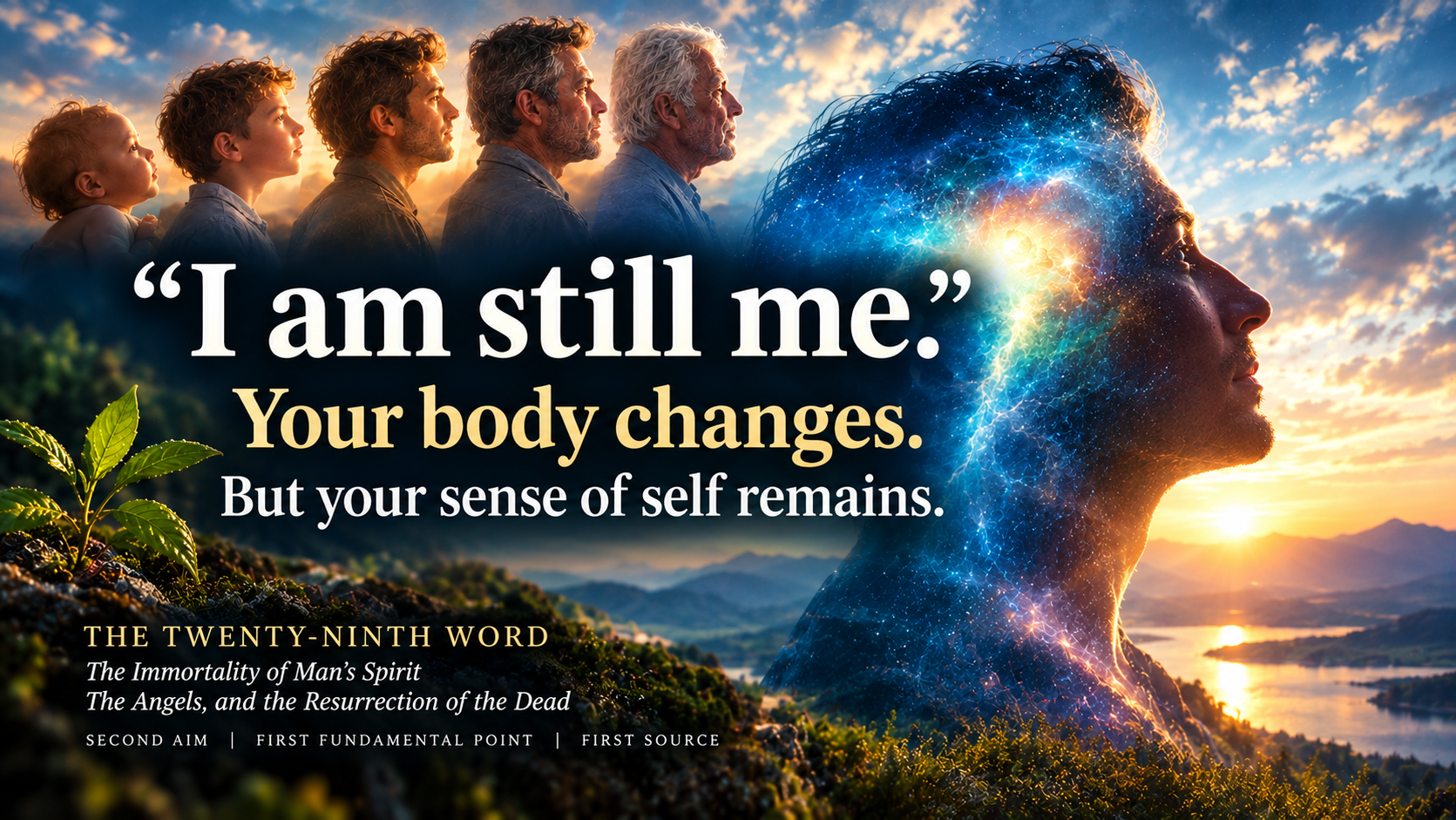
Your body changes.
Year after year.
Cell by cell.
Appearance by appearance.
The body you have today
is not the body you had years ago.
And yet…
something within you remains.
Something that says,
“I am still me.”
Your body changes.
But your sense of self remains.
Your memories remain.
Your consciousness remains.
Your inner identity remains.
This points to something deeper.
Something beyond the changing body.
Something permanent.
The human spirit.
For many years, the spirit inhabits the body.
And during those years,
the body undergoes constant change.
It grows.
It ages.
It is renewed.
It is transformed.
Yet the spirit remains constant.
The body changes.
The spirit does not lose its identity.
The body is temporary.
But the spirit is not dependent upon the body
for its existence.
Think of the body as a dwelling.
A house.
A home.
The spirit lives within it.
But the spirit is not the house.
And when the house changes,
the one who lives inside it remains.
This is the central distinction.
The body does not give existence to the spirit.
Rather, the spirit gives direction to the body.
The body is its instrument.
Its dwelling place.
Its visible companion.
And so, the temporary nature of the body
does not destroy the permanence of the spirit.
Death, then, is not necessarily the destruction of the spirit.
It is a separation.
The spirit leaves the body.
But it does not cease to exist.
There is another subtle point.
The body is not truly the spirit’s clothing.
The spirit possesses something more delicate.
A subtle sheath.
A fine and ethereal form.
Something that resembles a body.
Something that remains with the spirit
to a certain degree.
So when death comes…
the spirit is not simply left without form.
It leaves its earthly home
with its own subtle sheath.
The house is left behind.
The spirit continues.
And this leads us to a profound question.
If the body can change so completely
while the spirit remains itself…
why should the spirit disappear
when the body disappears?
Perhaps death is not the end of the journey.
Perhaps it is only the moment
when the traveler leaves one home
and continues onward.
The body changes.
The spirit remains.
The house is temporary.
But the inhabitant endures.
And in this distinction…
lies the first source
for understanding the immortality
of the human spirit.
ChatGPT
Original text
THE TWENTY-NINTH WORD
The Immortality of Man’s Spirit,
The Angels, and the Resurrection of the Dead
…
SECOND AIM
…
FIRST FUNDAMENTAL POINT
…
FIRST SOURCE: This is subjective. That is to say, if anyone studies his own life and self, he perceives an immortal spirit. Indeed, in the course of occupying its body for a number of years the spirit causes the body to change considerably, yet the spirit self-evidently remains constant. In which case, the body’s ephemerality does not affect the spirit’s permanence, nor spoil its nature, even though the spirit is completely naked at death. However, in the course of life, the spirit gradually changes its body-clothes, and at the time of death, it is suddenly undressed. It has been established by certain conjecture, indeed, by observation, that the body subsists though the spirit; in which case, the spirit does not subsist through the body. Rather, since the spirit subsists and is dominant of itself, the body may be dispersed and gathered together again as it wishes; it will not infringe the spirit’s independence.
In fact, the body is the spirit’s house, it is its home; it is not its clothes. What clothes the spirit is a subtle, fine sheath, something which may be likened to a body, is to some extent constant, and is ethereal and appropriate for the spirit. At the time of death, then, the spirit is not completely naked, it leaves its home dressed in its wraithlike sheath.
SOURCES
Risale-i Nur Okuma Programı 2.1.0, Words[2021] – 550, email: syesilova72@gmail.com
Bediuzzaman Said Nursi, The Words – The Twenty-Ninth Word – About the Immortality of Man’s Spirit, the Angels, and the Resurrection of the Dead, The English translations of the Risale-i Nur Collection, translated by Şükran Vahide and published by Sözler Neşriyat, are an exact printed version of the original text. (erisale.com)
https://erisale.com/index.jsp?locale=en#content.en.201.535