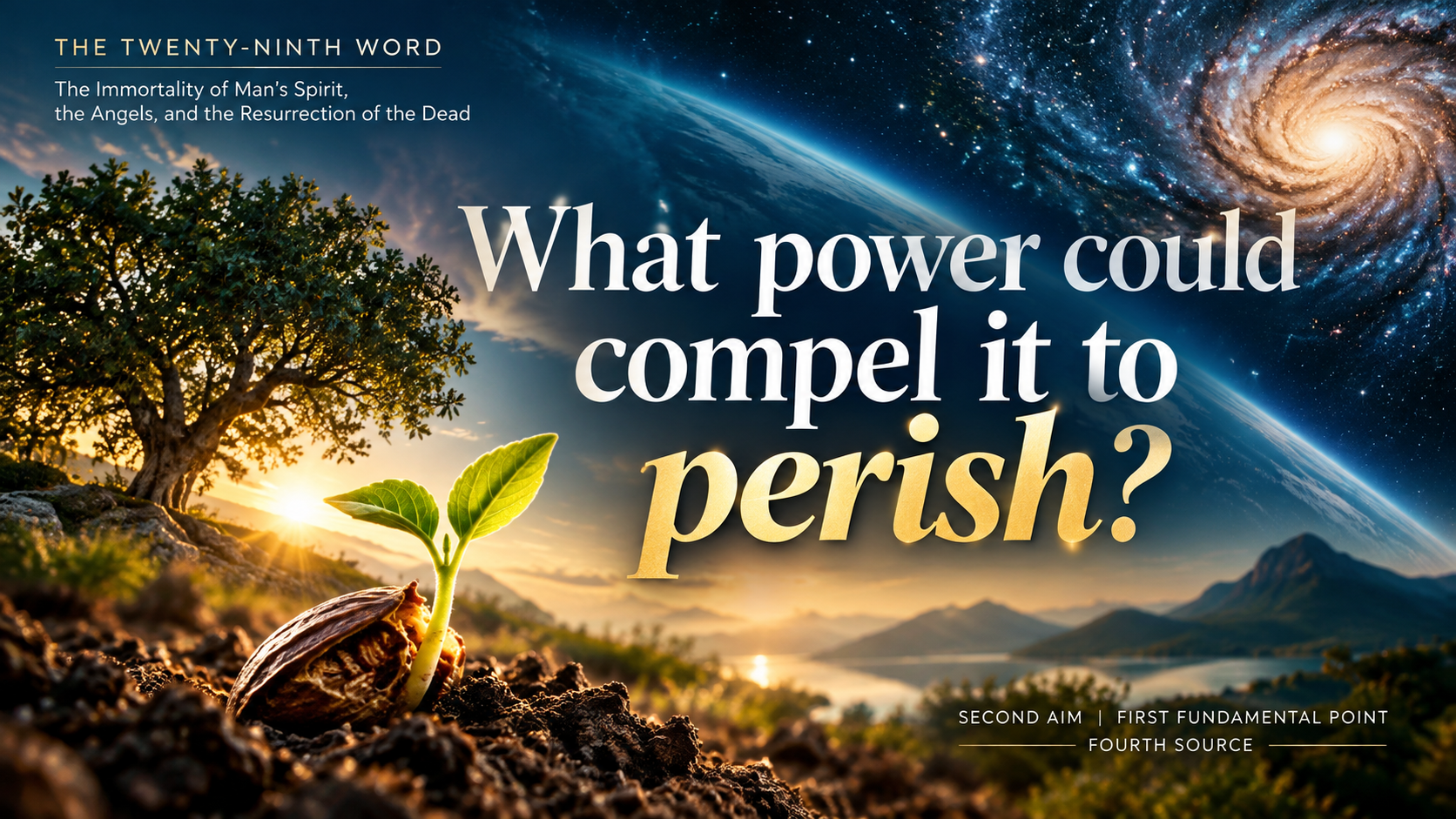
This text and video are based on an excerpt from The Twenty-Ninth Word in the Risale-i Nur Collection and explore the immortality (eternity) of the human spirit and its relationship with the World of Divine Command (Ālam al-Amr).
The main ideas and key points of the text are as follows:
The Nature and Origin of the Spirit: As expressed in Verse 85 of Surah Al-Isra (“Say: The spirit is of the command of my Lord”), the spirit originates from the World of Divine Command and the Divine Will. It is a living and conscious law to which Eternal Power has bestowed an external, tangible existence.
A Comparison with the Laws of Nature: The laws governing nature, which seemingly possess no independent external existence, also originate from the World of Divine Command. For example, when a fig tree dies, the law governing its formation remains preserved in its seed. These unconscious laws endure without corruption or alteration, even when the physical structures they govern disintegrate.
The Spirit’s Attainment of Eternity: If even the weakest and unconscious laws of Divine Command can preserve their existence and continuity, then it is all the more certain and necessary that the human spirit—which is stronger, more exalted, living, and conscious—should attain eternity.
THE TWENTY-NINTH WORD
SECOND AIM
FIRST FUNDAMENTAL POINT
FOURTH SOURCE
Look closely at the laws that govern life.
They are everywhere.
Silent.
Constant.
And remarkably enduring.
They shape the living world.
They guide the development of countless forms.
And they preserve the essential patterns of creation.
In a certain sense, these laws resemble the human spirit.
They originate from the World of Divine Command and Will.
Their nature is suited to the spirit.
Yet they lack one thing.
A visible, external existence.
Imagine, for a moment, that these laws were given such an existence.
What would happen?
Each law would become, in effect, the spirit of a species.
And here we discover something remarkable.
These laws endure.
They remain constant.
They preserve their unity.
They are not destroyed by change or transformation.
Consider a fig tree.
One day, the tree may wither.
Its branches may fall.
Its physical form may disappear.
Yet something remains.
The law of its formation continues within its tiny seeds.
The tree itself may be gone.
But the principle that shapes it lives on.
It has not perished.
Now consider what this means.
Even simple and seemingly insignificant laws can possess such continuity.
Even laws without consciousness can endure beyond the forms they govern.
Then what of the human spirit?
Could it be destined for something less?
Something that merely continues?
Or does its nature point toward a far greater reality?
The Qur’an offers a profound insight.
It declares:
“Say: The Spirit is of the command of my Sustainer.”
Qur’an, 17:85.
The spirit, then, is not merely a product of physical matter.
It belongs to a different order of existence.
It is a living and conscious law.
It comes from the World of Divine Command.
And through the power of the Eternal Creator, it has been given an external existence.
Here, the argument takes a deeper turn.
If unconscious laws, proceeding from Divine Will, can endure through change…
Then surely the human spirit has an even stronger claim to permanence.
For it shares their origin.
It emerges from the same World of Command.
And it is connected to the same Divine Will.
But the spirit possesses qualities that these laws do not.
It has a real, external existence.
It is conscious.
And it is alive.
Think about that for a moment.
A law may preserve a pattern.
But the human spirit possesses awareness.
A law may continue without knowing that it exists.
But the spirit experiences life.
It knows.
It perceives.
It reflects.
And this gives the human spirit a special place among the realities of creation.
If even unconscious laws can endure…
Then the conscious human spirit has an even greater reason to be connected with permanence.
Not merely survival.
Not merely continuation.
But a destiny that reaches beyond the limits of this world.
And perhaps this is the essential point.
The human spirit is not simply something that exists for a moment and then disappears.
Its origin points beyond the temporary.
Its nature suggests continuity.
And its consciousness opens the door to a deeper understanding of eternity.
For if the Creator has given the spirit existence…
And if the Creator wills its permanence…
Then what power could compel it to perish?
The question is no longer simply whether the human spirit can endure.
The deeper question is this:
Why should a spirit, created with such a nature, be destined for extinction?
Perhaps the signs of eternity are already written into the very nature of our existence.
We need only learn how to see them.
ChatGPT
THE TWENTY-NINTH WORD
…
SECOND AIM
…
FIRST FUNDAMENTAL POINT
…
FOURTH SOURCE:
Consider the laws that govern in species, for they resemble the spirit to a degree: since they issue from the World of the Divine Command and Will, by virtue of their source, they are to some extent appropriate for the spirit and only lack a perceptible existence. Study them and it will be seen that if those commanding laws were clothed in external existence, each of them would become the spirit of a species. Moreover, the laws are always permanent; they are perpetual and constant. No change or transformation affects their unity, or spoils them.
For example, should a fig tree die and be dispersed, the law of its formation, which is like its spirit, will persist in its tiny seeds; it will not die. Therefore, since even commonplace and weak commanding laws are thus connected to permanence and continuance, the human spirit must be connected not only with permanence and immortality, but with all eternity. For according to the Qur’an’s glorious decree of:
Say: The Spirit (comes) by command of my Sustainer, (17:85)
spirit too is a conscious and living law which proceeds from the World of the Divine Command and which pre-eternal power has clothed with external existence. That is to say, just as the unconscious laws which proceed from the divine attribute of will and the World of the Divine Command are always, or mostly, enduring, so it is even more definite that the spirit, which is a sort of brother to them, and like them is a manifestation of the attribute of will and comes from the World of the Command, manifests immortality. It is also more worthy of it, because it is existent, it has an external reality. And it is more potent, more elevated, because it possesses consciousness. It is also more enduring than them, and more valuable, because it is living.
SOURCES
Risale-i Nur Okuma Programı 2.1.0, Words[2021] – 551, email: syesilova72@gmail.com
Bediuzzaman Said Nursi, The Words – The Twenty-Ninth Word – About the Immortality of Man’s Spirit, the Angels, and the Resurrection of the Dead, The English translations of the Risale-i Nur Collection, translated by Şükran Vahide and published by Sözler Neşriyat, are an exact printed version of the original text. (erisale.com)
https://www.erisale.com/tr/sozler/yirmidokuzuncu-soz-ikinci-maksad#4222