The Resurrection of the Dead – Signs of Life Beyond This World | The Twenty-Ninth Word

Every sunrise follows a night. Every spring follows a winter. And every year, nature reveals countless examples of renewal.

But could these remarkable cycles be pointing towards something far greater?

In this episode of The Twenty-Ninth Word, Bediuzzaman Said Nursi explores the signs of the Resurrection of the Dead through the changing seasons, the renewal of nature, the human body, and the unique nature of human consciousness.

We discover how:

  • Night and morning reflect the idea of death and resurrection.
  • The changing seasons reveal the continuous renewal of life.
  • The human body undergoes remarkable transformations.
  • Every spring, countless forms of life return to existence.
  • The human mind reaches beyond the present moment, longing for eternity.
  • The renewal of nature points towards the individual resurrection of human beings.

The universe is filled with signs of renewal.

From a tiny flower emerging from the soil to the vast movements of the planets, creation continually presents examples of life returning after apparent disappearance.

Perhaps every sunrise carries a message.

After every night, there is a morning.

And after this worldly life, there is the promise of Resurrection.

📖 SOURCE & REFERENCES

Bediuzzaman Said Nursi
The Risale-i Nur Collection
The Words – The Twenty-Ninth Word
Second Aim – Second Fundamental Point – Fourth Point

English translation by Şükran Vahide
Published by Sözler Neşriyat.

Original text:
https://www.erisale.com/en/words/the-twenty-ninth-word-second-aim#4244

Risale-i Nur Reading Program 2.1.0
Words [2021] – 553

If this video inspires you, please LIKE, SHARE and SUBSCRIBE.

Join us as we explore faith, creation, wisdom, and the mysteries of existence through the Risale-i Nur.

DERS DÜNYASI English

#Resurrection #BediuzzamanSaidNursi #RisaleiNur

THE TWENTY-NINTH WORD
…

SECOND AIM
…

SECOND FUNDAMENTAL POINT
…

Fourth Point:
In each of many different things, in night and day and winter and spring, in the skies, and even in man’s personalities and in the bodies which he changes throughout his lifetime, and in sleep, which resembles death, is a different sort of resurrection resembling the resurrection of the dead; they all tell of and allude to the reality of Resurrection Day. For example, the day, year, lifetime of man, and revolution of God’s great clock known as the earth resemble the dials of a weekly clock of ours that tell the seconds, minutes, hours and days; each the forerunner of the following, they give news of one another; they turn and function. Just as they show morning after night and spring after winter, so they intimate that after death the morning of the resurrection will appear from that instrument, that vast clock.
   There are many varieties of resurrection that a person experiences during his lifetime. He sees the signs of the resurrection by dying in a sort of way every night and being reborn every morning; it is agreed that he undergoes what resembles a resurrection every five or six years by changing all the particles in his body; and he even undergoes a gradual resurrection twice a year. Also, every spring he witnesses more than three hundred thousand sorts of resurrection and rising to life in the animal and plant kingdoms.
   So many signs and indications and marks of resurrection most certainly point to the great resurrection of the dead as though they were droplets of it. An indication of a personal resurrection of the human being within the general resurrection may be the fact that an All-Wise Maker causes a sort of resurrection in the animal and plant worlds, that is, He raises to life exactly the same plant roots and some animals in the spring, and restores other parts of them, such as their leaves, flowers and fruits not exactly the same but similarly. For the human being resembles a species in comparison with the other animate species, and the light of the human mind has given such a breadth to man’s actions and thought that they encompass the past and the future. If he consumes the world even, he is not satisfied. In the other species the individual being’s nature is particular; its value is personal; its view, restricted; its qualities, limited; its pleasure and pain, instantaneous. Whereas man’s nature is exalted; his value, most high; his view, universal; his qualities, limitless; his immaterial pleasure and pain in part permanent. In which case, the various resurrections which are repeated in the other animate species self-evidently tell of and point to human beings being resurrected individually and restored to life exactly the same in the great resurrection of the dead. Since it is proved with the certainty of twice two equalling four in the Ninth Truth of the Tenth Word, we cut short the discussion here.

SOURCES

Risale-i Nur Okuma Programı 2.1.0, Words[2021] – 553, email: syesilova72@gmail.com

Bediuzzaman Said Nursi, The Words – The Twenty-Ninth Word – About the Immortality of Man’s Spirit, the Angels, and the Resurrection of the Dead, The English translations of the Risale-i Nur Collection, translated by Şükran Vahide and published by Sözler Neşriyat, are an exact printed version of the original text. (erisale.com)

https://www.erisale.com/en/words/the-twenty-ninth-word-second-aim#4244
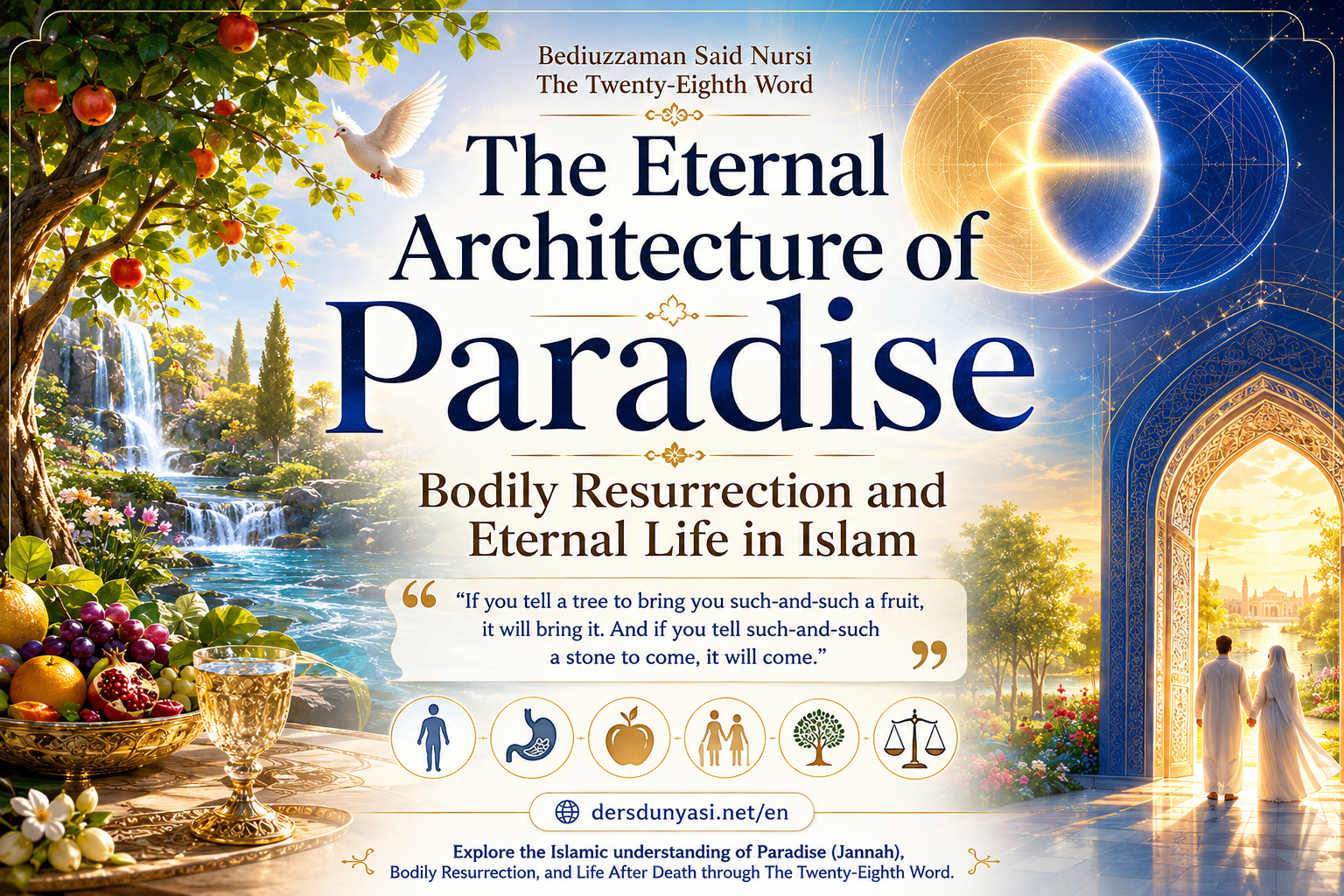

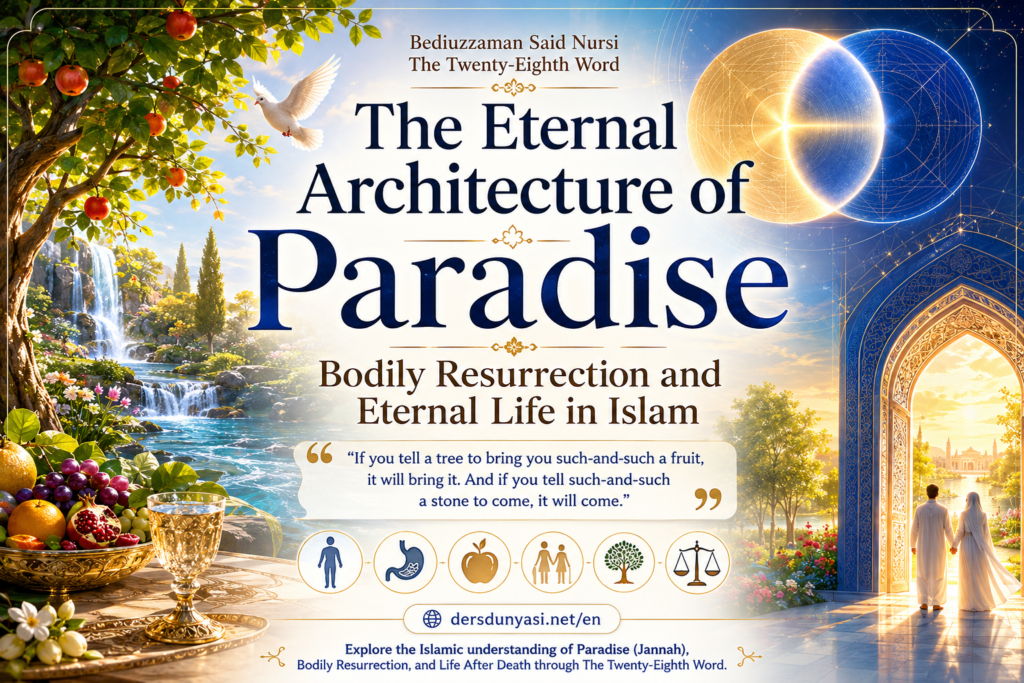
The Eternal Architecture of Paradise: Bodily Resurrection and Eternal Life in Islam

Paradise (Jannah), Bodily Resurrection, and Life After Death

“If you tell a tree to bring you such-and-such a fruit, it will bring it. And if you tell such-and-such a stone to come, it will come.”

Explore the Islamic understanding of Paradise (Jannah), Bodily Resurrection, and Life After Death through Bediuzzaman Said Nursi’s The Twenty-Eighth Word, a profound reflection on the nature of the Hereafter and eternal existence.

Paradise (Jannah), Bodily Resurrection, and Life After Death

The Eternal Architecture of Paradise

This text is an excerpt from The Twenty-Eighth Word, a work by Bediuzzaman Said Nursi that explores the reality of Paradise.

The author explains, with profound philosophical insight, why bodily resurrection is necessary in the eternal realm and how physical pleasures are integrated with spiritual delights.

In contrast to the imperfect nature of worldly bodies, it is emphasized that material existence in the Hereafter will manifest in a stable, balanced, and exalted form.

The text further states that bodily senses serve as instruments for perceiving and measuring the manifestations of the Divine Names, and that these faculties will be rewarded in accordance with the duties they fulfilled.

Ultimately, drawing upon the verses of the Qur’an, it argues that phenomena such as eating, drinking, and marriage will attain a far superior and more vital nature in Paradise.

NotebookLM & CahtGPT


PowerPoint


The Twenty-Eighth Word

This Word is about Paradise and consists of two Stations. The First indicates some of the subtle wonders of Paradise. However, it does not prove the existence of Paradise, since this has been proved in brilliant fashion by the twelve decisive Truths of the Tenth Word and by the firm and clear consecutive arguments in Arabic which form the basis and summary of the Tenth Word and the Second Station of this Word. This Station discusses in question and answer form a number of the aspects of Paradise which have been the cause of criticism. If Divine assistance is forthcoming, a great Word will later be written about that mighty truth. God willing.

In the Name of God, the Merciful, the Compassionate.

And give glad tidings to those who believe and act righteously that theirs shall be gardens beneath which flow rivers. Everytime they are fed with fruits therefrom, they will say: “Why, this is what we were fed with before.” For they will be given things in similitude. And they shall have therein spouses pure, and shall abide there for ever. – Qur’an, 2:25.

The brief answers to a number of questions about eternal Paradise.

The descriptions of the Qur’an’s verses about Paradise, which are more beautiful than Paradise, more lovely than the houris, and sweeter than the water of Salsabil, leave nothing to be said about it so that anyone should say it. However, in order to bring closer to the understanding those shining, pre-eternal, post-eternal, elevated and exquisite verses, we shall mention a number of steps, and, as samples of that Qur’anic Paradise, a number of fine points which are like samples of its flowers. We shall point to these through five allusive questions and answers. Indeed, Paradise is the means both to all spiritual and non-physical pleasures, and to all physical pleasures.

QUESTION: What connection with eternity and Paradise has faulty, deficient, changing, unstable, and suffering corporeality? Since the spirit has elevated pleasures, that is sufficient. Why is bodily resurrection necessary for bodily pleasures?

THE ANSWER: Because, just as in relation to water, air, and light, earth is dense and dark, but since it is the source and means of all the varieties of Divine artefacts, in meaning it rises above the other elements; and just as in regard to the mystery of its comprehensiveness and on condition it is purified, the human soul, which is also dense, rises above all the other human subtle faculties; so too corporeality is the richest and most comprehensive and all-embracing mirror to the manifestation of the Divine Names. All the tools and instruments for measuring the contents of the treasuries of mercy and reckoning their balances lie in corporeality. For example, if scales to the number of sorts of food and their pleasures did not originate in the sense of taste in the tongue, it could not taste and weigh them all up, and recognize and experience them. Also, the instruments for experiencing and knowing the manifestations of most of the Divine Names, and tasting and recognizing them, again lie in corporeality. And the faculties for experiencing all the infinitely various pleasures are also in corporeality.

As is proved in the Eleventh Word, it is understood clearly from the disposition of the universe and man’s comprehensiveness that the universe’s Maker wants to make known all the treasuries of His mercy, and all the manifestations of His Names, and to make experienced all the varieties of His bounties. The abode of bliss, therefore, which is a vast pool formed from the flood of the universe and a great exhibition of the textiles woven on the loom of the universe and an everlasting store of the crops produced in the arable field of this world, will resemble the universe to a degree. And it will preserve all its fundamental matters, both corporeal and spiritual. Its All-Wise Maker, the Most Compassionate One, will also give as recompense for the duties of the physical tools and instruments, pleasures worthy of them; and to His servants, as a wage and reward for the particular worship of each. Otherwise a situation would occur that was contrary to His wisdom, justice, and mercy, which is in no way fitting for the beauty of His mercy and perfection of His justice, and in no way compatible with them.

QUESTION: If a body is living, its parts are constantly being formed and dissolved; it is doomed to extinction and cannot be eternal. Eating and drinking are for the perpetuation of the individual, and sexual relations are for the perpetuation of the species. These are fundamental to this world, but there is no need for them in the world of eternity and hereafter. So why are they among the greatest pleasures of Paradise?

THE ANSWER: Firstly, the bodies of living creatures are doomed to annihilation and death in this world because of an imbalance between what is taken in and what is expended. From childhood until maturity much is taken in, and after that what is expended increases; the balance is spoilt, and the body dies. In the world of eternity, however, the particles of the body remain constant and are not subject to composition and dissolution, or else the balance remains constant. 1 –

(1 – In this world, the bodies of humans and animals are like guesthouses, barracks, and schools for particles. The lifeless particles enter them and acquire worthiness to be particles for the everlasting realm, which is living, then they leave them. In the hereafter, however, according to the verse, “The Abode of the Hereafter, that is life indeed,” the light of life is general. There is no necessity for that travelling, drill, and instruction in order to be illuminated. Particles will remain constant as permanent fixtures.)

Like a closed circle or perpetual motion, the body of the living creature becomes eternal together with the functioning of the machine of bodily life for pleasure. Although in this world eating and drinking and sexual relations arise from need and perform a function, various delights and pleasures have been placed within them as an immediate wage for the duty performed, and these are superior to other pleasures. Since in this abode of sorrows eating and sexual relations are the means to so many wonderful and various pleasures, certainly in Paradise, which is the abode of pleasure and bliss, those pleasures will take on a sublime form. The recompense of the duties pertaining to the hereafter performed here will also be added to them as pleasure, and they will be augmented by worldly needs which have taken the form of agreeable, otherworldly appetites, so will become an all-embracing, living source of pleasure worthy of Paradise and suitable to eternity. Indeed, according to the meaning of the verse,

And what is the life of this world but amusement and play? But indeed the Abode of the hereafter, that is life indeed, – Qur’an, 29:64.

substances, matters, which are inanimate and without consciousness and life in the abode of this world, there will be living and conscious. Like human beings and animals here, the trees and stones there will understand commands and carry them out. If you tell a tree to bring you such-and-such a fruit, it will bring it. And if you tell such-and-such a stone to come, it will come. Since stones and trees will take on this elevated form, it surely necessitates that, together with preserving their bodily realities, eating, drinking, and sexual relations also will take on a form higher than their worldly form, higher to the degree that Paradise is higher than this world.

SOURCES

Bediuzzaman Said Nursi, The Words – The Twenty-Eighth Word – This Word is about Paradise, The English translations of the Risale-i Nur Collection, translated by Şükran Vahide and published by Sözler Neşriyat, are an exact printed version of the original text. (erisale.com)

The Twenty-Eighth Word – https://erisale.com/index.jsp?locale=en#content.en.201.513