The Architecture of Resurrection and Cosmic Renewal
The texts and videos presented here offer an excerpt from The Twenty-Ninth Word, written by Bediüzzaman Said Nursi, which establishes belief in the Hereafter upon a rational foundation.
The work explains, through the metaphor of a magnificent palace, how the universe will one day come to an end and how an eternal life will subsequently begin.
The text examines the process of the destruction and reconstruction of the universe through six fundamental questions concerning necessity, possibility, and the power of the Agent responsible for creation.
The author emphasizes that the destruction of the world and the resurrection at the appointed time of the Resurrection can be demonstrated through rational proofs.
Accordingly, these sources constitute a systematic theological defense aimed at dispelling doubts concerning the end of the world and the immortality of the human spirit.
In conclusion, the text offers a convincing and comprehensive perspective on the questions surrounding the future of existence.
Gemini Notebook
THE TWENTY-NINTH WORD
The Immortality of Man’s Spirit, the Angels, and the Resurrection of the Dead
SECOND AIM
The Second Aim turns our attention to something profound.
The resurrection of the dead.
The end of the world.
And the life of the Hereafter.
It contains four fundamental points.
But before we reach them,
there is an introduction.
An introduction built around a simple comparison.
INTRODUCTION
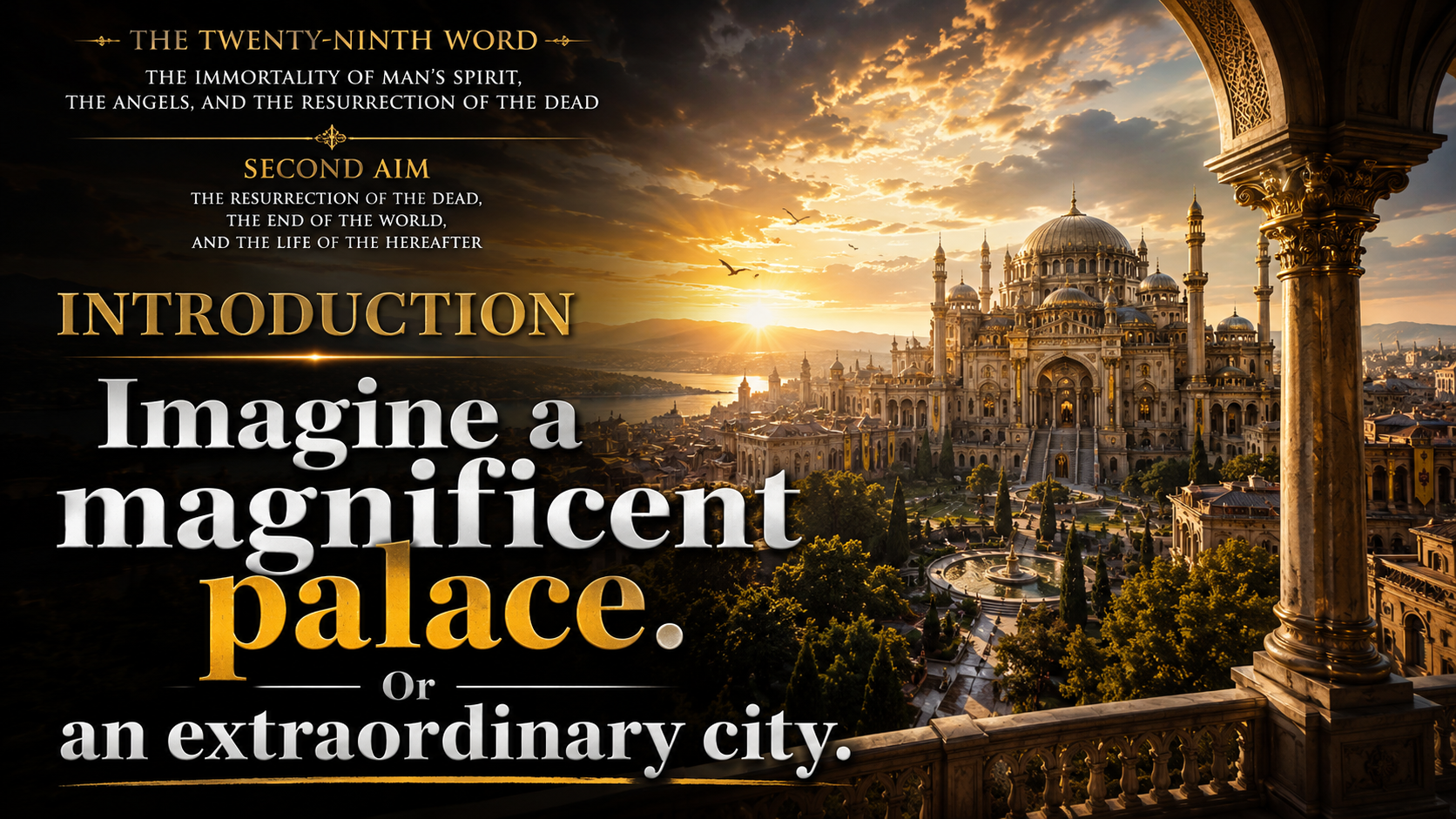
Imagine a magnificent palace.
Or an extraordinary city.
Someone tells you:
“This palace will one day be destroyed.
And then…
it will be rebuilt.
It will rise again,
complete and intact.”
What would you ask?
Naturally…
six questions would come to mind.
THE FIRST QUESTION
Why should it be destroyed?
Is there a reason?
Is there something that makes its destruction necessary?
If the answer is yes…
then that reason must be proven.
There must be a cause.
A purpose.
A necessity.
THE SECOND QUESTION
Now consider something else.
Who is going to destroy it?
And who will rebuild it?
Does its builder possess the power to do so?
Does he have the ability to create it again?
If the answer is yes…
then that power must also be demonstrated.
THE THIRD QUESTION
Then comes another question.
Is its destruction actually possible?
And more importantly…
will it really happen?
If the answer is yes,
then both must be established.
The possibility of its destruction.
And the certainty of its occurrence.
TWO MORE QUESTIONS
But the inquiry does not end there.
Another question appears.
Could this remarkable palace…
or this magnificent city…
be rebuilt from the beginning?
Could every part of it be brought together again?
Could it return to its former perfection?
If the answer is yes…
then another question follows.
Will it actually be rebuilt?
Will it rise again?
And if all these questions are answered…
if every point is demonstrated…
then something remarkable happens.
There is no opening left for doubt.
No hidden gap.
No place for suspicion to enter.
The argument becomes complete.
THE COMPARISON
Now consider the universe.
Look at the Earth.
Look at the heavens above it.
Think of the countless forms of life.
The immense order.
The delicate balance.
The extraordinary harmony.
The Earth is like a palace.
And the universe…
like a vast and magnificent city.
According to this comparison,
this great palace will one day be destroyed.
And then…
it will be rebuilt.
But this is not presented as a mere possibility.
There are reasons that necessitate it.
There are signs that point toward it.
And there is a Creator…
whose power is sufficient for it.
The destruction is possible.
And it will occur.
The reconstruction is possible.
And it will occur.
These truths will be examined carefully.
And they will be demonstrated…
beginning with the First Fundamental Point.
For now,
we are standing at the threshold.
A threshold between this world…
and the world to come.
And beyond it lies one of the greatest questions ever asked:
What happens…
when this world comes to an end?
And what happens…
when humanity rises again?
The answer begins here.
ChatGPT
Original text and videos
The Twente-Ninth Word
About the Immortality of Man’s Spirit, the Angels, and the Resurrection of the Dead
…
Second Aim
The Second Aim is about the resurrection of the dead, the end of the world, and the life of the hereafter. It consists of four fundamental points, and an introduction which is in the form of a comparison.
INTRODUCTION
If someone was to claim about a palace or a city: “This palace or city will be destroyed, and will then be repaired and reconstructed so that it is intact,” six questions would surely arise in the face of his claim.
The First:
Why should it be destroyed? Is there a reason or something to necessitate it? If the answer is “Yes,” he would have to prove it.
The Second:
A question such as the following would arise: “Does the builder who would destroy and then reconstruct it possess the power to do so? Would he be capable of it?” If the answer is “Yes,” he would have to prove it.
The Third:
The following such question would arise: “Is its destruction possible? And, is it going to be destroyed in the future?”
If the answer is “Yes,” and if he proves both the possibility of the destruction and its occurrence, the following two further questions would arise:
“Is it possible for this strange palace or city to be reconstructed from scratch, I wonder? If it is possible, will it be reconstructed?”
If the answer is “Yes” and he proves these as well, then in no aspect or corner of this matter can a gap or chink remain through which any doubt, misgiving or suspicion might enter.
Thus, like in the comparison, there are facts necessitating the destruction and reconstruction of the palace of the earth and city of the universe. Its author and builder is powerful enough; its destruction is possible, and will occur. Its reconstruction is possible, and will occur. These matters will be proved after the First Fundamental Point.
SOURCES
Risale-i Nur Okuma Programı 2.1.0, Words[2021] – 548, email: syesilova72@gmail.com
Bediuzzaman Said Nursi, The Words – The Twenty-Ninth Word – About the Immortality of Man’s Spirit, the Angels, and the Resurrection of the Dead, The English translations of the Risale-i Nur Collection, translated by Şükran Vahide and published by Sözler Neşriyat, are an exact printed version of the original text. (erisale.com)
https://erisale.com/index.jsp?locale=en#content.en.201.533”