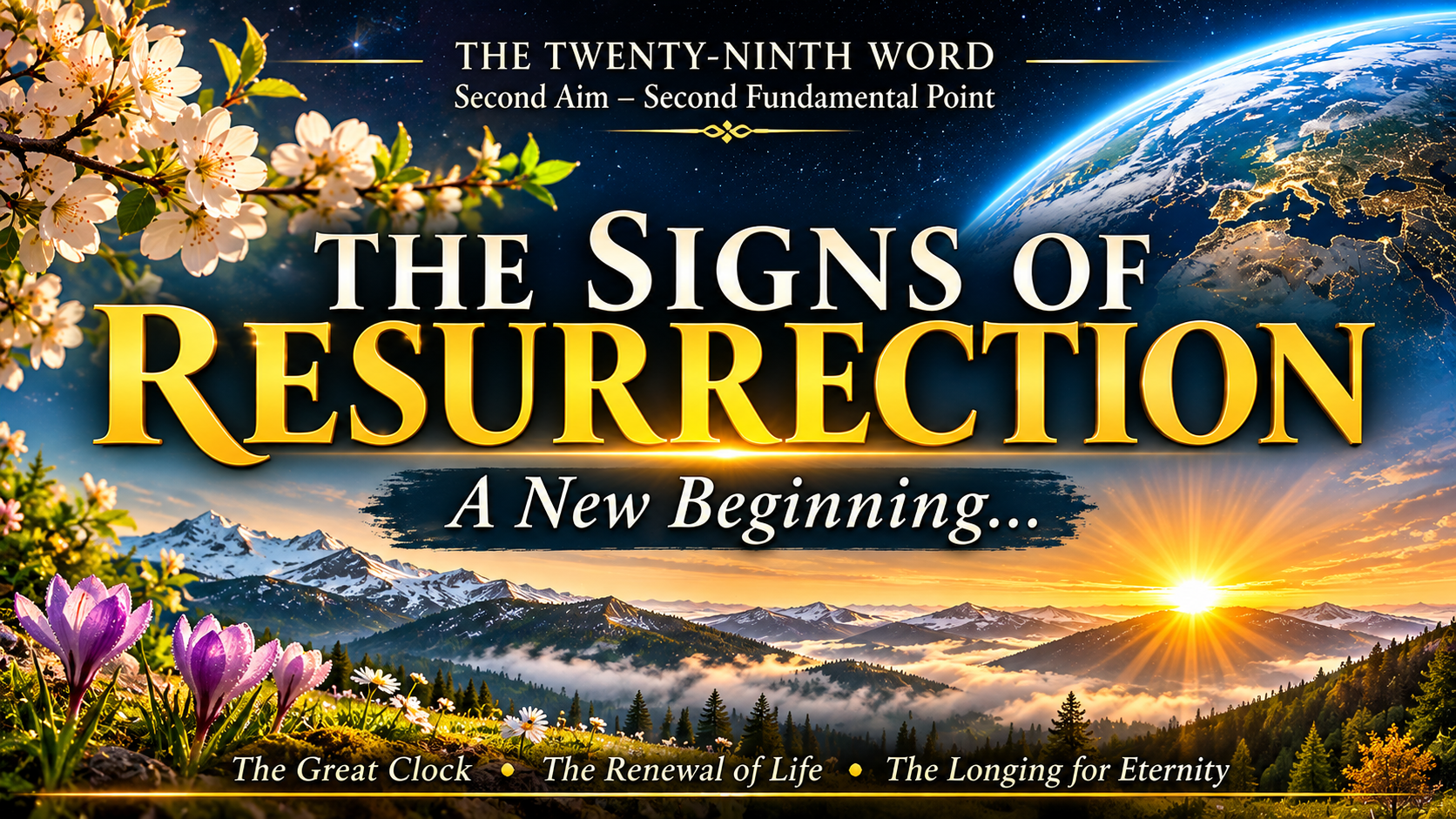
Every sunrise follows a night. Every spring follows a winter. And every year, nature reveals countless examples of renewal.
But could these remarkable cycles be pointing towards something far greater?
In this episode of The Twenty-Ninth Word, Bediuzzaman Said Nursi explores the signs of the Resurrection of the Dead through the changing seasons, the renewal of nature, the human body, and the unique nature of human consciousness.
We discover how:
- Night and morning reflect the idea of death and resurrection.
- The changing seasons reveal the continuous renewal of life.
- The human body undergoes remarkable transformations.
- Every spring, countless forms of life return to existence.
- The human mind reaches beyond the present moment, longing for eternity.
- The renewal of nature points towards the individual resurrection of human beings.
The universe is filled with signs of renewal.
From a tiny flower emerging from the soil to the vast movements of the planets, creation continually presents examples of life returning after apparent disappearance.
Perhaps every sunrise carries a message.
After every night, there is a morning.
And after this worldly life, there is the promise of Resurrection.
📖 SOURCE & REFERENCES
Bediuzzaman Said Nursi
The Risale-i Nur Collection
The Words – The Twenty-Ninth Word
Second Aim – Second Fundamental Point – Fourth Point
English translation by Şükran Vahide
Published by Sözler Neşriyat.
Original text:
https://www.erisale.com/en/words/the-twenty-ninth-word-second-aim#4244
Risale-i Nur Reading Program 2.1.0
Words [2021] – 553
If this video inspires you, please LIKE, SHARE and SUBSCRIBE.
Join us as we explore faith, creation, wisdom, and the mysteries of existence through the Risale-i Nur.
DERS DÜNYASI English
#Resurrection #BediuzzamanSaidNursi #RisaleiNur
THE TWENTY-NINTH WORD
…
SECOND AIM
…
SECOND FUNDAMENTAL POINT
…
Fourth Point:
In each of many different things, in night and day and winter and spring, in the skies, and even in man’s personalities and in the bodies which he changes throughout his lifetime, and in sleep, which resembles death, is a different sort of resurrection resembling the resurrection of the dead; they all tell of and allude to the reality of Resurrection Day. For example, the day, year, lifetime of man, and revolution of God’s great clock known as the earth resemble the dials of a weekly clock of ours that tell the seconds, minutes, hours and days; each the forerunner of the following, they give news of one another; they turn and function. Just as they show morning after night and spring after winter, so they intimate that after death the morning of the resurrection will appear from that instrument, that vast clock.
There are many varieties of resurrection that a person experiences during his lifetime. He sees the signs of the resurrection by dying in a sort of way every night and being reborn every morning; it is agreed that he undergoes what resembles a resurrection every five or six years by changing all the particles in his body; and he even undergoes a gradual resurrection twice a year. Also, every spring he witnesses more than three hundred thousand sorts of resurrection and rising to life in the animal and plant kingdoms.
So many signs and indications and marks of resurrection most certainly point to the great resurrection of the dead as though they were droplets of it. An indication of a personal resurrection of the human being within the general resurrection may be the fact that an All-Wise Maker causes a sort of resurrection in the animal and plant worlds, that is, He raises to life exactly the same plant roots and some animals in the spring, and restores other parts of them, such as their leaves, flowers and fruits not exactly the same but similarly. For the human being resembles a species in comparison with the other animate species, and the light of the human mind has given such a breadth to man’s actions and thought that they encompass the past and the future. If he consumes the world even, he is not satisfied. In the other species the individual being’s nature is particular; its value is personal; its view, restricted; its qualities, limited; its pleasure and pain, instantaneous. Whereas man’s nature is exalted; his value, most high; his view, universal; his qualities, limitless; his immaterial pleasure and pain in part permanent. In which case, the various resurrections which are repeated in the other animate species self-evidently tell of and point to human beings being resurrected individually and restored to life exactly the same in the great resurrection of the dead. Since it is proved with the certainty of twice two equalling four in the Ninth Truth of the Tenth Word, we cut short the discussion here.
SOURCES
Risale-i Nur Okuma Programı 2.1.0, Words[2021] – 553, email: syesilova72@gmail.com
Bediuzzaman Said Nursi, The Words – The Twenty-Ninth Word – About the Immortality of Man’s Spirit, the Angels, and the Resurrection of the Dead, The English translations of the Risale-i Nur Collection, translated by Şükran Vahide and published by Sözler Neşriyat, are an exact printed version of the original text. (erisale.com)
https://www.erisale.com/en/words/the-twenty-ninth-word-second-aim#4244